
Living with the differences
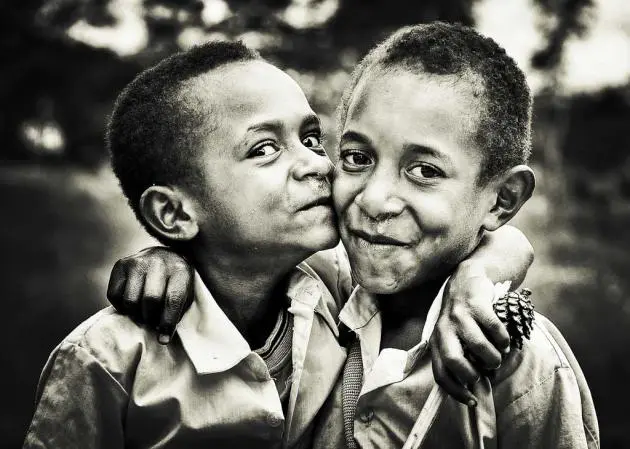


Outstanding works in Unesco's "Learning To Live Together" art competition are on show in Bangkok
When Indonesian teen Alland Dharmawan chose to photograph two children in Papua province, he was hoping to draw attention to a group and a culture that are all too often ignored.
“Papua is usually neglected as most Indonesians tend to focus on big cities and forget about the outer islands. These two kids show that the Papuans, as Indonesians, also need to be loved. They need the government and the people's attention. They want to live together with us, as one nation: Indonesia. These kids show us how important it is to love each other, to show our love and together, create a peaceful environment,” says the 19-year-old photographer.
His stunning black-and-white images beat more than 200 entries from throughout the Asia-Pacific region and won the grand prize in the competition “Learning to Live Together” held by the United Nations Educational, Scientific and Cultural Organisation (Unesco).
Filipino Allan Jay Quesada, the third place winner, meanwhile, found a simple expression of the Learning to Live Together theme: a smiling young girl holding a line of paper cut-out figures, each dressed in distinctive ethnic garb from the different Asean countries.
Both will be receiving their prizes in person at the “Learning to Live Together” exhibition, which opens tomorrow at Bangkok Art and Culture Centre. Unesco Bangkok’s director Gwang-Jo Kim will preside over the opening ceremony at 11.30am.
Ramya Vivekanandan, a programme specialist with the Education Policy & Reform Unit, and the head of the team organising the exhibition, says that the idea of “learning to live together” has always been the central focus of the Unesco mandate.
“Our organisation’s Constitution perhaps says it best,” she says: ‘Since wars begin in the minds of men (and women), it is in the minds of men (and women) that the defences of peace must be constructed’.
“This concept has thus been the backbone of everything that we do and have done as an organisation ever since our establishment in 1945.
It’s a perspective that has been reflected in Unesco’s various initiatives and projects over the years, among them the International Decade for a Culture of Peace and Non-Violence, which was commemorated from 2001-2010.
“However, it seems like something has changed in the last couple of years and brought even more of a sense of urgency to this work. Maybe it’s the rapid pace of globalisation and the erosion of borders and boundaries brought on by the information revolution. Or maybe it’s the increasing number of conflicts around the world, many of them based on cultural and ethnic differences,” Vivekanandan says.
“In any case, the international community [beyond Unesco] seems to have woken up to the fact that education is a key weapon with which we can confront these problems, as evidenced by the prioritisation of global citizenship education in the Secretary-General’s Global Education First Initiative.”
The exhibition highlights the importance of cultivating mutual understanding
and peace among young people in the Asia-Pacific region – Bangladesh, Cambodia, India, Indonesia, Malaysia, Myanmar, Nepal, Pakistan, Philippines and Thailand – especially now when conflicts are escalating.
Thirty photographs and paintings are on display and reflect the breadth of the entries received. They range from a heart-warming photo of disabled young athletes preparing for the Asean Para Games to a young Filipino’s illustration of what harmony between countries means to him through his memories of a childhood friendship with someone of a different culture.
Among them is colourful portrait by Somchai, a 17-year-old Thai student at Children of the Forest Foundation Thailand, a child protection centre for stateless and marginalised children from the Mon and Karen ethnic groups of Myanmar. The image depicts a smiling portrait of a boy cutting out shapes from multi-coloured squares and was submitted to Unesco by the foundation.
Although these children were born in Thailand, they are not ethnically Thai. Art offers them the opportunity for individual self-expression, which is very important as they have little or no rights or voice in their immediate community.
The exhibition coincides with this Saturday’s International Peace Day, the theme of which is, appropriately, Education for Peace.
The images on display vividly convey the desire among young people for cultural understanding and the barriers keeping these dreams from becoming a reality.
This event complements a multi-country study looking into how different countries throughout the Asia-Pacific region are putting the concept of “learning to live together” into practice through education, which will be completed in late 2013.
UNDER THE SAME SKY
“Learning to Live Together” opens tomorrow at the Bangkok Art and Culture Centre and runs until Sunday. Find out more at www.UnescoBkk.org/education/news/article/learning-to-live-together-asia-pacific-exhibition.
