
Why forgiving shouldn't mean forgetting
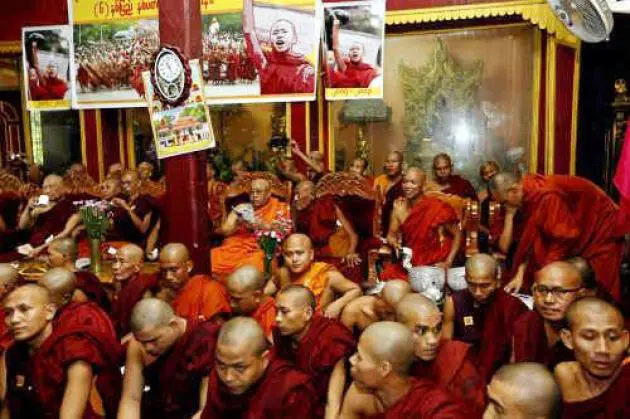


Myanmar marks the sixth anniversary of the Saffron Revolution by calling for a end to violence and recognition of democratic rights
For the people of Myanmar, September 2007 was one of the most difficult periods in its history of military dictatorship. Defying the generals under whose rule they had suffered for more than two decades, they came out on to the streets and the scent of revolution and uprising was once again in the air. Tragically, in the space of a few days, it was all over.
Without a doubt, many innocent people – from students and monks to ordinary citizens – gave up their blood and their lives that month in a pro-democracy uprising that was, as in 1988, brutally crushed by Tatmadaw forces. Although the movement was short-lived, it has burned into the collective consciousness as the Saffron Revolution.
Last Wednesday, a commemoration ceremony marking the sixth anniversary of the Saffron Revolution was held at Thardu Monastery in Yangon. Aside from remembering those who died, the ceremony mainly focused on the prevention of religious and racial violence, the regaining of internal peace, national reconciliation and the full expression of fundamental democratic human rights.
September 18 is not only the sixth anniversary of Saffron Revolution but also the 25th anniversary of the military coup that established the State Law and Order Restoration Council, or SLORC, later renamed the State Peace and Development Council (SPDC) until its dissolution following the 2010 election.
Those elections marked the end of nearly half a century of military dictatorships, a dark period in the country’s history that began in 1962 when General Ne Win launched a military coup and took over the country. Since 2010, the country has reopened its doors to the world and is working together with the international community to usher in a new era of democratic governance under the quasi-civilian administration of President Thein Sein.
Like never before – and, as demonstrated during last month’s anniversary events for 8-8-88 – Myanmar people can now freely use such public commemoration events to celebrate the will to live in a democracy. Those ceremonies were held with the purpose of not forgetting what happened in the past but of learning to forgive; of abandoning the hatred and letting go of resentment for how the military regime responded.
The Saffron Revolution of September 2007 was the last democracy uprising Myanmar has seen. It was not an ordinary uprising, in that it was led by Buddhist monks who could not stand to see the public suffer any further from the skyrocketing costs of fuel and daily consumer goods. But it was deadly: although no official number was ever released, approximately 100 people, including monks and students, were killed. Another casualty was Japanese photojournalist Kenji Nagai, who was shot dead at point-blank range near Sule Pagoda, in downtown Yangon.
The Saffron Revolution was sparked by a public, violent attack on two young Buddhist monks by soldiers in Pakkoku Township in early September 2007. Due to increased fuel and commodity prices, monks in Pakkoku had taken to the streets of the town for prayers and chants of metta (loving kindness). The two young monks, who had participated in the activity, were tied to a light pole with rope and beaten by the soldiers.
For that action, monks from the entire country demanded an apology from the SPDC government. When the government failed to respond, monks in Yangon began reciting prayers for the people suffering. Their mantra was simple: “May all be in peace and good health”. The movement then spread to other towns like Mandalay and Sagaing.
In the later days of the revolution, a variety of people from different classes – including university students, writers, social activists, and even some movie stars – supported the movement.
“Because of high fuel prices, there weren’t enough school buses to provide the university students’ transportation, and that only inspired students to participate in the revolution. Travel costs were unaffordable with our pocket money,” recalls D Nyein Lynn, a student leader during the Saffron Revolution.
About 20 university students were arrested and sentenced to at least six years in prison for their contributions to the revolution, according to D Nyein Lynn.
The SPDC government’s brutal crackdown on the Saffron Revolution badly tarnished the national image of Myanmar in the eyes of the international community. The army had violated Buddhist principles by attacking monks who had been demonstrating peacefully. The SPDC began its aggressive crushing of the movement on September 26 when it started rounding up participants, monks included, in the dead of night.
A significant violation was the invasion of the Buddhist monastery Ngwe Kyar Yan. In a midnight raid on the Yangon monastery, soldiers beat and arrested several monks. In the morning, pools of blood told the story. Monks from Ngwe Kyar Yan were, in fact, leading the revolution.
“In my opinion, bad experiences of a country should not be forgotten, but they must be forgiven if the nation is to have a better future,” says Buddhist monk Shin Agga Dhamma, one of the leaders during the Saffron Revolution. Shin Agga, who was arrested and spent four years and three months in jail for his participation in the events, says that national reconciliation depends on the willingness of all Myanmar citizens to cooperate in trust-building exercises – such as events like last week’s commemorations.
Shin Agga says he has begun to see changes under this civilian government. He hopes that a move toward more transparency between the government and the people will produce a more democratic nation in the future. And he believes that the spirit behind the commemoration events will help build the country’s peace and unity.
Former movie star Kyaw Thu has a similar view. Kyaw Thu, who supported the monks during the Saffron Revolution by offering them meals, points out that that there have been so many significant events that Myanmar could hold memorial days all year long to commemorate the pro-democracy movement. The point, he says, is to learn from these events and move on.
“To move forward, we need to work together in a spirit of mercy and mutual understanding,” he says.
Kyaw Thu adds that changing a political system cannot be a one-sided, either-or process. “This means we need to change our ways of thinking about the meaning of dialogue,” he says.
“Dialogue between the government and the opposition parties or ethnic armed groups is not just about building trust and reconciliation. It’s also to produce a strong foundation for the nation’s moving forward.”
Three or four soldiers who participated in the 2007 events and continue to serve in the army spoke to Eleven Myanmar with great reluctance and on condition of anonymity. Without exception, each recalled feeling sadness and fear at the prospect of confronting the monks, Buddhists like themselves, with force. All insisted that they followed orders on fear of grave punishment not only to themselves but also to their family and friends.
Meanwhile, there has been no word from the key government players.
An attempt to contact the chief minister of the Yangon Region government, Myint Swe, who was the SPDC’s commander for Yangon Region during the Saffron Revolution produced no fruit. His deputy director, Aung Kyaw Soe, would only say that the chief minister could not comment.
Even today, the public record continues to lack the perspective of key government actors in the Saffron Revolution. Inquiring minds want to know what they think of these past events. But more importantly, the public deserves to know their thoughts on how to solve political differences and cooperate with monks, students and all citizens for the sake of national reconciliation and a better future.
