
The Filipinos' fight, in photos


Play
Exhibition puts the spotlight on an Asean neighbour with struggles that parallel our own
An exhibition of historic news photos from the Philippines – shot by three highly regarded photographers over recent decades – is a powerful reminder that Thailand’s traumatic political divide is by no means a rarity in the region.
Filipinos also endured a fight for democracy that was at times desperate and bloody – against the dictator Ferdinand Marcos and their own military, which waged long-running battles against a communist “People’s Army” and was also prone to deadly “flare-ups” similar to the red-shirt uprising in Bangkok three years ago.
Like Thailand, the Philippines has also struggled with a violent long-running insurgency in the far south that has ravaged the lives of thousands.
“In my Homeland” (“Doon po sa Amin” in Tagalog), a collection of 32 pictures, is the first showing of work by Filipino photographers at the Foreign Correspondents Club of Thailand. On display until late next month, it covers much more than the country’s domestic turbulence.
The pictures by Alex Baluyut, Luis Liwanag and Nico Sepe, who last worked together on the Manila Times in 2000, cover a rich array of life in their country. There are scenes of ordinary life, rituals and customs, life in the slums and peaceful times, as well as disasters such as the eruption of Mount Pinutabo in 1991 (the second-biggest terrestrial eruption in the 20th century).
Baluyut is one of the Philippines’ top photographers. He worked with the Associated Press before realising he felt “boxed in” by the parameters of mainstream journalism. He quit in the early ’80s to take a “slow boat” to Mindanao, where he spent months “embedded” with communist rebels.
Mindanao was under-reported at the time, he says, and “people thought I was out of my mind” to go there. His feet were covered in sores from endless weeks tramping through swamps with the rebels on the southern island. But he recorded the adventure on 60 rolls of film and that led eventually to the publication of “Kasama”, a seminal book about the National People’s Army fighting to topple the hated Marcos regime.
Baluyut later pioneered a photojournalism course at Ateneo de Manila University, and now, at age 57, runs a master class in documentary photography in arts spaces in Manila and online.
Photos from Baluyut’s time with the NPA are included in the Bangkok exhibition, along with shots by Nico Sepe of the “No Man’s Land” in Kalinga Apayao and Cagayan Valley in northern Luzon.
There are also Baluyut pictures taken in the Cordillera region in the North, at the site on the Chico River of a proposed World Bank dam that never materialised because of opposition from indigenous people.
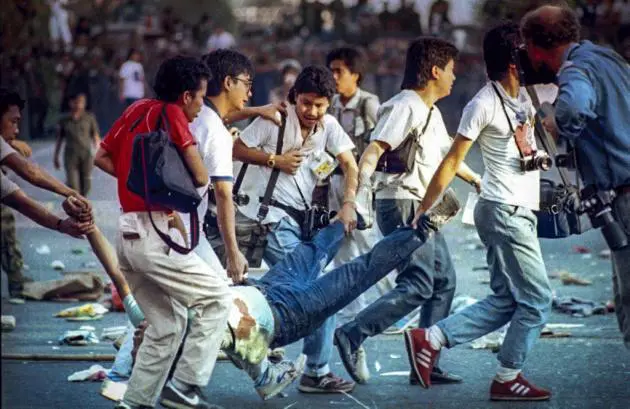
Liwanag has contributed a series of disturbing images of the notorious Mendiola Massacre in January 1987, when the military opened fire on farmers demanding the Corazon Aquino government fulfil its election promise of land reform. The protest, by more than 10,000 people, got out of hand and ended with the military opening fire and killing 13 farmers.
Sepe, a resident of Bangkok for more than two years, spoke at the exhibition’s opening earlier this month. He began his career as a photographer in the early 1980s, “stringing” for major wire services such as Agence France-Presse, Reuters and the Associated Press before a spell with Kyodo. His pictures include shots from Mindanao (the ongoing war against Muslim rebels), Manila’s famous “smokey mountain” (a massive rubbish dump), street children and the Feast of the Black Nazarene, plus an oil spill on the Pasig River.
“Life as a documentary photographer is always a balancing act, and not just in the Philippines,” Sepe said. “Financially it’s not very rewarding, so it’s always a dilemma where to get the next buck to finance a project. But, no matter what, it was always rewarding ... if you happen to show the images through publications or exhibitions, books. And all three of us have been in that situation ever since.
“But it is exciting, especially when you cover events or go to places that are not ordinarily reachable, just to expose a story or go on a fact-finding mission.”
In the ’90s Sepe got to go on tour with the president and to see war zones in Mindanao. His most “memorable tragedy” was getting ambushed in South Cotabato while on assignment. He survived, but his publisher refused to pay for his shattered camera.
“These are pictures that are felt and lived – not like most of the pictures you see today, pictures of anything, because clicking a camera has become a secondary body movement for everybody. Now everybody is a photographer. Hence, the world is full of visual rubbish.”
The pictures on show at the FCCT are certainly not that. They are a step back in time, to when significant events were told via black-and-white images. Baluyut and his colleagues have moved on to multimedia, but this show harks back to the days when history was captured by the most dedicated of photographers, who sometimes risked their lives to get that classic shot.
Images of a bygone era
_ “In my Homeland” (“Doon po sa Amin”) is on show until late next month at the Foreign correspondents Club of Thailand in the penthouse of the Maneeya building at Chidlom Skytrain station.
_ It’s open from 10am to late Monday to Friday. Entry when there is no other events is free. For details, see www.FCCThai.com.
