
Hunting for tiger fortress


Play
The quest to find a centuries-old forest encampment in the Sunderbans leads to a brush with a lord of the jungle
Troubled by the Portuguese pirates roaming his empire – which spanned almost all of the Indian subcontinent – Moghul Emperor Akbar realised he had to take action against these plunderers who had made the Bay of Bengal their base. He sent his best military commander, Moin Sheikh, to deal with them.
The pirates had been collecting wood from the Sundarbans for kindle to produce salt from seawater, and it is in the heart of this jungle that Moin Sheikh set up his fort. He built 35 houses amidst the treacherous muddy mangroves where the Bengal tiger reigns.
Fast forward to the present and the Mughal Empire is gone, the pirates turned to traders and the houses all but forgotten. Our tour guide tells us this story has survived for decades among the locals. Then, with a triumphant smile, he declares that he has managed to locate the remnants of this fort, now the home of tigers and snakes, and that he has collected bricks from the ruins to verify their age.
Our little launch is anchored at the southern tip of the Ganges Delta, in Katka, and with the absence of motion, the humid Sundarbans air is getting to us. Every nearby stream is a potential crossing point for the elusive tiger and yet the only sound we hear are the gentle waves breaking against the boat.
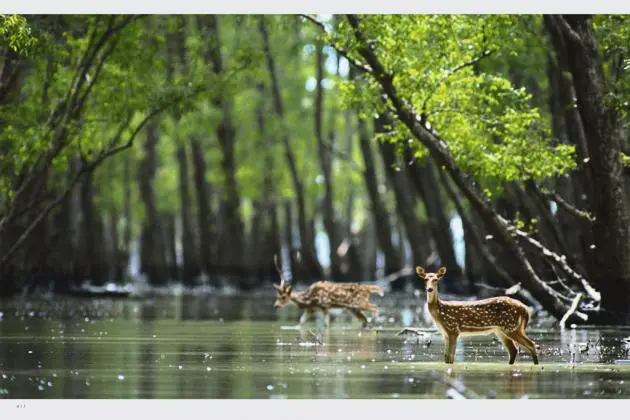
We board at 4am that morning in Mongkla with high hopes of seeing a tiger the same day. The journey downriver into the heart of the world’s largest mangrove forest quickly turned from breezy to oppressive, the sweat on the tip of my nose trickling into rivulets. At Katka, we stop to check in at the log-cabin headquarters of the national park. Waiting for us there is our first real encounter with Sundarbans’ wildlife – the Chitra Deer. As we approach a herd hundreds strong, they seem to hear the crunching of Sundari and Golpata fruits under our boots and look up. Then suddenly they run, shy and rightly so.
We return to the boat and the forest officer explains how his gun works, further fuelling our hopes of a seeing a tiger with stories about the times he has had to fire it. Our guide pilots the boat to the tiger trail, a steady three-hour hike through forest mud that threatens to suck off your shoes if you stand still for more than a second. It is easy to see no one has been here for months; the only footsteps are ours and the deer.
As we trek deeper into the jungle, the dense foliage of Sundari trees begins to thin and we see a massive ribbon of patterned skin on the mud before us. A huge python had passed. While I am praying for the sight of a tiger, weirdly enough I do not want to come face to face with the snake.
The tiger trail leads on. At one point we are engulfed in a horrible stench and our forest guard stiffens and loads his gun. But as the trail ends and the tide starts coming in, we are in waist-deep water and still no tiger.
Tired from the hiking, we are back at the boat waiting for dinner. The Sundarbans, with its stifling air and the watery silence affects you. You are alert to every little sound and somehow always on your toes, the constant silence always seems to herald something about to happen. I sit on the hull of the launch for four hours at a stretch as we head to Tambulbunia from Katka to spend the night.
Occasionally our captain shines the boat’s headlight towards the numerous rivers and streams that spread out like Lichtenberg branches on both sides.
I go to check if our dinner is ready and almost immediately hear shouts of “Tiger, Tiger” from our captain, another tourist and a deck hand.
A pattern of black on yellow was crossing a stream in the beam of the boat’s headlight. And except me, everyone there – some for the first time – had just seen the Royal Bengal Tiger, even if most just got a brief glimpse of its behind.
It’s hard to not beat yourself up for missing such a once-in-a-lifetime encounter like this by such a small margin of time.
I console myself with the knowledge that the day before I had found a large clay pot whilst out combing a mud beach. Digging it out of the brown gloop where it had washed to shore, I remembered the story of Akbar. I like to think the pot was one of the ones used by the Portuguese pirates to boil seawater for salt.
