
On the great divide


Play
The clash of civilisations has sent domes soaring and imaginations spinning in ancient Istanbul
Istanbul. Just the name conjures images of veiled belly dancers, whirling dervishes and Indiana Jones. Swap the fantasy for reality and you find a unique ancient city that straddles cultures and continents.
The Golden Horn, an inlet of the Bosphorus Straits, cuts the city neatly into two, separating its European from its Asian side. Most tourists land in Asian Istanbul and are ferried to their hotels in Europe across the landmark Bosphorus Bridge.
We were fortunate enough to stay at the Shangri-La Bosphorus, which overlooks this famous stretch of water and cuddles up to an illustrious neighbour – the Dolmabahce Palace, one of several in Istanbul filled with glittering gold and crystal and wreathed in history that sounds like it comes from “A Thousand and One Nights”.
Although photographs are forbidden within the palace, we manage to capture images of the lovely garden, with its picturesque landscape, fountains, playful statues of lion families and a million-dollar view of the Bosphorus.
You cannot help but be awed by the depths of history that swirl before your eyes here, even as you enjoy all the luxuries of modernity.
The city was founded by Constantine the Great around AD 300 and, as Constantinople, went on to serve four empires under Roman, Byzantine, Latin and Ottoman rulers. Constantine converted to Christianity and his capital became a regional centre for the faith for centuries, until the Muslim Ottoman sultans conquered the city in the 15th century.
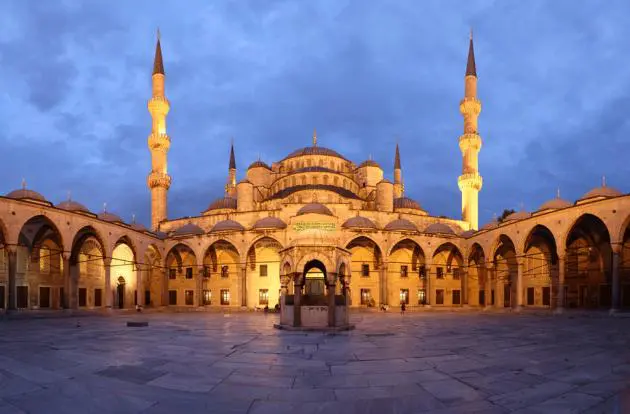
To understand modern-day Turkey, you need a quick tour through its labyrinthine history. Only then can you truly appreciate the treasures that remain here – the impressive underground water cisterns, the Roman obelisks at the Hippodrome, the original Christian Hagia Sophia, which later inspired the Blue Mosque.
Stare agog at Hagia Sophia’s celebrated architecture and you see a reflection of the city’s changing fortunes. Originally a church, it became a mosque under the Ottomans , but is now one of the world’s most magnificent museum buildings.
If Hagia Sophia’s vast panorama of history makes you giddy, head to the unique Museum of Innocence for a more intimate and quirky side of the city.
As with so many other things in Istanbul, this place lands visitors right in the middle of the Great Divide. But this time, it’s the dim recesses between fact and fiction, dream and reality.
The Museum of Innocence was established by Turkish author and Nobel laureate Orhan Pamuk and based on the museum that features in his 2008 novel of the same name. The building is stuffed with a collection of memorabilia from the star-crossed romance of the protagonists – a wealthy businessman and a lowly shop girl.
It is a testament, too, to the author’s creative process. At the entrance is an entire wall studded with the butts of cigarettes he smoked along with friends while seeking inspiration for the novel. Each stub is carefully documented with the smoker’s name and date it was smoked.
The exhibits offer a poignant glimpse of intensely personal details that made up daily Istanbul life during the 1970s and 1980s. Visitors are left to work out which are real and which came from the novelist’s imagination.
We emerge from the cavernous museum and into steep lanes filled with flea markets, antique shops and fruit stalls offering juice freshly squeezed from ruby-red pomegranates.
This exotic fruit is much loved here, and piles of it can be seen everywhere. I spy a group of three ceramic pomegranates, bursting at the seams with sparkling red glass seeds, and snap it up as a souvenir.
The fruit also figures prominently as a motif, adorning everything from palace walls to carpets sold at the Great Bazaar. At the Egyptian Market, delicious Turkish Delight glows in squares made from pomegranates, almonds, pistachios and Turkey’s famous honey.
Istanbul is a foodie’s dream – a land of milk and honey, olives and grapes, peaches and figs. Street-corner vendors serve up hot Turkish breads that look like giant pretzels, roasted chestnuts and corncobs, trays of steamed mussels served with wedges of lemon, and, of course, the ubiquitous kebabs, baklavas and sweetmeats.
These compete with restaurants where sizzling lamb kebabs and seafood stews give an even deeper taste of local cuisine.
Only those with stout hearts should try the Turkish coffee, though. So thick that it pours like cream, this potent brew gives many unwary sippers palpitations. The tea is a more dainty option, served in elegant glasses with nipped-in waists, and sweetly energising after a long day of sightseeing.
Whatever your pick-me-up of choice, you’ll need it in Istanbul. Few city’s in the world have as rich a blend of cultural treasures to discover, and that means plenty of exploring to do.
