
Another way of the samurai
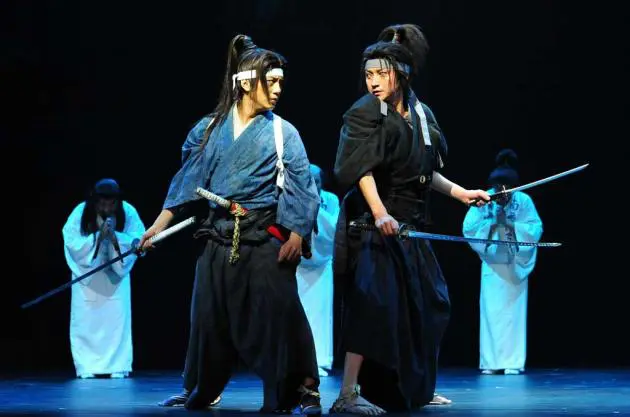


"Musashi" delivers a timeless and universal message in Singapore
The collaboration between the Esplanade – Theatres on the Bay and the Singapore Repertory Theatre on the ongoing “3 Titans of Theatre” project provided me with the opportunity to watch a production by internationally acclaimed Japanese director Yukio Ninagawa for the first time.
And just like the first play in the project “Shun Kin” by British director Simon McBurney, staged back in August, it met with popular and critical success.
Adapted from the real incident in which samurais Miyamoto Musashi and Sasaki Kojiro fought a famous duel resulting in the latter’s death, “Musashi” imagined that Kojiro survived and the pair met six years later at a Buddhist temple where priests and others tried to talk them out of another fight.
The twist was not for fun but to question why in a culture dominated by Buddhism and Zen, killing is the way of the samurai. Of course, this was not for historical purposes, but asked us to look at the wider, and more contemporary, scope of why people of all religions, still believe that violence should be defeated with violence while ignoring the value of living.
In the Bushido set-up with which most Asian audiences are familiar, the script by the late playwright Hisashi Inoue was unpredictable. Those who had done their homework were however aware that the play was based on the structure of Mugen Noh, or fantasy Noh, in which the dead and the living share the stage. It was not only a fine blend of compelling drama and satirical comedy but allowed each individual character to have significant time and essence in the story
Under the direction of Ninagawa, who’s now 78 but still productive, the 170-minute play, set almost entirely at one locale, kept to a fine pace. There were no dull moments in it and occasionally I would stop reading the English side titles and was still able to fully enjoy the performance and understand what’s going on. My only complaint was that the play’s main theme was repeated again and again in the dialogue, making me feel I was watching a TV drama whose director was worried that the audience would get lost during the commercial breaks.
Most of the cast members have been with the play since the premiere in Japan four years ago, and after performances at famous venues like the Barbican Art Centre in London and Lincoln Centre for Performing Arts in New York, worked as a strong ensemble. While Japanese expatriates seated next to me were focusing their attention on Tatsuya Fujiwara of “Battle Royale” and “Death Note” fame, I was mesmerised by performances by seasoned thespians like Kohtaloh Yoshida and Kayoko Shiraishi.
The design team, comprising set designer Tsukasa Nakagoshi, costume designer Lily Komine and lighting designer Jiro Katsushiba, was equally strong and their well-unified vision proved that a captivating play doesn’t really need scene and costume changes. Another strong component that supported but never showed off was Akira Miyagawa’s music and Masahiro Inoue’s sound design.
“Musashi” proves again the borderless and ageless power of theatre and explains why in this day and age when many of us, with much fun to be had with our smartphones and tablets as well as 3D movies, still go to the theatre.
LAST TITAN ON STAGE
The project wraps this weekend with Peter Brook’s “The Suit”, which runs from tomorrow to Monday at the DBS Arts Centre. Shows are at 4 and 8pm.
The production is in English. Tickets are S$38 to $108 at www.Sistic.com.sg. Find out more at www.3TitansofTheatre.com.
