
The African cradle of couture


Play
Yves Saint Laurent took inspiration from the mysteries of Morocco and changed fashion forever
A “Jewel” of the Islamic world between the 11th and 13th centuries, Marrakech, now one of Morocco’s most popular tourist destinations, still sparkles with tradition. To Yves Saint Laurent it was irresistible – a treasure store of ideas he plundered on his rise to become “king of French fashion”.
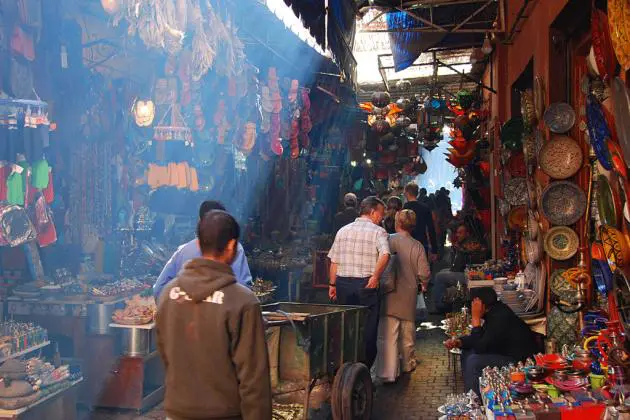
Walk in his footsteps through the old Medina quarter and you find yourself in a maze of narrow streets lined by stalls of colourful Berber clothing, carpets and accessories. Jostling for space are women veiled from head to toe in deep blue. Every so often a pungent aroma fills your nostrils, the first sign you are approaching a spice stall. The air is thick with mystery and intrigue.
Such sights and smells were always familiar to Saint Laurent, who was born in neighbouring Algeria.
A precocious and talented designer, he moved to Paris aged 18 and quickly gained a reputation. He visited Marrakech for the first time in the 1960s, attracted by a mood reminiscent of his hometown of Oran in Algeria.
Saint Laurent slowly fell in love with the city and in 1980, along with his boyfriend Pierre Berge, bought a mansion overlooking beautiful gardens bigger than a football pitch. Saint Laurent made the place his second base after Paris, retreating there twice a year to recover from the exhausting Paris Fashion Week.
“For him, the mansion was a place to relax and gain inspiration for new designs,” said Quito Fierro, 51, who looks after the mansion’s Majorelle Gardens where the designer’s ashes now lie scattered.
“He was very shy, but he used to joke a lot,” says Fierro of Saint Laurent.
The YSL collections of the ’60s to the early ’80s spawned fashion icons that clearly reflect the traditional Moroccan culture visible today everywhere in the Medina.
A simple dress of white cotton embroidered with colourful thread for Paris Fashion Week in 1982 is unmistakably a take on the traditional garb of the Berbers, a people indigenous to North Africa.
Fascinated by Berbers, Saint Laurent would visit local villages to learn more about the tribe. His deep curiosity about different cultures led to ideas that broke fresh ground in the field of fashion.
These days, as many as 700,000 tourists visit the Majorelle Gardens every year. Many of them drop in at the gardens’ Berber Museum, where about 2,000 exhibits, including ethnic garb and ornaments collected by Saint Laurent, testify to the deep influence the culture had on YSL.
Though busy conquering global couture, Saint Laurent also made time to boost the local fashion scene. Moroccan designer Fadila El Gadi recalls meeting the French couture “king” when she was still relatively unknown to the fashion world.
“I owe him for always giving me a supportive push,” she says.
Marrakech sewn up
Yves Saint Laurent was born in French-colonial Algeria, but moved to Paris at the age of 18 to learn design at Christian Dior. He broke new ground for women’s fashion with fresh new styles like safari jackets and jump-suits. In 2002, he retired. After his death in Paris in 2008, his ashes were scattered at his mansion in Marrakech.
