
Unity in art


Play
Armless painter Ekachai Wankaew explores the meaning of hope
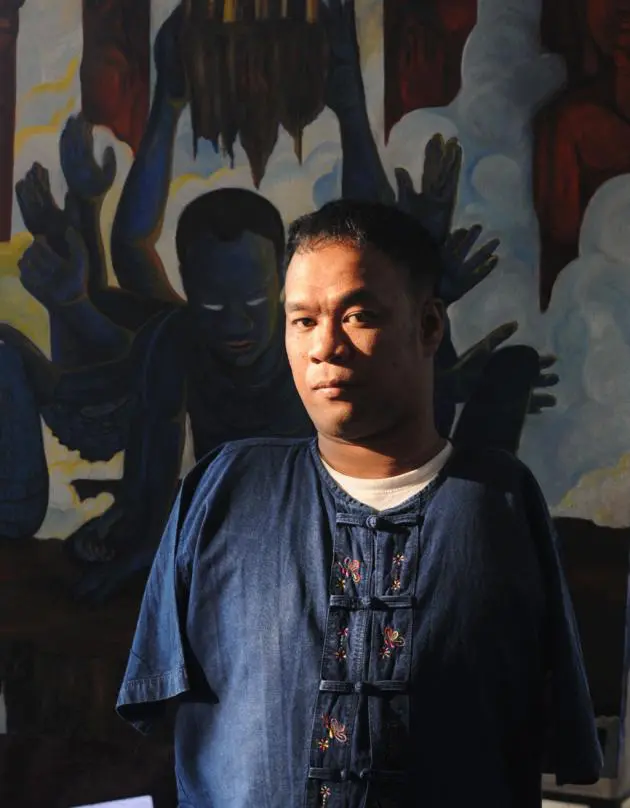
While the disabled are today far more accepted in Thai society than in the past, their rights are often still ignored and many are still denied access to services that the able-bodied take for granted. In the worst of cases, they may be hidden away or ignored. Ekachai Wankaew, who has no arms and severely deformed lower limbs, is no exception. Yet the Nakhon Sawan-born, 34-year-old has succeeded in overcoming his handicaps and is today a talented artist and teacher.
“I’ve memorised what Her Royal Highness Princess Maha Chakri Sirindhorn told me during my graduation ceremony. She said, ‘You are very good. You are an inspiration for many other people. Carry on!’,” says a smiling Ekachai, who graduated from Poh Chang Academy of Art (Painting) last year.
And Ekachai is indeed very good, as the public will be able to see for themselves in the upcoming exhibition “Art Is Hope” being hosted by the Shangri-La Hotel Bangkok from Thursday to January 5 as a part of its annual charity auction.
“I have been accumulating money towards a new home in Bangkok. It will be a place for me to create my art and for unprivileged children and other people to gain an appreciation of art,” says Ekachai, who has been working as an art instructor at the Vocational Education Institute, Bangkok Metropolis 2 for the last two years.
He’s created five oils for the hotel’s show and sale: “The Four Types of Lotus”, “Relations”, “Abundance”, “Unity” and “Perseverance.”
“They’re part inspiration and part imagination,” says Ekachai. “The fish and elephant are symbolic of love, unity and relationships. ‘Unity’ is related to the political situation of today, with the two fish in yellow and red representing the different views of the people yet underlining that they are from the same family.
“‘Abundance’ reflects the importance of elephants as part of Thai culture and the Thai way of life though sadly Thais seem to be much more interested in pandas these days.
“My painting, ‘The Four Types of Lotus’, is concerned with Buddhist teaching, signifying the progress of the soul from the primeval mud of materialism, through the waters of experience, and into the bright sunshine of enlightenment. It reflects human goodness and evil. ‘Perseverance’, meanwhile may look like Koh Tapu in Phang Nga but actually is an image of a Buddhist.”
Ekachai is also exhibiting a newly created oil that is symbolic of himself but with a lot of hands, though it won’t be part of the auction. “I would like to grab everything like normal people. The two pillars represent God and the devil, like two sides of man.”
Ekachai, who was born disabled, came into the world almost three months premature and weighed less than one kilogramme at birth.
“I was the size of a water bottle. When I was sick, my aunt took me to hospital in her betel nut basket,” he says. “But I was brought up as a normal child. I didn’t know what was wrong with me or why I moved more slowly than my siblings.”
His struggles to move unaided began as a preteen. He started by rolling himself towards the object he wanted and practised standing by pushing his head against the wall. He also got into the habit of clutching a stick with his toes and using the stick to copy the letters from a comic.
When he reached his teens, he applied for a place at elementary school but was denied because of his disability. But the youngster soon became bored with staying at home and after seeing a commercial, which stressed that all Thai children should have an education, pushed his father to get him into school.
His talent for painting became obvious during his elementary school classes.
“I loved painting with my feet and remember feeling so proud when I won first prize in a contest on the topic ‘What do you wish to have on Children’s Day?’. I received a bucket of saltine crackers, yam-beans and an orange and my mother was presented with the winning rosette,” says Ekachai.
After completing high school, he went to Nakhon Sawan Vocational College where he studied art for two years before moving to Poh Chang Academy of Art to earn his bachelor’s degree. As his parents, both lotus farmers, didn’t earn enough to support him through college, he decided to use his art as a means of covering his expenses.
“I made a living by working a street artist and doing cartoon portraits at Memorial Bridge as well as supervising the academy’s stationery store. I spent Bt100 a day and sometimes ended up walking almost five kilometres back to my rented room,” he says.
But his difficulties didn’t end with trying to make money.
“For my thesis, I needed to paint a large canvas – 2 metres high and 1.20 metres wide,” says Ekachai, who stands just 110 centimetres tall. “It was impossible for me to lie down and paint it or climb up on a ladder. A teacher tried to help me by suggesting I reduce the size of canvas and take more time to complete my thesis work. But I wasn’t prepared to do that. In the end, having stared at the canvas for three hours, I opted for an ‘upside down’ painting technique. My thesis was a surrealistic work with a big shell symbolising looking at the outside of people rather than the inside.”
A fan of surrealism, Ekachai names as his favourite artists Prateep Kochabua and Spanish surrealist painter Salvador Dali.
These days, he doesn’t only paint by using his toes but also his mouth and shoulder.
“While working as an official of the Art for All Foundation, I took care of a group of children with multiple disabilities who did everything by using their mouths and shoulders. I observed their technique and tried to adopt it. Painting with the shoulder is very hard because it’s hard to control your weight and difficult to see. But I made it in the end,” says Ekachai, who has also given art lessons to prisoners.
All for a good cause
_ “Art Is Hope” opens on Thursday and runs until January 5 at the Shangri-La Hotel Bangkok.
_ An auction of Ekachai’s paintings begins at 7.30pm on Thursday, with proceeds supporting the building of Ekachai’s non-profit art centre, which that will allow everyone, whether physically impaired or able-bodied, to learn about and appreciate art.
_ Sets of ”Unity” greeting cards reproduced from Ekachai’s artworks will be on sale for Bt500.
