
Mourning the unknown


Play
An undertaker recruits volunteer mourners to assist at the last rites for friendless deceased
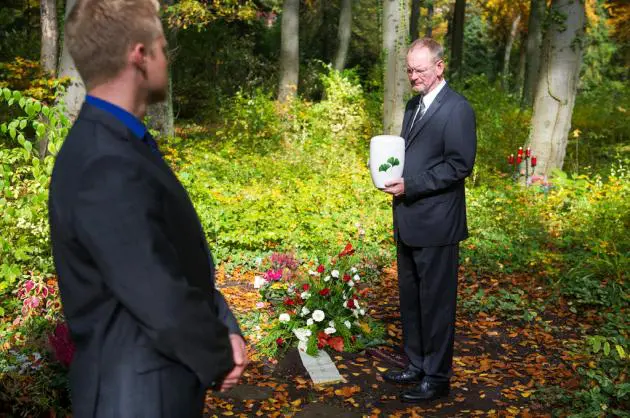
The mourners never knew the deceased, but they have shown up at the funeral to boost the numbers.
If the volunteers were not there, the congregation would be zero. A funeral is sad enough. A funeral with no guests is sadder still.
“This is all about helping bring dignity to the funeral,” Hans Heine, 67, tries to explain. “It’s so that dead people who may have been lonely their entire life are not alone on the final journey.”
He is standing in a funeral parlour at the main cemetery in the German city of Saarbruecken. The volunteer mourners stand before a flower-decorated urn and then accompany it as it is carried outside to be buried.
There are no reliable figures on whether solitariness is more common than it used to be. Perhaps the profoundly lonely have always been among us. Heine has so far attended about a dozen funerals of strangers as a volunteer mourner.
“I think it is very sad when somebody is buried without any relatives, friends or acquaintances attending,” comments Saarbruecken funeral director Hubert Laubach.
He recalls several funerals in recent years where as undertaker, he was alone in the cemetery chapel with the obligatory pastor and an organist.
“You’re always looking up at the door and thinking, somebody must be coming. But the pews remained empty,” the 57-year-old said.
At the start of this year Laubach and his son posted an ad in a newspaper calling for “voluntary mourning guests”.
Very quickly, people responded. Now, Laubach has a list of six people whom he can call on to attend such funerals.
“We stand there like a group of mourners, a kind of family,” he says.
Heine always shows up wearing a black suit and white shirt. “I dress respectfully, in keeping with the occasion,” says the former store employee. As a child, he served as an altar boy at a Catholic funeral where the only others were the priest and another altar boy.
“I bawled my eyes out that night,” he recalls.
Today he doesn’t allow himself to be so greatly affected by such lonely funerals: “I guess they’re a sign of the times.”
Funeral director Laubach has about 20 burials per year where no relatives can be located. They might include a lonely old woman who dies in a nursing home, an elderly man in a hospital or a homeless person.
The authorities hire him for the funeral and pay him. He knows little more about the deceased than the name and last address.
As far as he knows, Laubach is the first funeral director in Germany to organise volunteer mourners.
The Federation of German Undertakers says it knows of one other project, in Goettingen, Germany.
There, a group called the Tobias Fraternity, which includes funeral directors among its members, organises a dignified funeral if there is no one else to mourn. The practice dates back to the days of medieval fraternities, says the Tobias group.
In Saarbruecken, Laubach tries to find mourners among the deceased person’s neighbours.
“We also print funeral notices and post them in the apartment block where the deceased lived, in the hope that someone will attend the funeral,” he says. He tries to discover the dead person’s religious beliefs so he can call in an appropriate clergyman.
“Even if somebody had no religion, I still try to find a pastor.”
Laubach’s business operates 13 funeral homes in Saarland state carrying out around 900 funerals each year. But it is those where there are no relatives and friends that touch him the most deeply.
“I just can’t understand how there can be nobody paying their final respects to these people.”
