
It's Bangkok in bloom!


Play
Famed florist Sakul Intakul sniffs out the best places in town to enjoy flowers - in art, in essence and in real life
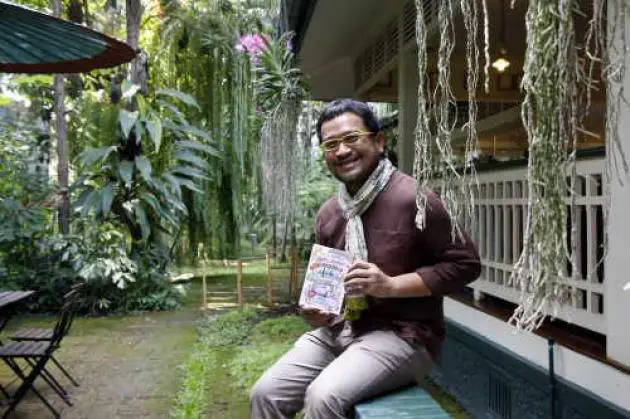
HOW ABOUT a tour of Bangkok to see where actual flowers are blooming rather than political chaos? Sakul Intakul, one of the country’s most famous florists, has just released a guidebook called “Floral Journey Bangkok” that celebrates the city’s literally more colourful side.
Sakul visits the street vendors who hawk intricately woven garlands, surveys the wealth of species blossoming at Pak Khong Talad, luxuriates in the well-tended gardens at the Grand Palace and admires the floral motifs among the history-rich murals at temples.
“The idea is to reveal another perspective of Bangkok,” says Sakul, who has sculpted flower arrangements for Their Majesties the King and Queen and for hotels from Bali to Rome. “The book presents tropical flowers and gardens as destinations that will appeal to the tourists who want to peek behind the steel-and-glass veil of metropolitan modernity.
“Floral art,” he points out, “is an integral part of Thai culture – seen in royal feasts, religious ceremonies and important milestones of our lives.”
Sakul amassed the information for the new 184-page, English-language pocket-sized book while doing research for his 2009 coffee-table book “Dok Mai Thai: The Flower Culture of Thailand”. Sakul and co-author Prinya Ruenprapan spent another three years trekking around the city, tracking down the most fragrant sites.
“Floral Journey Bangkok” recommends 10 “destinations” in the capital and close by – the Grand Palace, Pak Khong Talad, Lumpini Park, the Jim Thompson House, the Chatuchak Wednesday Market, Sri Maha Mariamman or Wat Khaek, the Erawan Shrine, Bang Krachao, the Sampran Riverside and Suan Nong Nooch, and Sakul’s Museum of Floral Culture.
There are illustrated maps for the palace, Lumpini Park, Chatuchak and Sakul’s museum, showing the location of every plant mentioned.
“Tourists visit the Grand Palace and the Temple of the Emerald Buddha to see the grandeur of the architecture, but I’m eager to unveil the hidden charms,” Sakul says, who created the intricate floral arrangements for the 2006 banquet there that marked His Majesty’s 60th anniversary on the throne.
“When you walk through the main gate of the Grand Palace you’ll see cone-shaped makham – tamarind trees – that are inspired by European landscape gardening, but at the same time reflect traditional Thai beliefs about auspicious plants. Makham is usually planted to the west of a house because it was traditionally prescribed as protection against evil spirits and enemies, as well as legal disputes.”
In the adjoining temple, Sakul points out the bodhi tree in a basin beside Ho Phra Monthien Tham, small in stature but so cleverly sculpted that it looks like a “giant” bonsai tree. King Rama V planted it, seeding it from the Mahabodhi tree at Bodh Gaya in India, under which Siddharatha Gautama achieved enlightenment to become the Buddha.
Lumpini Park is Sakul’s favourite place to relax thanks to its leafy surroundings, which seem to laugh off the concrete and cacophony beyond its walls.
“You can see a variety of tropical flowering trees there, taking turns to bloom all year round,” he says. “Some foreign visitors might be keen to see the diverse variety of palm and coconut trees. From February to April, chompoo pantip – the pink trumpet trees – around the food court are in full bloom, making the place astonishing with pink flowers.”
The century-old, colonial-style mansion on Samsen Soi 28 that Sakul turned into the Museum of Floral Culture last year is tasked with conserving Thailand’s lovely floral arts. There are garlands, pendants and other decorations, some with a more modern style, and antique samples of the floral arts of India, China, Japan, Laos, Tibet and Indonesia (specifically Bali). Old photographs evoke the exuberance and intricate refinement of Siamese floral culture as far back as Rama V’s time.
The botanical garden behind the museum has a classic sala and a pool. Its flora include guay tanee (Musa balbisiana, the wild banana), pikul (bullet wood), dok rak (crown flower), pud (a gardenia, the cape jasmine), champee and champa (white and orange champak).
And there’s a window at the museum that Sakul made which replicates a mural in the prayer hall of Wat Somanas depicting a flower chandelier.
“Wat Somanas is worth a visit to see the amazing paintings of flowers that are shaped like European chandeliers,” he says. “The arrangement depicts a floral fusion of European, Chinese and Indian, together with different sizes of Thai floral tassels.”
Bangkok’s temples often offer a rich profusion of flowers – both living and modelled. At Wat Pho they appear in a lavish mosaic on a gate, at Wat Benchamabophit in an intricate bas-relief on a sala gable, and at Wat Thepthidaram in paintings of Indian-inspired tassels flanking a Chinese lantern in the ordination hall.
In place of photos the book offers 86 wonderful illustrations by Japanese artist Maki Fujii, a painter of kimonos who conducts Japanese-language tours at the museum. Despite having lived in Thailand for 12 years, Fujii admits she knew little about Thai flowers.
“It took me almost six months to complete the illustrations because I had to study all the flowers and plants, as well as malai [making garlands] and khruang khwaen [pendants],” she says. “And pinpointing on the maps where each bloom is located was tough and time-consuming.”
Fujii used an extremely fine Japanese brush and coloured pencils. To ensure accuracy in the hues, Sakul had the illustrations printed on a light cream-toned paper identical to traditional Japanese paper.
“Floral Journey Bangkok” is just as rich in its history, tracking the story behind Thai floral culture and the myths and symbolism of the various flowers, and doubles as a guide to the “auspicious” plants found in and around many Thai homes.
As to a Thai-language edition, Sakul says many people have asked for one “because it’s far more than a travel guide, covering many things we’ve forgotten or never realised”.
“Give me time to see the feedback from the English version,” he laughs.
FOLLOW YOUR NOSE
>>“Floral Journey Bangkok”, by Sakul’s own publishing house, Purple Press, costs Bt359 at leading |bookstores.
>>The Museum of Floral Culture hosts workshops on flower arrangements on the second Saturday of every month. Next up is the session on February 8 showing how to make a Valentine bouquet.
>>The museum is open daily except Monday from 10am to 6pm. It’s on Samsen Soi 28, sub-soi Ong-Karak 13, off Nakhon Chaisri Road.
>>Admission is Bt150 (Bt75 for |children), inclusive of a guided tour. Call (02) 669 3633-4 or visit www.FloralMuseum.com.
