
All in art together


All in art togetherIn 2013, Montien remembered, rage against the government and "Hello, Asean!"
As bureaucrats and businesspeople across Southeast Asia continue preparations for the next phase in the region’s unification as a trading bloc – the inauguration of the Asean Economic Community in 2015 – the arts are not being neglected.
The Bangkok Art and Culture Centre this year hosted a seven-month Asean Arts Festival, beginning in June with a talk in which former Asean Secretary General Surin Pitsuwan underscored how important art and culture are in building a social relationship among the member nations.
More discussions and exhibitions followed that gave Thais a deeper understanding of the region’s eclectic art and cultural traditions. This month there is “Asean Nights: Asean Beyond Frontier”, a music and film series taking place outside the centre, and “Concept Context Contestation: Art and the Collective in Southeast Asia”, an exhibition of contemporary art that continues into March. And “Media/Art Kitchen: Reality Distortion Field (Bangkok Version)!” runs through February.
The multimillion-baht Asean Arts Festival has involved more than 200 artists and staff members, and planning is underway an expanded version next year.
Silpakorn University hosted “We=Me” in August, featuring more art from across Southeast Asia, with 15 artists participating, plus one from China, and a symposium for curators. The aim was to share and make connections.
Culture Ministry’s Office of Contemporary Art and Culture opened its Contemporary Art Museum with an Asean art exhibition. The new museum on Rajadamnoen Klang Avenue is a three-storey colonial-style building renovated at a cost of Bt500 million. Its inaugural show has 200-odd works chosen to reflect Asean diversity. The participating artists were treated to a trip to the Ayutthaya historical park and a tour of Bangkok galleries.
Six artists from Thailand, Singapore and Myanmar are taking part in the show “Currency Crisis” at the Whitespace Gallery, which moved this year to bigger premises on Soi Saladaeng. Singaporean curator Tang Fu Kuen, who designed his country’s award-winning pavilion at the 2009 Venice Biennale, has put together a controversial exhibition of performance, installation and “happening” art. It opened in November and continues through January 12, a springboard for the gallery’s regional expansion. The show will move next to Art Stage Singapore, taking along the work of Thailand’s Manit Kantasak.
Thavibu, the Kingdom’s first digital commercial gallery, continued this year to build on its strength in Southeast Asian art with great shows from Myanmar and Vietnam. And the concept gallery Rock Around Asia set up shop the lobby of the Novotel Suvarnabhumi Airport Hotel to display Asian art and offer art tours of Bangkok.
Art gets angry
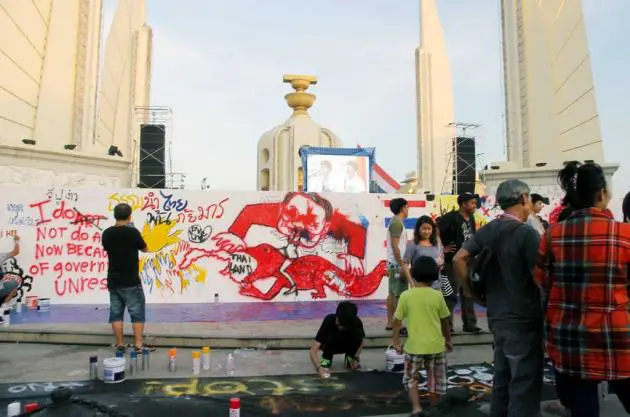
Art emerged as a weapon in the political war engulfing Rajdamnoen Avenue this month and last with some of the country’s most notable satirical artists displaying works assailing the government. The immense protest rally around the Democracy Monument had in its midst an exhibition called “100 Square Metres: 100 Artists”.
Vasan Sitthiket, Naowarat Pongpaiboon and Sutee Kunavichayanon were among the artists painting, sketching – and writing – on the spot. More than 100 paintings and a poem by National Artist Naowarat were put on exhibit, as aesthetic as they were sarcastic. One anonymous painting depicted Thaksin Shinawatra inside the skin of a monitor lizard whose tail thrashed dangerously about.
The national flag, the Victory and Democracy monuments and the faces of key Pheu Thai politicians filled the art, swathed in the colours of the moment – red, yellow and a perhaps more hopeful blue.
Credit duly paid
Montien Boonma, who would have been 60 this year but for his untimely death in 2000, lay the foundation for conceptual art in Thailand. Even more, he showed the world the great things of which Thais were capable.
So the large exhibitions of his work held this year at the Jim Thomson and Chulalongkorn University art centres were fitting tributes and welcome reminders of the impact he had.
Thompson’s “Montien Boonma: Unbuilt/Rare Works” in April featured – rather than the massive installations infused with herbals scents that were Montien’s trademark – fascinating unfinished pieces that shed light on his creative process.
Classic Montien icons were there, like beads, bells and alms bowls, along with some 60 drawings rarely or never before seen in public, and sketchbooks, photographs and video recently brought to light by the Thompson Centre, the Thai Art Archives and the artist’s estate.
In July curator Somporn Rodboon presented “Spiritual Ties” at Chula, showing the work of Montien’s former students and assistants from Thailand and overseas. They included Navin Rawanchaikul, Thatchai Hongpaeng, Tawatchai Puntusawasdi, Udom Chimpukdee, Kitti Maleephan and Amrit Chusuwan.
Montien’s use of materials and interpretations of their meaning, and his very philosophy, were a huge influence on younger artists. He was often given credit for their success.
In March, Somboon Horntienthong was the recipient of the homage in the wonderful show “Raj Loesuang and the Boy Somboon Hormtientong” at BACC. The “boy” was 64-year-old Somboon, finally working in tandem with one of his childhood inspirations, 74-year-old Raj, as part of a retrospective that included abstract paintings, sculpture, installations and comics.
At 84, National Artist Chalood Nimsamer is still working too, and his show at the Art and Culture Centre in May shared the joy of a lifetime of dedication. He also still teaches at Silpakorn University, where he himself learned his craft from Professor Silpa Bhirasri, the father of Thai modern art.
Highlighting Chalood’s retrospective were 400 murals created since 2010, shown alongside 100 of his best older paintings, sculptures and prints and even some experimental installations.
In September Chavalit Soemprungsuk, 74, returned home from Amsterdam for a rare solo show at the Culture Ministry’s new Contemporary Art Museum. Chavalit lives and works in the Netherlands as the first Thai artist to receive a bursary there to further his graduate studies. The Bangkok exhibition included digital sketches, silkscreens, paintings and installations.
