
A night at the museum


Play
Kid bed down at the American Museum of Natural History
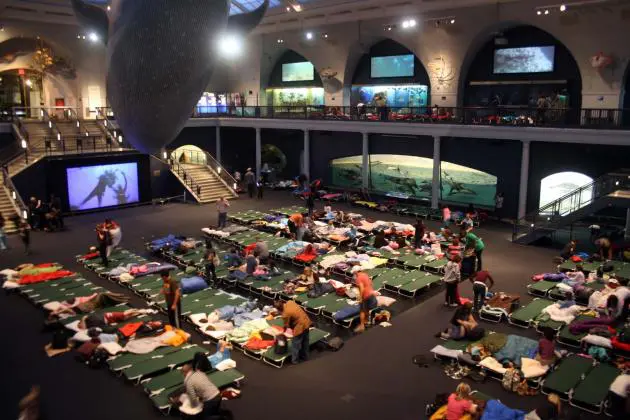
There's a soft sound of snoring in the gallery, and somewhere, the rustling of a sleeping bag. Asleep on green cots are around 250 children and numerous parents, in the middle of the world’s largest natural history museum.
Overhead, suspended from the ceiling is a life-sized whale.
Not too long before, the children had spent hours observing butterflies, petting hedgehogs, and shining their flashlights at the skeletons of dinosaurs. The kids also played tag, racing among such stuffed creatures as tigers, lions and elephants.
The fun went on until midnight, when the lights went out in the Milstein Hall of Ocean Life, which is now serving as a dormitory for the night.
Before nodding off to sleep, the question on the kids’ minds – and never clearly answered – was: Will the animal displays really come alive at midnight?
“This is our is-there-a-Santa Claus question,” says Leslie Martinez, with a mysterious smile. “The children are always asking it, and we never say yes or no. After all, we don’t want to ruin the fun and excitement.”
For seven years now, Martinez has been organising “sleepovers” in the renowned American Museum of Natural History (AMNH) located by Manhattan Island’s Central Park. And she knows that nearly every child that comes here has seen the hit 2006 film “Night At The Museum”, starring Ben Stiller. The flick was shot on location in the museum founded more than 140 years ago.
In the film, Stiller plays a night watchman in the AMNH who discovers that at midnight, all the animals and dinosaur skeletons and even the wax human figures come to life and make life tough for him.
On a recent Friday evening, after closing time, the children and parents arrived carrying sleeping bags, blankets and stuffed animals, and one of the sleepover organisers admonishes the children to obey the museum rules.
“No running, no eating in the exhibition, and always wear your shoes or slippers,” she tells the children sitting at her feet. “Are you excited? Okay – go have yourselves a super-dino time!"
Now the children have an entire museum to themselves, one that seems endlessly huge. The AMNH after all takes up four complete city blocks and consists of 26 interconnected buildings.
There have hardly ever been any incidents, Martinez says.
“Once, a child broke off the tooth of a dragon in a special exhibit. And of course, kids do get lost, but only temporarily. Overall, we have more problems with the adults than with the children.”
On this night, the children are divided into two groups – “Dinosaurs” and “Outer Space” – and now they have a full programme to get through, be it the museum’s own butterfly hall, a special show about whales, or viewing live animals that are active only at night.
In one room, children can craft their own fantasy figures.
“I don’t like fossils all that much,” says 8-year-old Sasha Hurowitz, dressed in pink-striped pyjamas while painting a paper totem pole. “My brother does, but he’s kind of crazy.”
The brother Asher, 10, is also making a totem pole and doesn’t react to his sister’s remark. A guide working at the arts-and-crafts room says, “I got some special paint that shines in the dark. The kids can take the totem poles to bed with them and they then feel protected.”
In the next room, a mother is taking pictures of her three children standing in front of the giant Tyrannosaurus rex skeleton, the one that was seen in the film “Night in the Museum”.
The AMNH has over 20 sleep-over parties per year, each attended by up to 500 children between the ages of 6 and 13. There must be one adult guardian for every three children. And though the tickets cost US$145 (Bt4,800) per person, the sleepovers are usually sold out well in advance.
“Our model is very successful and has been copied already by many other museums,” says Leslie Martinez. “Museums can be so intimidating for children. But in this way they can learn about them in a completely new fashion and feel like they’re a part of it. There is simply a huge difference if you have once spent a night in a museum.”
Gradually, the shrieks and laughter of the children die away, replaced by the sound of yawns.
Exhausted, many kids curl up in the seats of an in-house cinema, where a film about penguins in the Arctic region is running. A bedtime story follows the film and then it’s off into the sleeping bags.
At 7 o’clock sharp the next morning it’s “rise and shine” - and time for the children, their parents and all their toys and sleeping bags to be gathered up and leave the premises. At 10am the first of the day’s 30,000 visitors will start arriving.
