
Speaking out in art
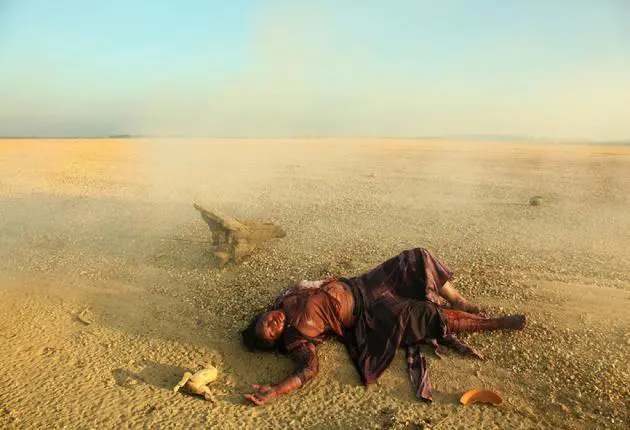


Seven of Myanmar's top contemporary artists showcase their works in Singapore
While freedom of expression has yet to become law in Myanmar, the relaxation of the draconian censorship laws has come as welcome news to country’s art community.
Some are even daring to ruffle a few feathers, funnelling their pent-up creative energies into works that take a critical and hardly complimentary look at the old regime.
A new exhibition “Intermission on Stage”, which is being curated by Yone Arts, offers a snapshot of life in military-ruled Myanmar. Featuring a broad spectrum of works from paintings and photos to installations, it will be on view from Wednesday through Saturday at Marina Bay Sands Convention Centre in Singapore as part of the Art Stage Singapore International Art Fair, the main launch pad for Southeast Asian contemporary art.
This year, the fair brings together 600 artists from 130 galleries spanning 28 countries.
Helping put Myanmar artists on the map is the Burmese-born, Miami-based art consultant Paula Tin Nyo, founder of Yone Arts. Yone Arts promotes the exchange of culture and resources between Myanmar and the international community through the emerging oeuvres of Myanmar contemporary artists.
Born in Yangon, Tin Nyo is a third generation artist, educator and writer from the premiere media family in post-colonial Burma. Her grandfather, Edward Law Yone, was editor and publisher of The Nation in Yangon. Though closed down by the regime, the defunct English daily inspired this paper, The Nation, over in Bangkok.
Following Yone’s release from Insein Prison, the family left for Bangkok where they settled on Soi Ruamrudee for two years before moving to the US as political exiles in 1969. Tin Nyo wasn’t quite six years old. Adjusting to life in Pennsylvania was not easy but the youngster studied hard, landed a place at Yale and graduated with degrees in philosophy and art.
Tin Nyo is one of the intellectual and artistic diaspora now returning and rediscovering her motherland. She’s on a mission to promote Myanmar through art, which she refers to as a “spiritual and visionary medium” that has conveyed Myanmar’s consciousness through the decades.
“Intermission on Stage” focuses on Myanmar’s unwavering artistic aspirations during its nearly half a century of isolation and censorship under junta rule.
“In times of censorship, things can be said in a subliminal way that cannot be said in any other way. I want the world to see the courage and the creative power of Myanmar’s consciousness…the courage of artists who continued to create worthwhile pieces during those decades in isolation and which should become a part of a durable world.
“My exhibition reports what happens during the intermission just before the curtain rises on Act 2. People think after the sanctions, the country was left to rot in hell. I challenge that view. I want to tell the West that my country’s artists were able to continue to create worthwhile pieces,” she says, adding that she was personally against the economic sanctions against Myanmar because the punishment hurt mostly ordinary folk.
“Intermission” takes on controversial and weighty themes like the female nude, ethnicity and displacement through works by Sandar Khine, Soe Naing, Ko Z, Min Zaw, Mor Mor, Nge Lay and Zay Yar Aye.
Sandar Khine’s bold and unconventional depiction of fat women in the nude, a socially destructive subject during the military regime years, could stir up controversy at home. The artist raises the issue of women’s empowerment in Myanmar by equipping her naked model with a camera as a way of returning the scrutiny of her viewers.
Mor Mor’s droplets could be viewed as the teardrops of Myanmar where the plight of the marginalised rural poor and the displaced ethnic minorities falls on deaf ears, as documented by Nge Lay and Ko Z.
Digital art collides with the ancient Myanmar vernacular of botanical forms in Zay Yar Aye’s masterpieces to convey the growing optimism and anxiety that comes with a social networking frenzy.
Staging an exhibition of this scale has not been easy even with Tin Nyo’s extensive experience in the international art world. After 70 gallery visits over six trips to Myanmar within a year and a half, Paula found what she wanted: artists with authentic roots who have a statement to make about isolation and censorship.
“I want to help them stay authentic as they develop and interface with the rest of the world. There’s a danger that Myanmar artists could just kind of see what’s going on elsewhere on the Internet and leave some of their roots. There’s a search for newness, but there’s nothing new, just a new way of compiling everything. So authenticity is very important,” she says,
The unflinching loyalty to traditional line-based art is evident in the work of especially Sandar Khine and Min Zaw. Kine’s heavy-set model offers a maze of lines in ways a slim figure cannot.
“Lines are in our blood, a forte, a sort of Myanmar DNA, if you will. A line is not just a line. It’s a shape. There’s the thinness, the thickness to it. This sensitivity to lines is a very Burmese thing,” Tin Nyo says.
For the curator, “Intermission” is a stepping stone a larger artistic endeavour – a new gallery in Yangon that promotes Myanmar’s contemporary art as a form of cultural exchange.
BURMESE DAYS
“Intermission on Stage” runs from Wednesday to Saturday during Art Stage Singapore International Art Fair at the Marina Bay Sands Convention Centre.
Highlights include 10,000 diary sketches created by Soe Naing as a daily vigil during the military regime years.
For more information, visit YoneArts.com or ArtStageSingapore.com.
