
The world's longest snapshots


Play
South Korean photographer Atta Kim tricks time
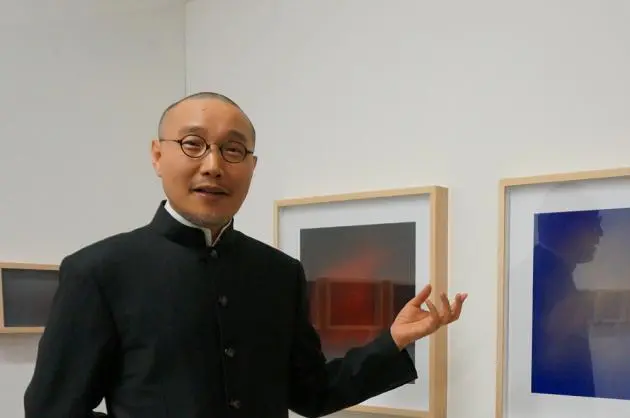
Atta Kim, whose innovative, striking photographs have received much attention in the global art community, returned to Seoul with a solo exhibition last week, ending a six-year hiatus in the South Korean capital.
Kim is presenting new images to wrap up the “On-Air” project that won him world attention, as well as earlier works. He will also introduce another ambitious, philosophical project at upcoming exhibitions in his homeland over the next two years.
Using methods including long exposure – as long as 24 hours – Kim has gone beyond the traditional definition of photography, which is the recording of a moment, making it instead a means to express philosophical thinking.
Images of metropolises such as New York, Beijing and Paris seem deserted thanks to eight-hour exposures that make moving objects look like dust, leaving only the immovable objects, such as buildings, streets and skies.
His photo of naked people inside Plexiglas boxes for a museum display caught the world of photography by surprise as well. Creative ideas and imaginative presentation made Kim the first Asian photographer to be featured in an exhibition at the International Centre of Photography in New York and, in 2009, to be invited to the Venice Biennale.
As the long-running project nears its end, his pictures have shown more monotony in style and profundity in thought.
“I’m looking for something void. What I’ve been searching for is the fundamentals of objects, and this is the result,” Kim said in his studio in Paju last week, pointing to a grey rectangular composite of 10,000 overlapping photos of New York City.
“This is the most difficult work I’ve ever done, but I consider it my most representative work because it shows hidden qualities that can’t be seen with the naked eye,” Kim said.
He took photos of all 15,817 words in the Confucius Analects, a venerable collection of books on philosophy, and formed a single image that looks like an abstract painting.
Unexpectedly, though, what takes up most of his studio isn’t photos but a large fabric ripped into pieces and solemnly hung. His new series “The Drawing of Nature” isn’t images of moments captured through a camera lens but recordings of layers of time on white cloth.
He describes it as drawing “by” nature. He sets up canvases and leaves them for months at historic or otherwise meaningful places, like the Demilitarised Zone that divides North and South Korea, and Henan Sheng in China, dubbed “the birthplace of Chinese civilisation”, and Bhod Gaya in India, where the Buddha became enlightened. He’s taken his canvases underground, under the sea and to a military shooting range.
“I could stand in these places for two years, but since I can’t, I use the white canvas as litmus paper, as an indicator of the character of the place,” Kim said.
The final state of the canvases varies. Typhoons tore the one that was installed under the sea and the one buried underground decomposed into small pieces. Those installed in cities bear different types of stains.
“The canvas installed on a Native American reservation was really clear even a year later, but some of the canvases set up in the cities really result in different images.”
Kim is waiting for approval to install a canvas at the former Nazi concentration camp in Auschwitz and “console its soul” by placing another canvas in Gombaeryong, South Korea, famed for its wildflowers, “because I believe art can heal wounds”.
Different
views
n Kim’s exhibition runs until February 7 at 313 Art Project in Dosandaero, Gangnam, Seoul.
