
As long as it's sufficient


Play
The Thailand Convention & Exhibtion Bureau offers an educational tour of sustainable living
A CHANCE to tour the country and learn more about the much-touted but still little understood theory of sustainable living is being offered by the Thailand Convention & Exhibition Bureau.
The bureau, aiming to stimulate the country’s Mice hospitality industry (Meetings, Incentives, Conventions and Exhibitions), recently unveiled “A Royal Trail Inspiration” in collaboration with the Pid Thong Lung Phra Foundation and Thai Airways International, Air Smile, Bangkok Airways, Air Asia and Nok Air.
The airlines offer discount fares to Chiang Mai, Chiang Rai, Nan, Sakhon Nakhon and Krabi so that participants can visit any or all of the 14 royal projects in those provinces and see sustainable living in practice, especially sustainable agriculture.
Groups of citizens and corporate employees can sign up for the programme, which continues through March.
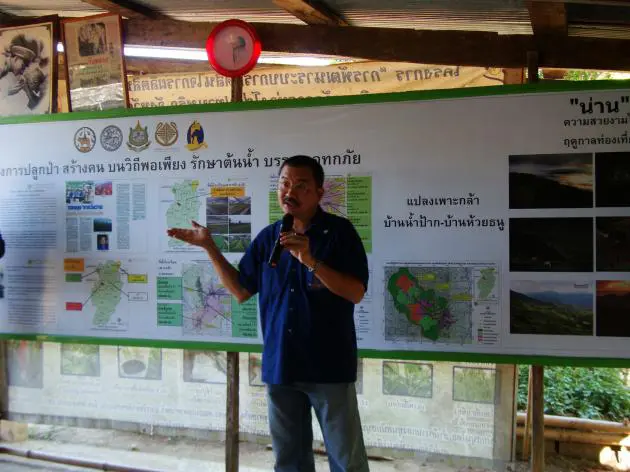
At the Royal Initiative Discovery Foundation Pilot Project at Ban Nam Pak in Nan, village head Thanawat Pangluan conducts a two-day tour showing how rice is cultivated on terraces 1,100 metres up a mountain and how natural resources are managed in a sustainable way.
The project, established four years ago, covers 30,000 rai in three villages and 217 families, most of whose members raise crops or livestock.
“We used to have a terrible time with the effects of global warming, such as landslides,” Thanawat explains. “But a team of specialists taught us that the heart of agriculture is conserving water, so we learned how to take better care of the forest to hold the groundwater and protect the soil. They educated us about living with nature more equitably.”
Land among the villages has been devoted to rice terraces, vegetable gardens and fishponds and these produce ample food for personal use and to sell elsewhere.
“The foundation also taught us how to manage our living expenses better so that we can stay clear of debt,” says Thanawat. “We appreciate the self-sufficiency theory. It’s made our villages stronger – we’ve been able to help establish a market for organic produce in Thailand – and it fosters morality in folks.”
Natnicha Makla lives in one of the villages and serves as a volunteer with the foundation. Her home doubles as a school where people from around the area can learn how to improve their agricultural techniques. Outside the house grow bamboo, longans, rambutans, chillies, cashews, tamarinds and bananas, and there’s a sty of black pigs and a chicken coop. They’re all part of a huge economic experiment.
Natnicha blames the hilltribes living further up the slope for causing the landslides that used to plague the villages. They’d cut down all the trees so there were no longer any deep roots to anchor the soil.
“The foundation built our village as a prototype for Nan province,” she says. “We built a dam behind the school in 2010 and now have enough water to cultivate crops year round, and we planted seasonal fruit and vegetables among our houses. Once our productivity improved, our lives got better. We no longer have to go and find jobs in the big cities, so our families stay together and are happier.”
Over in Bo Klua district, the Phufa Development Project is another overnight stay and an education in how to educate. The people there are healthier, better schooled and keen to preserve their traditions.
The Phufa Cultural Centre, established in 2009, is actually a 500-metre trek on which visitors come to appreciate the ways of the Mlabri tribe. Five learning stations along the route include three typical Mlabri houses, with bamboo walls and amazing old rice mills in the cellars.
In a forest teeming with plants that can be put to good use, the young guide shows how to grill potatoes with wild honey to make a classic Mlabri dish while he points out various odd-shaped fruit and herbs growing all around.
In the middle of the village is an exhibition hall documenting the tribe’s history and culture through old black-and-white photographs. Outside, a few residents demonstrate their handicrafts, fashioning piggy banks and walking sticks from locally gathered materials like bamboo and shoulder bags woven from vine and dyed with natural colours.
IT’S THE NATURAL WAY
>>Find out more about the programme by calling 1105 or visiting www.TCEB.or.th.
