
Asia's unseen workers revealed


Play
Seoul photo exhibition shines the spotlight on peasant farmers struggling to survive
For 15 years, poet-turned-photographer Park No-hae roamed alone around uncharted villages and remote settlements in Asia and the Middle East, carrying just a fountain pen and a rusty camera. Now he seeks to share his encounters and revelations with the modernised populace and redefine humanity’s true values.
Titled, “Another Way,” Park’s new photo exhibit of 120 carefully selected pictures taken in six countries – each photo accompanied by a short poem-like caption written by the poet-photographer himself – is on display at the Sejong Art Centre in Seoul.
Photographed in different hinterlands of Asia including Pakistan, Indonesia, India, Laos, Myanmar and Tibet, the images feature ordinary lives of countless commoners around the world, mostly peasants tied to their land, who lead a humble but hopeful life despite poverty and difficult circumstances.
“I wanted to share the greatness of daily life that these many unknown people live. Unmindful of the progress that the rest of the world is riding on, they till the land and live silently day by day without being aware of how great their contributions are,” Park says. “These obscure people are the true backbone of today’s world.”
He shoots with a special technique that minimises the use of light and maximises “backlighting”, in which the main source of light comes from behind the subject. The technique gives the subject a vibrant hue or glow, creating a moving scene that transforms the seemingly insignificant subject into a more grandiose and lively figure.
The poet-photographer’s captions add context and depth to his works by imbuing a thoughtful narrative and reflective meaning to each captured moment.
“Each caption took a lot of effort and time. It embodies the history of the country where the photograph was taken, the story or event as well as the challenge and question that is directed at today’s world,” Park said. “However, the caption should not interfere with the viewer’s own judgement,” he adds.
Alongside a photograph of a farming couple living at the summit of a snow-topped mountain in a small Pakistani village is a poem that reads, “This place is too high and too cold – barren. The couple who grows apples in a hand-built mud house say, ‘One can’t choose his or her country and parents. One simply accepts what can’t be changed and tries one’s best in the parts that can be changed.’ The couple light up the fireplace, handing over a cup of warm tea and smiles.”
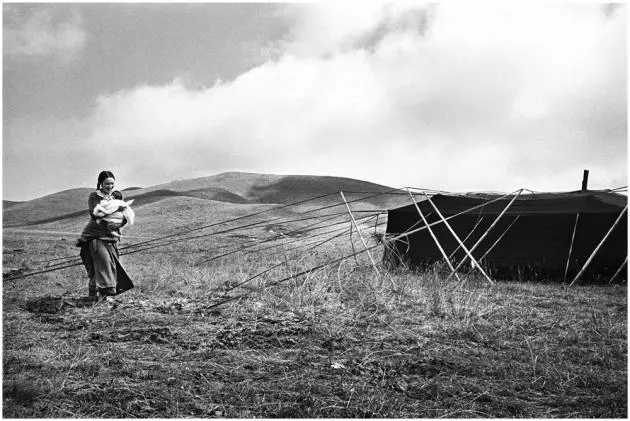
In another picture, a Tibetan woman holds her baby by a handmade tent. In the caption, she says: “I am just a temporary passer-by on this land ... after I have left, new leaves will grow, new sun will shine, and new children will be born.”
“These Tibetan people never stay in one place for more than three months, although there is no written law that requires them to do so. They naturally understand that staying will ruin the land and make it desolate in the long run. Protecting what is shared is simply a part of their lifestyle,” Park says.
Park himself has had a close connection with labour and workers. He rose as an icon of resistance against South Korea’s authoritarian regime in the 1980s with his poetry collection that shed light on the suffering of Korean workers, “Labour’s Dawn,” for which he served seven years in jail. Upon his release during the democratisation era, he began travelling abroad.
Through his exhibition, Park seeks to help answer the ultimate questions that afflict today’s generation distraught by competition, wealth and the drive for success: What is a good life? How should one live?
“Everyone has something that he or she wants. One’s path becomes clear only upon realising that one’s current path is not the right one,” Park says.
“I hope that by reflecting on the lives of these humble people, today’s generation can move away from a narrow vision of their own paths and find hope and meaning.”
RAISING HOPE
<< The exhibition runs until March 4 at the Sejong Centre Art Museum. Tickets are 5,000 won (Bt150, 3,000 won for students). Proceeds will be used to provide aid to the people in the photos
<< For more information, visit www.AnotherWay.kr.
