
Behind the 'Monuments Men'


Play
Washington's National Gallery played a key role in the World War II effort to save art
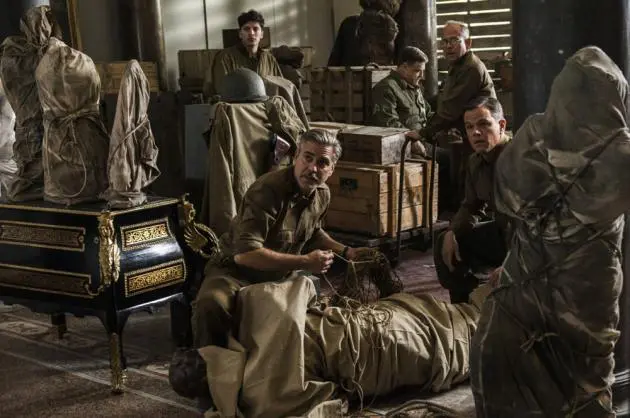
The inside story of “Monuments Men” can be found in the archives of the National Gallery of Art on the Washington Mall.
While the movie is about the work to save artwork and architecture during World War II, the story’s roots go deeper, into the annals and the leaders of the gallery during the war era.
While their roles don’t lend themselves to be played by stars like George Clooney and Matt Damon, without them there would be no “Monuments Men”.
“They were people who weren’t looking for recognition who worked behind the scenes,” says Maygene Daniels, chief of the National Gallery of Art archives.
Chief among them was the gallery’s then-director, David Finley, whom Daniels described as a “brilliant, fantastic figure” who knew how to make things happen in Washington.
The gallery was only in its infancy when World War II broke out, but it was in the centre of the capital where the US war effort was being run, situated between the White House and the Capitol building. Harlan Stone, chief justice of the Supreme Court, was not only a friend of Finley but a member of the gallery’s board of directors.
The seminal event in the formation of the “monuments men” came when Finley urged Stone to present the idea to President Franklin Roosevelt of a commission to oversee the rescue of European art.
Within months Roosevelt approved the Commission for the Protection and Salvage of Artistic and Historic Monuments in War Areas, and appointed Supreme Court Justice Owen Roberts as chairman. It became known as Roberts Commission.
Daniels describes the commission as a “superb scholarly group” whose knowledge of European art and architecture informed officers in the field.
The “monuments men” were aesthetes in uniform – art historians, curators, archivists and librarians. Six of them were associated with the National Gallery of Art prior to their service, and in later years three held important positions at the museum.
As the movie highlights, their key job was rescuing masterpieces from Nazi pluderers.
But before they got into the field, the commission had to persuade the US War Department to formalise its Monuments, Fine Arts and Archives programme.
It also had to locate the men – and a few women – who had the necessary background for the job, about 245 people in all, including some Britons and other nationals, Daniels says.
They were all uniformed soldiers, and the Americans among them were from all the branches of the US military. Most of them worked independently as “embedded” officers following frontline troops into war zones.
They provided information to military strategists, including details such as the locations of churches with spires tall enough to imperil Allied bombers and targets that should be spared because of their cultural importance.
When they came across things like a church damaged by bombs, their job was akin to applying first aid. When stashes turned up of art removed from museums, the finds were recorded and eventually delivered to collection points in Munich and Wiesbaden, Germany.
Their work continued after the end of the war and included cooperation with directors of German museums.
When Daniels considers their accomplishments, she quotes the 1946 report about the commission, which concluded: “The successful activities of these few men is out of all proportion to their number and their position within the military machine.”
As the movie opens in cinema, the gallery is unveiling an exhibit o that will highlight some of the experiences of real-life officers.
One of them was Lieutenant Charles Parkhurst Jr, who recorded an oral history for the gallery’s archives 45 years after his service.
The officers sometimes got clues from local residents, he said, describing how while pursuing a rumour he ended up at the foot of a hill surprised to find a full-size cast of Rodin’s “Burghers of Calais”.
Parkhurst, who became assistant director of the gallery after his military service, describes how he then went up a hill to a castle and found room after room of art.
“The owner of the castle gave me a cup of tea and a list of the objects,” Parkhurst recalled.
Then owner then added: “I’ve been wondering how long it would take you guys to get here.”
Men on the move
< “Monuments Men” opens in |cinemas on February 20.
