
Czech mate to the Grim Reaper


Play
A grisly secret lies waiting for visitors among Olomouc's gothic castles and cathedrals
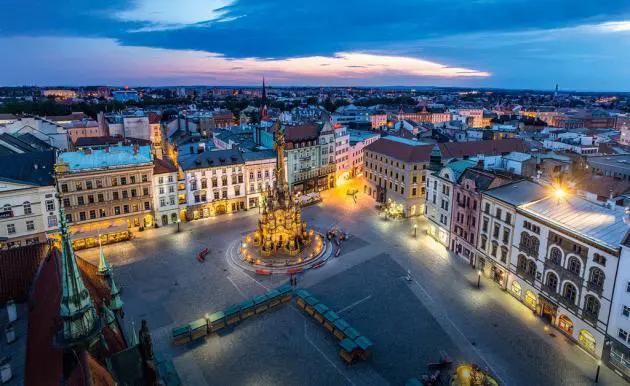
Setting out for a late-night stroll after hours of driving, we gasp in awe as we turn the corner into Olomouc’s town square. Rearing up in front of us is the ornate Holy Trinity Column, lit up like a vast candle of gothic gorgeousness.
Like almost every Czech city, Olomouc has a Marian Column to commemorate the end of the great plague, but here they decided to add something grander and so the Holy Trinity Column was built. Constructed from 1716 to 1754, at 35 metres tall and 17 metres wide, the column is the largest free-standing Baroque structure in central Europe.
Its three tiers are carved with statues and reliefs depicting 30 saints and apostles and the virtues of hope, faith and charity. Above them are representations of the Assumption of the Virgin Mary and the Holy Trinity. Its base houses a chapel. In 2000, it was declared Unesco world heritage.
Just across from the column is the town hall complete with an astronomical clock, one of only two in the Czech Republic, the other one in Prague.
The town hall dates back to the 14th century and has four storeys topped by a tower open to the public – although most people are either unaware of this or have no interest in climbing to the top.
Trudging up the stairs is not for the faint-hearted and by the time we reach the top at 75 metres, passing the watchman’s chambers along the way, we are puffing hard.
But the view is worth the effort: Casting my eyes below to the town square, I look up to see the whole city stretched before us, a skyline dotted with cathedrals and monasteries, as well as castles in the far distance.
Nearby is St Moritz, a nondescript church outside but a dazzling jewel inside. Although considered one of the country’s finest examples of Gothic architecture, St Moritz’s interior has been reconstructed in Baroque style. Entering the church, I bask in the glowing colours of the stained-glass windows, then explore the Gothic altar, 15th-century sculpture of Christ on the Mount and the pipe organ which, with its more than 10,000 pipes, is one of the largest in the world. The church hosts the annual International Organ Festival Music organised by the Moravian Philharmonic.
Within walking distance of the square is St Wenceslas Cathedral, the seat of Olomouc’s archbishop. Originally a Romanesque basilica, it was consecrated in 1131. After a fire in 1204 and many makeovers, it was reconstructed in the neo-Gothic style in 1883-1888. Its interior is just as impressive as its exterior.
Bone-chilling church
Venture just a little further from the town square and you find Olomouc’s most macabre memorial. I enter the Sedlec Ossuary to find thousands of skeletons welcoming me with open arms – literally. Here, the grisly remains of 4,000 people have been sculpted into chilling interior decor. A splendid chandelier composed of almost every bone in the human body hangs above my head. Surrounding me are two large bone chalices, four baroque bone candelabras, six enormous skull-adorned pyramids and a family crest in (you guessed it) bone. Festive bone bunting is hung throughout like crepe paper at a birthday party.
The ossuary has a long history, beginning in the 13th century when the Abbot of the Sedlec Monastery brought a handful of soil said to be from Jesus’s tomb back from Jerusalem. He scattered it across the Sedlec cemetery, securing its status as the most desired burial site in Bohemia. Everyone wanted to be interred in that handful of the Holy Land and more than 30,000 were. Soon, there simply wasn’t enough room for everyone to rest in peace, and the bodies were moved to a crypt to make room for the newly dead.
In 1870, a local woodcarver, František Rint was employed for the macabre task of artistically arranging the thousands of bones. Rint came up with the stunning chandelier as well as the amazing Schwarzenberg coat of arms, which includes a raven pecking at the severed head of a Turk – all made of human bone.
His artist’s signature is still on the wall – naturally, in his medium of choice, bone.
Just one hour by car from Olomouc is Bouzouc Castle. Perched on a hilltop overlooking a valley, the 14th-century castle has a fairytale look and has been used as a backdrop in a number of movies.
Built as a fort to protect the trade route between Olomouc and Bohemia, its battlements, bastions, oriel windows, gargoyles, watchtowers and drawbridges gives it a decidedly mediaeval atmosphere. Its dry moat was once used to breed bears.
These days it’s a tourist attraction, with one tour offering visitors an introduction to the secret world of dragons and dragon slayers.
Steeped in tradition and history, with an abundance of beautiful and important architectural monuments, it won’t be long before Olomouc becomes firmly planted on the global tourist map.
