
From Syria, art full of agony
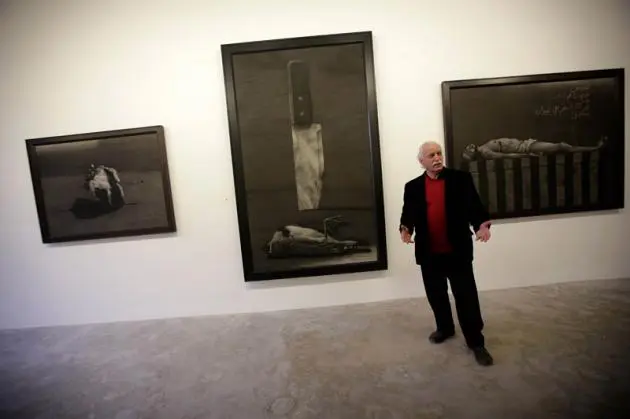


Painter Youssef Abdelke, jailed last year as a dissident, pulls no punches
SYRIAN PAINTER and dissident Youssef Abdelke offers a haunting vision at the Tanit Gallery in Beirut, Lebanon, of the war tearing his country apart, in which neither individuals nor symbols are spared from violence.
One painting shows a knife hanging over the corpse of a bird, another the empty gaze of the mothers of “martyrs” lost to the fighting, and a third a decapitated head.
The 30 canvases, etched in the former detainee’s minimalist style, offer a searing glimpse into a war that has claimed more than 136,000 lives and driven millions from their homes.
“There is so much destruction and blood,” Abdelke says. “We have to paint the human drama.”
The war “weighs heavy on the ideas and feelings of every poet, painter and musician”, adds the white-haired artist in his early 60s.
Most of the works are in his trademark black-and-white and were produced from the start of Syria’s uprising in March 2011 through last year, when he was detained for a month for peaceful opposition to President Bashar al-Assad’s embattled regime.
Among the most striking paintings are those portraying the mothers of “martyrs”. One shows a woman kneeling before a chair, over which a photograph of her dead son is placed. The mother clenches her hands over her mouth, struggling not to cry out in pain.
Another painting shows the empty stare of a mother carrying a picture of her dead son, her young daughter facing her with folded hands that convey grim resignation.
“The Martyr of Douma”, referencing the rebel-held area near Damascus that has been under an army siege for months, shows a severed head, its eyes wide open. “The Martyr of Homs” is a giant, severed hand drenched in blood.
“This is what my country has become – bloodied hands, severed heads, destruction,” says a Damascene woman visiting the exhibition, her eyes welling up with tears.
Amid all the bleakness is an occasional reminder of the hope that ignited the uprising, which began as a series of peaceful protests against the Assad family’s four-decade rule.
One painting shows a tiny butterfly perched on the edge of a knife, a metaphor for the fragility of the peaceful demonstrations, which gave way to an insurgency and then a civil war after the regime fired on protesters.
For Abdelke, “there are no frontiers” when painting war’s devastation. “When [Spanish artist Francisco] Goya painted the executions of ‘The Third of May’ he was actually portraying executions that take place in all wars, everywhere in the world,” and not just those that took place in the 1808 Spanish rebellion, says Abdelke.
“The more truthfully you paint, the more you move your viewers.”
Abdelke’s detention last summer sparked outrage among Syria’s intellectuals and artists, but he calls it “just a small detail in this terrible tragedy”. The long-time communist had been detained before, in the 1970s, under Assad’s father Hafez. He then moved to Paris for 25 years, only to return in 2005.
Not all Abdelke’s subjects are anonymous. One painting, “Hamza, Layal and the Others”, shows Hamza al-Khatib, a child brutally tortured to death by the security forces in Daraa province, cradle of the revolt. Khatib and another child’s body, wrapped in a shroud, are covered in flower petals.
Another painting shows Bassel Shehadeh, an iconic filmmaker and peaceful activist killed in an army offensive on Homs in 2012. Next to Shehadeh’s smiling face are a flower, a camera, an image of Che Guevara, and the words: “Our revolution is stronger.”
The exhibition continues until March 8.
