
A bite of Burma
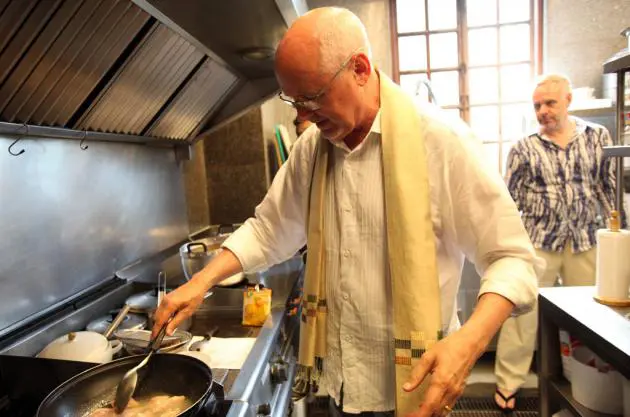


Myanmar's gourmet traditions from past to present are encapsulated in a new book
Myanmar's largely untapped culinary wealth is something that foreigners, even fellow Asians, tend to love or loathe. Blame it on the oiliness.
Robert Carmack and Morrison Polkinghorne, who refer to themselves as “globetrotting gourmets”, fall mostly into the first category and spent more than a decade travelling across Myanmar to find the best cooks, taste dishes and come up with rare recipes worthy of a 390-page cookbook.
Along the way, they discovered colonial era classics, restored their glory and inspired a new generation of hotel chefs. The result of their 15-year culinary adventure is “The Burma Cooking: Recipes from the Land of a Million Pagodas”, just out from River Books.
Classically trained and holding diplomas from French culinary institutes, US-born and Australia-based Carmack is the author of five cookbooks and a television food stylist who also writes about Southeast Asia. His partner Morrison, a textile designer, loves Myanmar’s art and crafts, especially lacquerware.
“The Burma Cookbook” explores Myanmar food over the past 100 years through lavish illustrations and well-researched text and looks set to herald a renaissance of colonial era favourites.
To understand Myanmar food, it’s necessary to first debunk its “spicy” myths.
For one thing, Myanmar food is not all that similar to that of its neighbours, especially those to the east.
Myanmar people like spices, Carmack notes, but their predilection will never be on a par with Thais or Indians because they only care about turmeric and paprika-like chilli powder and not much else.
They like pulses too, like the Indians. But to say the food is an Indian-derivative is wrong and unfair to both cuisines.
And there’s the greasy factor that’ll put any ghee-rich Indian favourite to shame.
Given Myanmar’s long isolation, its food remains largely a mystery to outsiders. Now, with tourism booming, visitors are eager to discover the delights of authentic Myanmar food.
“We visited the country for the first time in 1996. Locals were happy to see us in longyi. Old Yangon with its colonial architecture is still there, crumbling and decaying, looking more magnificent as a result. The Myanmar people have to be the most friendly in Asia, if not the world,” Carmack says.
Contemporary ethnic Burmese food embraces aspects of its neighbours while retaining a style distinctive to Burma alone. Dishes invariably boast an oily puddle seasoned with garlic, onion and ginger, which Carmack compares to Greek food, another cuisine known for dousing its herbs and fresh vegetables in oil,
Myanmar’s fondness for dried Indian spices is unquestionable, but only turmeric and chilli powder end up in the kitchens of this former British colony.
“The Burmese never depend on spices although Shan noodles so tend to have a sprinkling of Chinese five spices or masala, They rely on the subtle flavours of their rhizomes,” says Carmack.
Like Thailand, Myanmar people love citrus-flavoured salads that serve to cut the fat. But here the flavours are less assertive. Lime and lemon are used in less quantity than in Thailand, and likely to be tamed or melded with chickpea flour or ground peanut.
Carmack notes that the unctuousness does serve a purpose, namely imparting a protective coating against airborne spoilage in a country without reliable refrigeration.
And of course, there are the pulses, used generously in Myanmar but not in other Southeast Asia nations.
Carmack cites Myanmar cuisine’s relations with India to the west and China’s Yunnan province in the northeast as the reason why Indians and Chinese enjoy a Burmese meal in Yangon while most Thais instead come armed with their instant noodles.
Carmack says Myanmar uses more ngapi, or shrimp paste, (gapi in Thai) than in Thai food.
Thailand boasts a greater variety of fresh ingredients. But Myanmar has a richer reservoir of “heirloom crops”.
“Myanmar has Asia’s best potatoes,” he says, adding that he always orders French fries whenever he comes to Yangon. “The texture and the flavour is much better here. Potatoes grows well with the volcanic ash in the highland area.”
But it’s Myanmar cuisine’s colonial roots that seem to appeal the most to foreigners.
The two authors were allowed exclusive access to the Strand Hotel’s archives and unearthed historical menus along with a few Anglo-Burmese recipes.
Opened in 1901, the Strand best sums up Myanmar’s colonial legacy, with an aura of restrained gentility and an afternoon tea with cucumber sandwiches still being served to this day. In the olden days, the menu was very much a European affair with at most an Anglicised curry.
Today, the Strand is reviving such colonial-era classics as kedgeree, mulligatawny, colonial goose, Scotch eggs and Bombay duck.
“I think you will be seeing more and more of them, and new hotels and chefs are taking up these recipes. We met a chef who cooked Yorkshire pudding and roast beef up until the new millennium. Later we found his grandson and had him cook for us,” says Carmack.
The colonial period, Carmack explains, saw an over-representation of Indian and English flavours. In those days, Myanmar’s five largest cities were populated by an Indian majority, with the ethnic Bamar largely exiled to their country roots.
Even these days, it’s tricky to enjoy eating in Yangon without facing an angry backlash from local ingredients.
Carmack recommends only well cooked local fare, rather than the Western cuisine at five-star hotels.
“I hear through the grapevine that you’re more likely to have food problems at five-star hotels. The burger there is more likely to make you sick. A brilliant Swiss chef in Yangon told me there’s a hot trail and cold trail in the kitchen of (fine hotels). And in a country that has regular power outages, some don’t understand that sliminess [on the meat] needs to be washed off. Westerners have different hygiene and the Western stomach is more sensitive,” says Carmack.
For his part, Morrison loves exploring Yangon’s Chinatown especially on 19th Street: “The food can be a bit scary. In terms of hygiene, get something that’s hot. Generally everything’s fine.”
For Western food, check out Sharky’s on Dhamazedi Road near the Shwe Dagon, one of Carmack’s favourites, which uses local ingredients with a Western flair. “It serves better Western food than anywhere in Bangkok,” he asserts.
He also recommends enjoying or least studying the culture of local food.
“You can learn a lot of a country’s history, art and culture, how they ‘break bread’ together,” he says.
MYANMAR TREATS
“The Burma Cookbook” by Robert Carmack and Morrison Polkinghorne is available at bookshops and from River Books for Bt1,195.
