
Coming in from the cold


Play
There's more to spying than Snowden and the NSA
Long before most of us knew what the acronym NSA meant, spying was a normal, though little-mentioned tool of many governments around the world.
Traditional spies could only dream of the surveillance capabilities possessed by the National Security Agency, as revealed since last June by whistleblower Edward Snowden, but more rudimentary methods can be just as secretive and perhaps even deadlier.
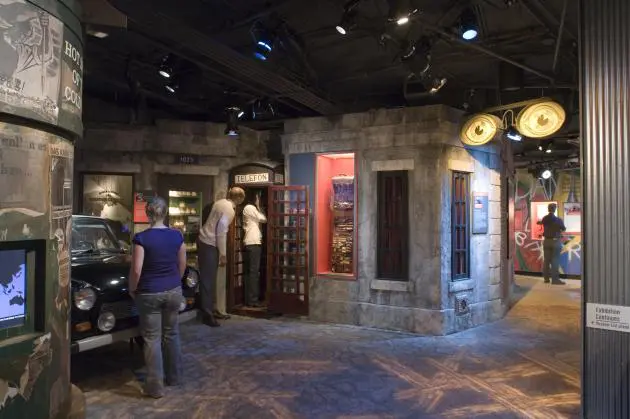
Just along the street from the FBI – the US counterespionage agency – tourists can walk into the International Spy Museum. This small museum is dedicated to showing who the spies are, how they are trained, how they work, and above all, how they survive. Or don’t.
The museum, which prides itself on being the only public museum in the United States dedicated to espionage, explains to visitors with a sign at the entrance that it makes no judgements about the political inclinations or loyalties of the spies. It simply showcases their capabilities.
The International Spy Museum opened in Washington on July 19, 2002 after six years of research and curating with the help of top experts: former directors or current high level officers from the FBI, the US Central Intelligence Agency, the Russian KGB, MI5 of Britain and other services.
From the start, the museum reminds visitors that espionage goes hand in hand with mystery, adventure and even romance. It is difficult to make a distinction between all those spy novels and action films we are familiar with and the realities of daytoday global espionage.
The Spy Museum recently opened a show on the "bad guys" in the James Bond films, including evil Raoul Silva in the latest feature, “Skyfall”.
It covers the history of espionage globally since biblical times up to the 20th century and focuses on legendary spymasters including Cardinal Richelieu of France, immortalised in The Three Musketeers by Alexandre Dumas, and Mata Hari, the Dutchborn dancer who was executed by a French firing squad after being accused of spying for Germany during World War I.
Among its many treasures the museum proudly displays a 1777 letter from George Washington in which he authorises an espionage network in New York.
The museum has one of the legendary Enigma machines used during World War II by Nazi Germany, which was unaware the Allies had cracked its code. That breach changed the course of the conflict.
The museum has collected videos and sound recordings of “real” spies who tell their stories of how they were able to pull off risky missions, among them the evacuation of a group of US diplomats hiding in the Canadian embassy in Iran in 1979 after Islamists took over the US compound. Ben Affleck turned that exploit into the Oscar-winning film “Argo” two years ago.
Included in the museum collection are some of the props used in the movie. Truth can be stranger than fiction at the Museum.
It boasts “the largest collection of international espionage artefacts ever placed on public display”, many of them seen for the first time.
Among the odd items: microphones hidden in fake tree trunks, cameras camouflaged in tobacco packets and a tiny pistol in the shape of a lipstick tube, dubbed the “kiss of death” by KGB agents who utilised it.
Alluding to the 1960s US television comedy series “Get Smart”, the museum has a real shoephone.
KGB experts inserted a transmitter, a microphone and batteries into the heel of a shoe belonging to a Western diplomat so they could listen to his conversations and meetings.
There is no time for boredom as each room includes interactive games for visitors: a favourite one being how to deactivate a bomb in a few seconds. “The world is counting on you, don’t mess up,” warns the game screen.
Another test is a challenge involving different images for the viewer to discover who is spying on who.
And for those doubters who question whether movie spy heroes would really be able to endure extreme physical stress – such as hanging from the edges of skyscrapers or dangling from cranes – there is a machine called Your James Bond Moment that lets a visitor test his or her stamina.
A museum employee encourages visitors to try out the mission, which involves hanging from a beam at a short distance from the floor while being buffeted by strong winds, as if the person were hundreds of metres above the ground. She times the grip with a stopwatch.
Usually they let go after a few seconds.
The games are not only for young children. Older kids and even adults have fun as they feel the excitement and satisfaction of being a spy.
With so many attractions, the Spy Museum attracts visitors in droves: around 700,000 a year, according to media reports.
Overall, a record 18.5 million people visited the US capital in 2012, the most recent year for which statistics are available and listings by the Washington Post and Time magazine rate the Spy Museum among the top sights in the city.
