
Shards of broken dreams


Lek Kiatsirikajorn photographs the ambitions - of people and a country - that got "Lost in Paradise"
Bangkok residents know better, but for many people upcountry, the capital is paradise, the promised land of fame and riches – or at least an improvement on their own bleak and withering rural landscape. Photographer Lek Kiatsirikajorn has witnessed their disillusionment once they reach this false paradise, though.
In a series of photos on display at Bangkok’s Kathmandu Gallery and the Quai Branly museum in Paris, upcountry people of various ages wander through the metropolis treading on the shards of broken dreams.
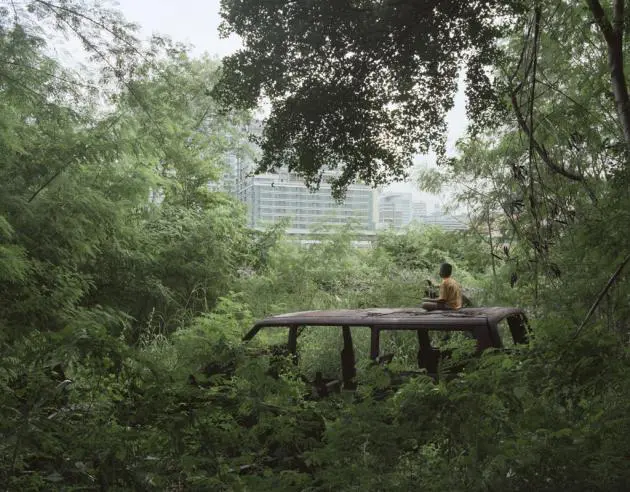
One youngster from Ayutthaya, Weerapat Srivichien, sits alone on the roof of a ruined car, gazing out of a green oasis he’s found, at the skyscrapers along Rama IX Road. Boonsri Puangklang, 63, from Nakhon Ratchasima, crosses the Chao Phraya River to pick vegetables to sell.
Elderly security guard Tongleang Keawsai from Yasothon is pictured among rows of abandoned townhouses in Pattanakarn where some folks squat illegally. Middle-aged Wachira Tonheng from Chachoengsao stands with his small daughter in the construction site where he’s the foreman, looking at a temple set against the distant city skyline.
Lek’s exhibition “Lost in Paradise” has only eight shots at the Kathmandu. The other 13 he produced for the series belong to the Quai Branly, which bestowed a grant for the three-year project. He delivered the goods to Paris in October.
Lek, Argentinean Hugo Aveta and South Korean Che Onejoon shared the Branly’s “Les Residence de Photoquai” grant in 2012. Lek had been invited to exhibit at the Photo Quai festival the year before.
He’s aware that he’s produced more than just photographs. The series is a stunning social statement and a valuable documentation of the plight of migrant rural people who work hard for their living in Bangkok.
Lek, 37, in fact offers an allegory on modern Thailand, a country that left its agricultural past behind in search of wealth and now, disappointed at falling short, laments its lost history.
“At the beginning I only wanted to portray the contrast between nature and modern development in Bangkok by photographing just landscapes,” says Lek, who has a master’s in photography from the Arts Institute in Bournemouth, England.
“My interest shifted when I met migrant workers and started talking to them. Some of them had only been in Bangkok for a couple of years, some had lived here a long time and some were the descendants of migrants. They go to certain places around the city for food and leisure, but some also live there, temporarily. These places are their sanctuaries in the modern city.”
During his last two years in England, Lek became fascinated with the great American documentary photographers like Walker Evans, Stephen Shore, Joel Sternfeld and Alec Soth. He was inspired by their strongly visual yet utterly personal portrayals of society.
Having been an expatriate gives Lek a different view of his homeland too. On his return in 2008 he became aware of aspects he hadn’t seen before, enabling him to portray Thailand in a more “universal” way. His shots of the 2011 flooding became the fascinating collection “Flowing through the Wreckage of Despair”.
For “Lost of Paradise” he spent quite a bit of time with each subject. He had them pose with backs turned to the camera to suggest a distant gaze, off toward the imagined bright future of the metropolis. The photos are displayed without captions, but the exhibition booklet expands somewhat on the stories behind the images.
As for Weerapat, seen perched on an old car, Lek explains that his parents came to Bangkok from Ayutthaya many years ago and the boy now attends secondary school. “I met him while he was helping his mum sell jasmine garlands in the road.”
The Paris museum has a picture of elderly Suchai Tarmart reclining in a beat-up beach lounge, under a tree in Klong Toei. Lek says he moved to the capital 40 years ago from Nakhon Sawan with his parents and now sells noodles. He’s living in a small shelter until he can move to his son’s house, also in Bangkok.
Lek was curious to see a young man fishing in the big city. It was routine stuff, though, for Kai from Tak, who was living in the Charoen Krung area when they met in 2011. Kai was 29 and had been in Bangkok for five years, labouring. He relied on the fish and naturally growing fruit and vegetables for his meals.
“When I first saw him he was aiming his slingshot at a mango tree to knock down some fruit. He told me he missed his home in Tak, but there was no choice but to leave. He had to come to Bangkok for work because there was no work at home. He was sending money home every month, even though his income was so low.”
Lek’s picture of Kai shows him, fishing rod in hand, hoping for a catch in a swamp, surrounded by sedge, an acute contrast with the urban skyscrapers on the horizon.
Lek regards agriculture as “the taproot of Thailand”.
“Nearly half the population are farmers. Our tradition and culture are directly related to it. In the 1980s the government wanted Thailand to become the fifth tiger of Asia – the fifth industrialised, developed country, after Hong Kong, Singapore, South Korea and Taiwan.” The resulting legislation brought a surge of foreign investment but also a sharp decline in the agricultural workforce. Industries took over vast areas of farmland, he notes.
“Young rural workers head to the big cities for jobs in factories and other industries, so farmers have to continue working in the fields until they get too old to work, and then there’s no one to pass on their wisdom to. The decline of agricultural resources is one of the major problems Thailand is facing today.”
Three decades into the government’s ambitious push for progress, “We still haven’t reached our goal of becoming the fifth tiger of Asia – not even close,” Lek notes.
“Instead, our taproot has rotted away. The migrant rural workers are like Thailand. They left their past for Bangkok in the hope of a better future, only to find themselves at a standstill, stuck in the middle between their long-lost past and their unobtainable future. Only time can tell how long this big tree of Thailand will still be able to stand.”
URBAN STANDSTILL
“Lost in Paradise” continues through April 27 at the Kathamandu Photo Gallery on Silom Soi 19, near the Indian Temple.
For details, see www.LekKiatsirikajorn and www.Kathmandu-Bkk.com.
