
The Lady speaks out
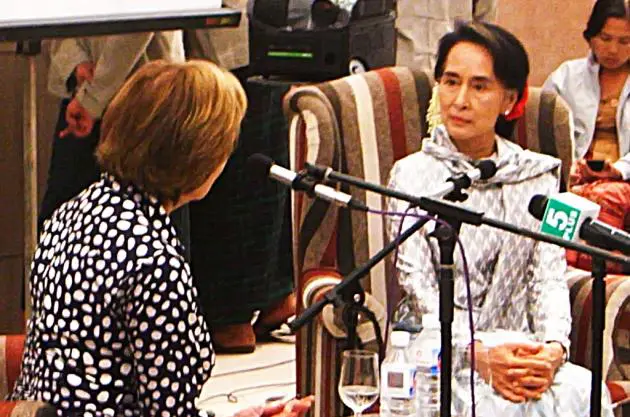


Aung San Suu Kyi discusses her private life as well as democracy and religion during a guest session at a literary fest
There is little the world doesn’t already known about her private life but Daw Aung San Suu Kyi nonetheless lifted the lid on her privacy to reflect her attachment to Buddhist and democratic values during her recent appearance at the Irrawaddy Literary Festival in Mandalay.
Suu Kyi was at the festival as both its patron and as a speaker, joining two sessions at which the fans were so numerous that a gigantic video screen had to be mounted on the outside for those who couldn’t squeeze their way into the conference room.
However, her presence disappointed some media members because the Lady stopped short of alluding to hot issues in her own country. Perhaps, though, that was predictable given her stance on certain subjects.
For the most part though, Suu Kyi came across as first and foremost a politician with a strong sense of duty, an erudite orator, a practising Buddhist, a voracious reader (she picked Elizabeth Bennett as her literary heroine) and a good cook.
Arriving in her traditional outfit amid tight security for the “In Conversation” session chaired by Dame Joan Bakewell, Suu Kyi was all smiles. The questions from Bakewell covered Suu Kyi’s family life, upbringing, her education in Burma, India and England and her political aspirations.
Suu Kyi regarded her mother Khin Kyi as the family’s breadwinner following the death of her father, who was assassinated in 1947 when she was a toddler. She grew up reading Myanmar poetry and, as a youngster, political books left behind by her father and hearing stories about how much he loved his country.
She said people of her father’s generation were characterised by their liberal views towards the world.
“I don’t think one can inherit views, but I was influenced by his views. My father’s generation was very open-minded, wide open to new ideas. And that lives on in certain people, especially among the older generation,” she said.
And politics has always been a subject dear to her heart. When her mother was ambassador to India, Suu Kyi studied politics at the Convent of Jesus and Mary School in New Delhi. By the time she went to Oxford, she was already familiar with British democratic tradition.
“If you read PPE (Philosophy, Politics and Economics) at Oxford, then you have to read political books about the British democratic life,” she said.
Her time at Oxford enforced her democratic values, which she has tried her best to spread to her own country. As for growing democracy in Myanmar, Suu Kyi doesn’t see it as her political destiny, but more of an individual’s duty and responsibility.
“A sense of duty means you think of people, not about yourself, not only you. In fact, with a sense of duty, you understand you do not live alone in this world. There are others in this world and you have to think of those others and see what you owe to them, what you can share with them.
“I’ve tried to explain to my people what the democratic values are. They are about being open to new ideas. In the 2012 elections, I explained why they have responsibility to vote, as part of their democratic rights. Rights entail responsibility. Discovering the concept of voting is part of individuals’ responsibility,” she said.
Her comments turned the remainder session into a lengthy debate about democracy.
Bakewell pointed out how Myanmar’s quest for democracy had parallels in South Africa, which also the emergence of a key figure from private to public life.
“Those parallels are exaggerated. To begin with, perhaps our struggle for democracy would have been a lot easier if all those who wanted democracy were a different colour from those who didn’t want democracy. Then it would be a case of colour discrimination. But that makes life a lot easier. Because we are the same colour, it means there is confusion with regard to values, commitments and support,” she said.
Asked to define democracy, Suu Kyi didn’t hesitate.
“The simplest definition is the rule of the people, the government of the people by the people for the people. Put this way, it’s respect for the people at large, the general public. That means basically respect for human beings and human rights,” she said.
With prompting from Bakewell, the topic then turned to religion.
“I’ve learned to understand Buddhism is a peaceful and serene religion. But how does Buddhism play out politically?” she asked.
“I don’t think Christians are quite Christian in their political lives,” Suu Kyi relied with a smile. “So Buddhists are not necessarily Buddhist in their political life, or even in social life. People ask me, ‘are you a Buddhist?’ My answer would be I’m studying to be one, to be a better Buddhist. I’d like to say I’m a good Buddhist, but I’m not in a position to say I’m a good Buddhist as I’m trying to learn to be one.”
Buddhism was what she turned to while under house arrest, and even today she tries to include meditation in her everyday life.
To her, meditation is central to her awareness both of her own mood and those of other people.
“Meditation has taught me tremendous awareness of getting annoyed, getting tired and feeling better. I meditate unless I’m lazy or tired, mostly once a week,” she said.
“I was born into a Buddhist family. Buddhism is rooted in a practical cause. It’s about the discovery of what the human mind and human beings are like. The more I meditated, the more I learned of how true to life Buddhist teachings were.
“For example, I’m very fond of the teaching that explains how to distinguish a good man from a bad man. A bad man always exaggerates his good points and minimises the good points of others. A good man does it the other way around. And a bad man will always exaggerate everything people say to him in gratitude. It’s a very simple bit of teaching. I’ve found that very human. And believe me, I can tell a good man from a bad man.
As the session moved on to the topic of development, Suu Kyi noted that she sees many of the good men working in her country. Poverty could be an enemy of democracy.
“I’m not unaware of some mega-rich individuals who have done a lot to try to make the situation of the very poor better. So I don’t think we can forget that.
“I hope development in Myanmar will be an inclusive kind, not the kind that some people get richer and richer and those at the lowest level stay exactly the same,” she said.
