
When the old is made new


Play
The classical Jim Thompson House is the apt setting for an art show about "reconsidering
THE JIM THOMPSON House in Bangkok, that bastion of charming Siamese tradition with its splendid architecture and antiques assembled by the late American “silk king”, is hosting an exhibition that takes a fresh and very modern look at what he wrought.
In “Transmission” – the show continuing through August – seven artists from across Southeast Asia utilises various media, from woodwork and painting to video and sound installation, to explore what might be “renewable” in the old wisdom.
Australian-Chinese David Teh from the National University of Singapore was selected as curator because he’s been “inside” – five years in Thailand – and has an “outside” view of contemporary Southeast Asian art.
The Jim Thompson House and museum provided “the resource for thinking”, says Gridthiya Gaweewong, director of the art centre at the compound on Soi Kasemsan 2. And the exhibition offers a “conceptual interface between cultural heritage and contemporary art”.
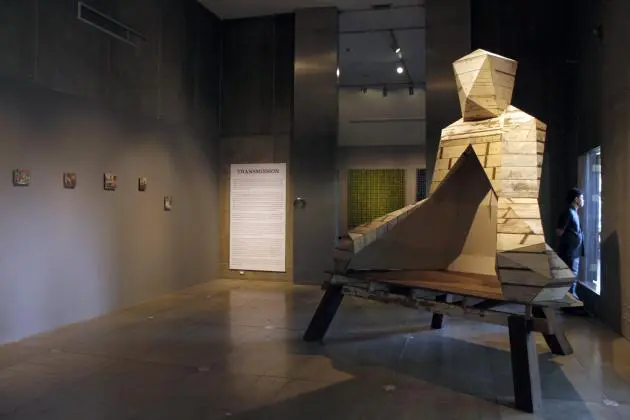
A Vietnamese collective called the Propeller Group – Phunam, Matt Lucero and Tuan Andrew Nguyen – have erected an elaborately carved jackfruit-wood sculpture at the entrance. “Antique Space Debris” looks like it might be a priceless artefact with its carving borrowed from Hue, Vietnam’s imperial city. But there’s no authenticity to it, and that’s the group’s point. For an explanation, see also their short video screening in the adjacent room, “Fade In: Ext Storage – Cu Chi-Day”. This is about colonialism and falseness.
The video tells the story of an attempt by the Danish collective Superflex to send it some “art” in Vietnam – wooden toy guns from a Dutch museum. Customs officials in Ho Chi Minh City blocked the replicas, and we end up seeing them being carted around a storage facility while an artist tries to explain to a FedEx employee by telephone that they’re only props for a show. The punch line is that these items followed the same trade route – in reverse – that the Dutch used to fill their museum with prized porcelain from China in the 17th century.
Meanwhile Thailand’s Thakol Khao Sa-ad, who comes from a woodworking family, found his inspiration in the Jim Thompson residence itself, which comprises six entire or partial old houses purchased in various places and reassembled in Bangkok.
Before the world went metric, Siamese builders used the anthropic system of measurement. Thakol has set out on a table eight pieces of wood, each one sok in length – as long as a forearm – but who’s forearm? He measured eight friends’ forearms and cut the timbers to match, and of course they’re all different lengths. The same holds true throughout the classical Siamese house, in which measurements corresponded to various parts of the human body.
In showing how international standards compare to local and even “personal” standards, Thakol has also hung a one-wa-long piece of wood. Four sok equals one wa and is the equivalent of two metres. Putting the display in context, he’s laid another table with his hand-made carpentry tools.
Another Thai, Suwitcha Dussadeewanich, has erected a sala-like structure in the compound that resembles in shape a statue of the Buddha. “Reconsider”, adorned with aged timbers from an abandoned school and house, suggests that sacred power stems not from art’s finery, but from its social context.
Gridthiya points out that the Jim Thompson House is architecturally a Thai house, but its functions met Western needs, including indoor toilets and air-conditioning. “A drum has become a lamp stand, for example. Thompson interpreted the Thai house in a new way to match his Western lifestyle, and his interpretation is one thing should ‘reconsider’, as Suwitcha’s work suggests.”
Sakarin Krue-on’s 12 small paintings, tempera on wood, reproduce murals at Bangkok’s Wat Suthat and Wat Suwannaram that depict everyday life in bygone times – children at play, women swimming in a canal. The social hierarchy is adhered to, though, with images of monks occupying a higher level.
Sakarin has been studying the Thai paintings that Jim Thompson collected, which generally illustrate the life of the Buddha or the legend of Prince Vessantara, but Thompson too enjoyed scenes of the common people, whether threshing rice, shopping in the market place or even giving birth.
Nick Chan of Singapore fills the gallery with a dynamic environment of ambient sound recorded around the house, art centre and garden, but it’s designed to respond subtly to the visitor’s presence, right at the edges of the audible spectrum. Natural and man-made sounds become indistinct.
Indonesian Albert Yonathan Setyawan draws on the repetitive patterns of bencharong chinaware, but in his ceramics forgoes its multiple hues in favour of pure white. Flora and fauna motifs merge, suspended between gravity and flight. He also shows two meticulously drawn renderings of bowls and flowers, deploying gouache and gold paint on wood and paper, all delightful reminders of the effort that’s required in manual reproduction.
“Undergrowth” and “Flowers in the Planes”, two huge paintings by Cambodian Sopheap Pich, dominate one wall. He works primarily with materials plentiful in his homeland: rattan, bamboo, burlap and beeswax, and makes pigments from the earth.
Sopheap too asks questions about modernity and global standards, and here offers grids of bamboo behind which are abstract paintings on burlap. The grids look identical at first, but seen closer are quite different in size. That’s the skill that’s possible in making things by hand. No precision measuring devices or machinery is needed.
THE PATH TO THE PAST
>>The exhibition “Transmission” continues until August 30 at the Jim Thompson Art Centre on Soi Kasemsan 2 near the National Stadium BTS station.
>>The centre is open daily from 9 to 5.
>>Find out more at (02) 216 7368 and www.JimThompsonArtCenter.org.
