
An art in its own right


Play
A Vienna gallery welcomes copyists
Faking an old master is not a crime: In the Austrian capital Vienna, it’s a legitimate way to reproduce great art, conducted with the full knowledge of the city’s celebrated KHM art gallery.
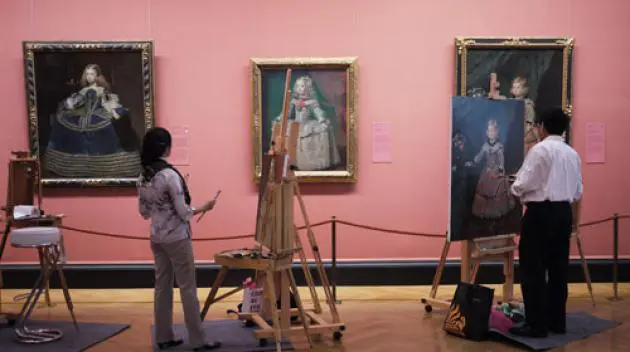
A delegation of top Chinese painters was in town recently honing their western brushwork technique the traditional way, standing at easels in front of paintings by Velazquez, Vermeer and Bruegel and painstakingly copying.
Students, pensioners and professional artists all copy at the KHM or Kunsthistorisches Museum.
Brigitte Humpelstetter, 77, a self-taught Austrian artist, has been copying an original Bruegel painting, detail by detail. She has been at it almost every day for the past six months.
“I have plenty of time,” the pensioner laughs.
It’s her second time reproducing “The Hunters in the Snow”, painted in 1565 by Pieter Bruegel the Elder.
The hounds, hunters and skaters are first sketched with a fine pen, the blazing fire has yet to be added. But the landscape already seems as freezing cold as in the original.
For 20 years she has been coming to the KHM and has not grown tired of the almost 1,000 Old Masters in the museum.
“My husband likes beautiful women. For him, I painted the ‘Portrait of a Young Venetian Woman’ by Durer,” she says.
Often she used to be the only copyist in the magnificent building, but things have changed since 13 Chinese artists settled in to develop their painting skills.
“It is as if Vermeer were driving a car in front of me. I follow him and try to understand why he has taken the route he is driving,” explains portrait specialist You-Yong.
The 26-year-old from Beijing feels awe at being face to face with the original Vermeer.
He’s only been at the Vienna museum for two days, but in the eyes of many of the museum visitors, he has already perfectly captured the painting by the Dutch master that he’s copying.
Why Vermeer?
“Velazquez was already full.”
His Chinese compatriots love the Spaniard, whose work plays an important role in calligraphy education.
Also at work in the gallery is Danqing Chen, probably the most prominent of the visiting Chinese artists. The 61-year-old’s paintings of Tibet are well known. He has lived in New York for the past 18 years and his paintings are highly prized at home in China.
Twice so far he has copied the “Infanta Margarita Teresa in a Blue Dress” by Velazquez, both times working from reproductions.
“Seeing the original shows me how clumsy I was,” he says.
His work, which he expects to complete inside a week, is not intended for sale. “This is for my own pleasure and that of students in China,” he says.
That isn’t always the case. Most copyists sell their work and can charge 10,000 euros (Bt448,000) or more for a good reproduction.
“We don’t ask what happens to the copies,” says Christine Surtmann, assistant to the museum director.
Every copy made has been meticulously recorded in a register for over a century. Thousands of paintings have been copied since the foundation of the KHM 120 years ago.
The records show that copyists have become rarer since the 1960s. In better times, the income is probably not worth the long hours at the easel, Surtmann says.
As well, copying the Old Masters doesn’t play much of a role any more in art education these days.
“Today that is unfortunately ignored,” says Marcela Chiriac. For three weeks the 21-year-old Moldavan has been working on copying “Cupid Making His Bow”, a painting by Italy’s Parmigianino from around 500 years ago.
“To capture the luminosity is particularly difficult,” says the young woman, who for the past two years has been funding her studies by copying paintings at the KHM.
In a couple of weeks Cupid’s curly locks and shining skin should look just like the original.
Copying is an art in its own right.
“One mustn’t copy what one sees. The understanding must go much deeper,” Chiriac says.
