
Getting to the bottom of a problem


Play
Impacted anal glands is a condition found prequently in dogs through less of ten in cats. But felines do suffer from the problem
IN MY household, just when one health problem is solved, another appears.
At least, so far, all the news is good. The kidney stone we found in my poodle pup Wan-Wan a few weeks ago is so small that the vet thinks it will eventually dissolve, as long as I feed Wan a special “urinary food” for dogs with problems like hers.
We’ll know in three months, when she’ll be checked again.
Then, as I do the daily cleaning, I find cat poop outside the litter tray, right on the floor.
None of my cats has ever had litter tray problems like this, even when they had diarrhoea. I have no idea who it is, except for sure it’s not Phantom. The poop of this eight-kilo cat is much bigger than what I find on the floor.
Usually, when a cat stops using a litter tray, you first think of behavioural issues. Anxiety, fear, territorial problems - any one of these might drive a cat to urinate and defecate on the floor instead of in the tray.
Then, one morning, I notice that brat cat Yoyo is constantly cleaning himself under his tail. When I look, I find a puncture wound on his rear end. It’s red and puffy.
I think one of the other cats, probably Wild Child Menohra, got him with a tiny claw, and now, he has a puncture wound on his rear end that must be treated immediately.
When the vet sees Yoyo’s painful bottom, though, she doesn’t blame Menohra.
“Yoyo’s anal glands are impacted,” she says. “They’re filled up.”
Anal glands are actually sacs, one each on either side of the anus, filled with a bad-smelling liquid that is normally released when a cat or dog poops. Lots of mammals have anal sacs, not only cats and dogs but humans too. The animal with the most famous pair of anal sacs is the skunk, that pretty little North American animal who shoots unforgettably bad-smelling liquid from its anal sacs directly onto its enemies.
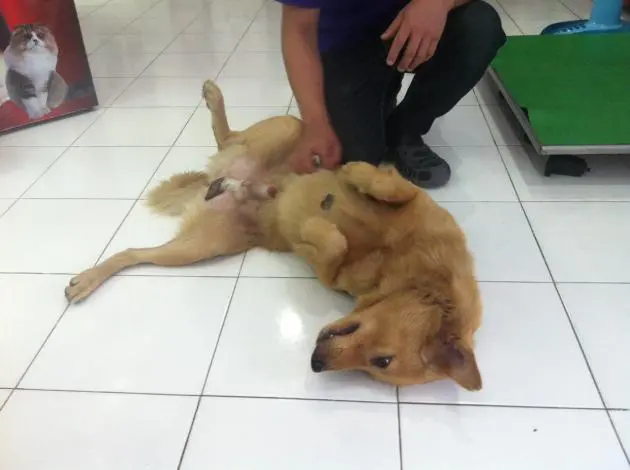
My doggie Wan has had problems with anal glands ever since she was a puppy. When she stops enjoying her walks, when she gives me looks of pain and discomfort, I know those glands are impacted, and I have to take her to the vet, who has the unpleasant task of gently squeezing her bottom.
During what the vet calls “expressing the anal glands”, that bad-smelling liquid comes out. When it’s completely removed, Wan returns to her happy self.
Some dogs are like Wan and have constant problems with their anal glands. If you see your dog constantly cleaning himself, or scooting on his rear end across the ground, or, like Wan, not moving too much, he might have impacted anal glands. Don’t try squeezing the glands yourself. It’s a painful procedure and requires an experienced vet.
Cats seldom have this problem, but here is Yoyo, and his anal glands are causing him a lot of discomfort, the reason he hasn’t been using his litter tray.
Worse yet, that liquid has pushed through the gland, causing that puncture wound. He has to stay at the clinic, so that the vet can express his glands every day, ensuring that the wound heals only when his glands are completely clean.
That puncture wound constantly closes over, keeping the anal glands from emptying properly. The cat has to undergo another painful procedure when the vet opens up the wound every day.
The poor cat stays at the clinic for more than a week. When he finally comes home, he wanders around the house complaining about his experience to anyone who’ll listen.
At least he’s okay now, in the end.
