
'Flood Fighter' is no Child's Play
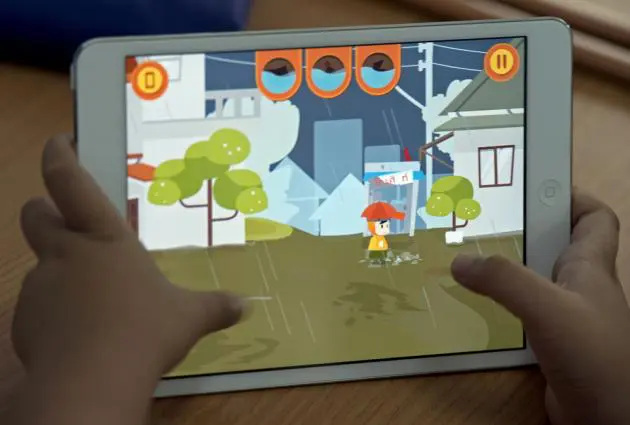


From out of the 2011 deluge, UNESCO's game spreads across Asia, teaching survival tips
DODGING ELECTROCUTION, drowning and even crocodiles, the virtual hero of the mobile game “Flood Fighter” aims to educate children across Asia about the perils posed by Mother Nature.
More than 800 people, including dozens of children, were among the victims of devastating floods that hit Thailand in 2011, affecting 65 of 77 provinces.
In an effort to prevent further deaths, the United Nations Educational, Scientific and Cultural Organisation – Unesco – hatched the idea of a free educational mobile game-app to spread the word.
“In Thailand everybody has a mobile phone, so why not convey our message through an application?” says Ichiro Miyazawa, who oversaw development of “Sai Fah: The Flood Fighter”.
The free download for phones and tablet computers has proved a hit in a country that in 2012 had almost 130 mobile-telephone subscriptions per 100 inhabitants, according to the International Telecommunication Union.
Just a few weeks after its launch in January, the game topped the charts for educational apps in Thailand, with more than 22,000 downloads.
The concept is simple: The house of Sai Fah, whose name means “lightning”, has flooded. He must complete missions during 22 episodes before, during and after the rise in the waters, each one carrying a message of prevention.
The tasks include stocking essential items, putting important belongings high up, not drinking water unless it’s been boiled first, cutting the electricity supply, and avoiding snakes that have been forced from their natural habitat and crocodiles that have escaped from farms.
Ayutthaya province, where the game is set, was particularly badly affected by the 2011 floods. Homes, temples and car factories were underwater for weeks. In the district of Ban Praek, which Unesco officials visited to promote the game, memories of the disaster are still raw.
“The water came up to my head,” says Nittaya Soponpit, director of a community education centre. She believes the game will help children to be ready for any repeat. “They will know how to prevent, how to prepare, how to handle floods.”
Some of the game’s lessons appear to have already been learned. Next time “I will prepare drinking water,” says 17-year-old student Kitkanok Klungnumkoo after trying out the game at a demonstration by Unesco.
“I’ll follow the advice of the game by cutting the electrical circuit,” adds Pornnamphet Sainet, 10. “I was scared the water wouldn’t go down. I still don’t know how to swim!”
“Sai Fah” isn’t meant to be a substitute for swimming lessons or lifejackets in a country where most children cannot swim. But its message is simple, says Miyazawa: “Just stay away from the water as much as possible.”
In the game, the small boy wearing a red umbrella hat must use a stick to test the ground in front of him and avoid falling into a hole or being swept away by floodwaters.
After its success in Thailand, a recently launched English-language version of the game aims to spread the message in other Asian countries affected by floods, such as Bangladesh, Indonesia, Myanmar and the Philippines. At least 4,000 downloads were recorded in the initial weeks.
Annual monsoon rains that regularly cause floods drench those countries. Rapid urbanisation, deforestation and poorly designed infrastructure aggravate the problem.
While the new version is not in their mother tongue, children who play video games are usually capable of understanding instructions in simple English, says Nathalie Sajda, project manager at Opendream, which developed the game for Unesco.
And while some cultural and environmental references might be specific to Thailand, “there are some lessons that are universal”, she adds.
“They might not know the temples of Ayutthaya, but at least the design is very cute. It’s playful and fun, and that’s the most important thing – that people enjoy playing.”
The biggest challenge for developing a video game is how to win people's attention, Sajda says. “Children these days have very high expectations of games.”
While the game developer has previous experience on similar projects, such as a sex-education game, for Unesco it was uncharted territory. “There’s big potential in gamification,” says Miyazawa. “Why not create a game that can promote peace, or one about gender violence? We can do a lot through mobile phones and applications.”
