
Anyone who had a heart


Play
Waiting's the worst part for boy in desperate need of a transplant
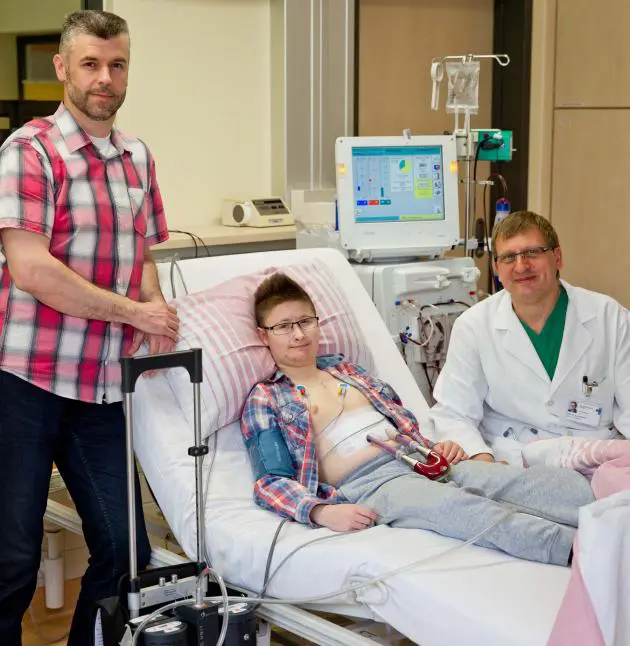
Marc Vales’ second heart weighs more than 10 kilograms and is mounted on wheels. It goes wherever he does, and though it keeps him alive, it also gets in the way of a 15-year-old boy’s life.
“I’d like to ride a bicycle or play table tennis. Or go on holiday,” Marc said. “But I can’t.”
Vales is from the Bavarian town of Amberg and has been waiting for a donor heart for more than a year. He has had six major heart operations, and since his kidneys don’t function properly any more either, he has dialysis treatments three times a week.
He is not giving up. While the dialysis proceeds, his external heart – the size of a small trolley bag – does its pumping, nurses monitor the data and the youngster concentrates on mathematics exercises. In just a few weeks he plans to take his exams for graduation from secondary school.
Vales has a congenital cardiomyopathy, a weakness of the heart muscle. Though very rare, “it’s the main cause of heart transplants in children and adolescents,” says Sven Dittrich, head of the department of paediatric cardiology at Erlangen University Hospital in Bavaria.
“Cardiomyopathies are killers,” Dittrich explains, noting that the symptoms often go unrecognised at first. “Who expects a child to have a heart problem?”
At the age of 9, Vales got his first heart pacemaker, and it served him well for five years. But in November 2012, his heart’s weakness showed itself with a vengeance. During a traineeship at the company employing his father, a mechanical engineer, Vales continually felt nauseous.
Initially everyone suspected influenza, but when his condition worsened, a paediatrician examined his heart and sent him straight to a hospital.
Upon hearing the diagnosis, “Our world fell apart,” says his mother, Claudia, 43.
Ups and downs for Marc and his family followed. He underwent several operations, one of which went very badly, his liver and kidneys failing and his entire body turning blue. Since then he has required dialysis.
“We’ve been told four times that he wouldn’t make it, and each time he made it after all,” his mother says.
“The disease’s course has been extreme,” Dittrich says. “Marc not only needs a new heart, but will also need a kidney transplant at some point.”
He was in the intensive care unit for 11 weeks and spent nearly a year in the hospital in all. Losing patience one day, he burst into tears and said, “Mama, I want to have a new heart at last.”
A 5-year-old girl with an artificial heart shared his hospital room. “He saw that he wasn’t alone,” his mother says.
In January 2013, Marc was put on a waiting list for a donor heart. And he received his artificial heart to bridge the time until a transplantation of a real one.
“I’ve always told him he’s got to see the machine as his best friend, because without it he wouldn’t be around any more,” his mother says. In November, Marc was allowed to go home.
“That,” his mother says, “was a ray of hope” – and quite unusual as well. “A child with an artificial heart has never been at home before.”
Dittrich agrees that it was unusual. “After long discussions, we entered some uncharted territory with Marc,” he says.
The move seems to be working. “At the moment,” says the youngster, “I’m doing well again with the device”.
Several times a week he has to lie quietly for hours, and day and night the complicated contraption consisting of a pump and tubes is attached to his midriff. The strapping makes it hard to take a shower, and going to a swimming pool is out of the question.
“I can’t simply visit friends,” he says. So they come to see him.
He stopped going to school a year and a half ago. Teachers have been giving him lessons in German, mathematics and English at home and in the hospital. When he is at home, either his mother, father or a nursing service staffer has to be nearby. Every day he has to take medications.
“A whole boxful,” says his father, Andre Vales, 45.
“You’ve got to adjust,” he says in describing the situation. He no longer takes business trips and his wife has quit her job for the time being.
“Day-to-day life is madness,” she says, as the family, every evening, awaits “The Call” with the news that Marc’s donor heart is ready.
“Waiting’s the worst part.”
“It’s tragic, really, that he still hasn’t got a heart.” says Dittrich, who points out that the number of donors had plummeted since a scandal broke in Germany in 2012 over doctors alleged to have falsified patients’ medical files to push them up on organ transplant lists.
The number of transplants fell by 40 per cent last year, he says.
“We clearly notice that. Waiting periods for new organs have lengthened dramatically - in some cases unbearably so.”
Nineteen children in Germany up to 15 years of age were on the waiting list for a donor heart at the end of last year, according to Eurotransplant, the organisation responsible for the allocation of donor organs in Austria, Belgium, Croatia, Germany, Hungary, Luxembourg, the Netherlands and Slovenia. Until age 16, they have elevated priority.
Thirty-two children in Germany up to age 15 received a donor heart in 2013.
Meanwhile, Marc is cramming for his exams. He wants to do well, graduate from school and celebrate his 16th birthday with a new, healthy heart.
