
You make breakfast, he makes art
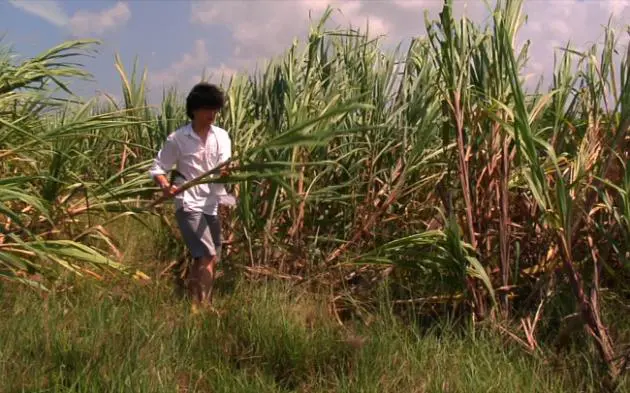


South Korean artist Lee Wan rebuilds his morning meal from scratch, tracking the ingredients to Thailand and elsewhere
ARTIST LEE WAN noticed one day that the ingredients of the bread and carrot juice he had for breakfast came from more than 10 countries. The bread was made with flour from the US and cooking oil from Malaysia, baked in China and sent to South Korea. For him, the process was incomprehensible, as well as inefficient.
So he became part of the process.
“I decided to become a producer,” Lee says at the Samsung Museum of Art, which through the coming month hosts an exhibition of work by promising young Korean artists called “ArtSpectrum”.
Last year Lee tracked down the breakfast ingredients’ sources. He flew to Taiwan and visited a sugarcane farm, where the sugar in his carrot juice was produced. For a month he worked to produce sugar, a sugar bowl and a spoon. In a video on show at the museum, he cuts sorghum with a sickle, peels it, grinds it with a stone and extracts liquid sugar. He makes a ceramic bowl and a stainless-steel spoon, which are physically on display as well.
The labour taught him more than how to make sugar from scratch. He began to understand Asia’s socio-economic dynamics from the perspective of a manufacturer. “People will call me crazy, but the project is significant in that it teaches me how the world works and problems of unfair distribution,” he says.
Lee learned that the sugar industry in Taiwan has long been the driving force of the country’s economic development. Its origins date to the Japanese colonial era, when Taiwan’s traditional sugar production was industrialised.
In his videos, he offers detailed analyses of Southeast Asian societies changing under the outside influence of capitalism. “In Myanmar people use smartphones before they have electricity at home,” he says.
He went on to Thailand, Myanmar and Cambodia to track more ingredients. At Thai silk company Jim Thompson he made a silk jacket. In Myanmar, he spent three weeks at a gold mine run by a Chinese company and extracted three grams worth the equivalent of Bt4,900. The silk jacket and gold are also on view along with videos documenting the processes.
Lee is currently growing rice in Cambodia. He rented a small field for the equivalent of Bt500 and is paying a farmer another Bt500 to tend to the paddy. He’ll revisit next month for the harvest. “I’ll cook the rice for people coming to my exhibition someday,” he says.
He’ll visit a couple more countries later this year to complete the “Made In” project. “My goal is to recreate the breakfast that inspired me to embark on the project.”
The artist plans to visit a couple more countries in the latter half of this year to complete the “Made In” project. “My goal is to recreate the breakfast that inspired me to embark on the project,” he said.
A sculpture major while at university, Lee has used various media, including video and installation, finding that sculpture can’t adequately present his ideas. In previous work he’s sought to break common perceptions of objects through various elements of sculpture. He once made a baseball out of chicken meat, and another time challenged the habit of judging by common standards by cutting and adding to a chair and table so they would weigh the same.
What’s next sounds much more complicated. “My next project is about imbalances in the distribution of money. I’ll trace the flow of cash in the financial markets in New York.”
