
A breath of fresh air


Play
Bhutan takes the light approach to tourism to protect the mountain kingdom's environment and culture
Tucked away at the eastern end of the Himalayas, the Kingdom of Bhutan has never figured prominently in the geography textbooks of Thai schools. Thus, like many Thais, the country only really came to my attention in 2006 when its soon-to-be monarch, Crown Prince Jigme Khesar Namgyel Wangchuck, flew to Thailand to take part in the celebrations marking the 60th anniversary of His Majesty the King’s accession to the throne.
The 26-year-old, who became king six months later, caused a sensation among Thais, especially the women, and his visit give birth to a fledging tourist trade, which has steadily increased over the last seven years.
But travelling to this country that’s variously known as the Land of the Thunder Dragon, the Land of Gross National Happiness and even the last Shangri-La, is not easy. Fearful that mass tourism will negatively affect the largely unspoiled natural environment and rich cultural heritage, the Bhutanese have imposed a strict limit on the number of tourists allowed to visit each year. All foreigners, except Indians and Bangladeshis, are required to sign up with a Bhutanese tour operator and travel on a planned itinerary that costs US$250 (Bt7,800), making the average five-day,four-night package at Bt40,000 to Bt60,000 excluding air fare, untenable for many Thais.
“The fact is we don’t want many tourists. We want to share our country with tourists so that they can enjoy Bhutan and they can have a good experience in Bhutan and the Bhutanese can have a good experience with them but without damaging our environment, our culture and our value system,” says Prime Minister Tshering Tobgay, during an audience with the Thai media at his office in Gyalyong Tshokhang, the national assembly hall, in Thimphu, Bhutan’s capital.
“We want them to enjoy the mountains, the air, the scenery, the culture, but we need to ask ourselves how to diversify the product, how to give them a better experience. These are issues we will look at but they are to improve tourism quality not to increase numbers.”
It’s hard to argue with such sentiments.
Disembarking from Bhutan Airlines’ Airbus A320 at Paro International Airport on an unusually balmy March morning, we inhale not just the gloriously fresh air but also the beautiful mountain scenery.
The bus drops us off in downtown Paro and we walk slowly up the main street lined with traditional buildings housing small shops, institutions and restaurants.
It is here that I begin learning some basic Dzongkha words such as kuzuzangpo la (hello), kadrinchhe (thank you), zhim bay (delicious), ing (yes) and men (no).
We also enjoy our first Bhutanese meal which includes the traditional dish emadatshi made from chilli peppers and cheese, as well as popular beverages like naja (milk tea) and suja (butter tea). Despite the chilli, I find it tasteless though that’s probably because it isn’t cooked with fish sauce or salt.
I also try on the national attire for men. The gho, a knee-length robe tied at the waist by a cloth belt, is worn by most Bhutanese in their daily life, as part of the efforts to preserve their culture.
Our visit sightseeing trip first takes us to the Taktshang, or Tiger’s Nest, Bhutan’s most famous monastery, built in the cliffside of the upper Paro valley. The temple complex was first built in 1692 around the Taktshang Senge Samdup cave where Guru Padmasambhava, credited with bringing Buddhism to the country, is said to have meditated for three years, three months, three weeks, three days and three hours in the eighth century.
We refuse the offer of mounting a horse or mule – a ride costs 800 to 1,000 Ngultrum (Bt400-Bt500) – and hike up to the monastery buildings. It’s not a walk for the fainthearted: the round trip stretches over 14 kilometres and the altitude is about 900 metres.
We are driven from Paro to the capital Thimphu on a surprisingly good road though the journey takes more time than we had anticipated due to ongoing construction works. It does however allow vehicles to stop for long enough to buy some food and drink from the local vendors.
Arriving in the capital, we are amazed to see marijuana plants all along the street. It’s not for human consumption though – that’s illegal – but grows so well in Bhutan’s climate that it is used to feed pigs.
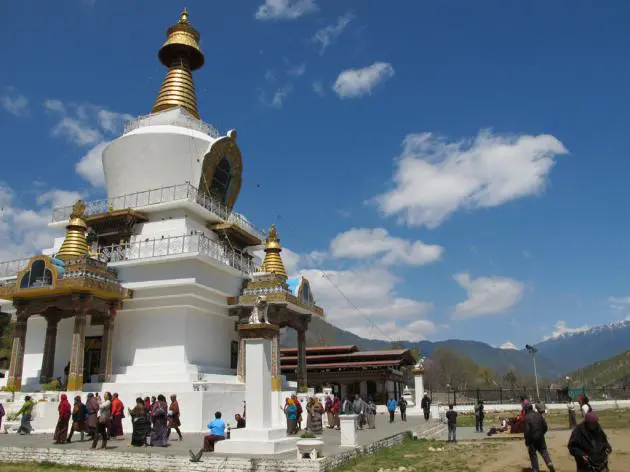
Our guide takes us to Buddha Point, a gigantic Shakyamuni Buddha statue in the mountains from where we can see the entire Thimphu valley. We also visit the National Memorial Choeten, whose stupa was built in 1974 in the memory of Bhutan’s third King Jigme Dorji Wangchuk. Here, we see the Bhutanese circumambulating the building with their prayer wheels and beads in hand, spinning the large red prayer wheels that flank the front entrance.
The next stop is Punakha, home to the country’s most photogenic dzong (fortress), which stands on an island between the confluence of the Pho Chhu (father) and Mo Chhu (mother) rivers in the Punakha-Wangdue valley.
We stop in nearby Sobsokha village and are amazed to see phalluses painted on the walls of homes, hanging from the eaves and the rooftops, as well as on sale at a few arts and crafts shops. The phallus remains a staple of Bhutanese culture that the Bhutanese believe the “scandalous” yet integral image aids in fertility, offers protection from evil and dispels malicious gossip.
Walking along a muddy and dusty path bordered by fields of mustards and rice to Chhimi Lhakhang temple, we stop for a moment to take in the magnificent scenery and breathe in the cold air.
The following day, as we board the flight back to Bangkok, I remember PM Tobgay’s words about wanting tourists to have a good experience in Bhutan – the mountains, the air, the scenery and the culture. We certainly enjoyed every minute.
Bhutanese bargain
_ The Kingdom of Bhutan has a promotion for Thai tourists only through August. Travellers booking their flights will receive a 50-per-cent discount on the airfare and only pay $65 a night for their stays. However, independent travel is banned, so the itinerary must be worked out prior to departure with a recognised tour operator.
