
Raising standards at the spa


Play
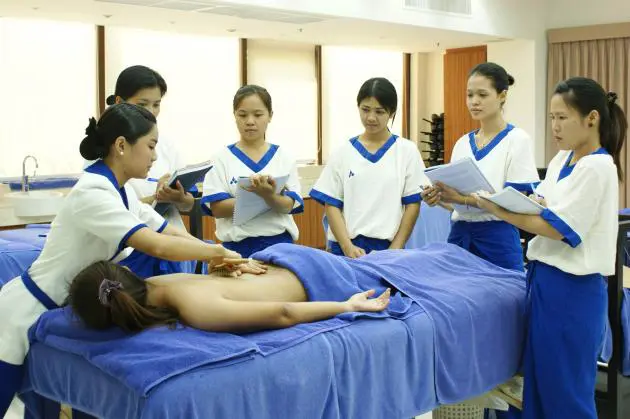
Associations set out to certify therapists and bring Thailand's wellness industry to a world-class level
One of the fastest-growing business sectors in Thailand over the last two decades, the spa industry is aiming to position the Kingdom as the “wellness” hub of the region once the Asean Economic Community comes into effect next year.
Its success in achieving that goal will however depend on whether it is able to ensure that the spa services offered meet internationally recognised standards and that the therapists providing those services are fully trained and licensed.
And much remains to be done. “Our problem is that we face a lack of human resources and there is no standardisation in the industry,” says Krod Rojanastien, president of the Thai Spa Association and manager of Chiva-Som Academy.
“Training does exist but there is no single certification. We need far more cohesive training along with a diploma or a degree endorsed by the Thailand Professional Qualification Institute and certified by the Ministry of Education. This recognition should also be accredited and become part of the National Qualification Framework that allows eligible students to work or study further anywhere in the world,” he says.
“Apart from quality products, it’s skill that really drives the industry. For example, if you go to a spa and enjoy a really good massage, the chances are that you will ask for the same therapist on a repeat visit and be disappointed, perhaps even refuse to stay, if he or she is not available. Our aim is to make sure that top quality therapists are available at every spa and that the massage or treatment is excellent regardless of the therapist. Without standardisation, we cannot hope to become the leader in this industry,” Krod says.
Revenue from the spa industry in 2012 was estimated at Bt16 billion and is said to be growing at about five per cent annually. However, the recent political instability has led to a 24-per-cent drop in earnings, though Krod is quick to point out that these figures are probably not representative of the true picture.
“There are only about a thousand spas registered with the Public Health Ministry, but there are many more spas tucked away in small sois, so it’s impossible to know the real figures. And of course many spas are attached to hotels as well as to private medical clinics.”
Efforts have been made in recent years to promote the industry and keep its growth on an upward spiral.
Many public agencies have become involved. The Health Ministry, for example, has worked to ensure high hygienic standards in spa operation, equipment and products, while the Labour Ministry has organised several training courses. The Health Ministry also set up a spa grading system through awards, but this proved so unpopular that it was dropped. The Commerce Ministry through the Department of International Trade Promotion has supported the industry in terms of marketing and public relations and the Tourism and Sport Ministry has been involved in monitoring services to ensure tourists are happy and come back for more.
“It’s all been very fragmented and that makes it impossible to judge results in tangible terms. Some spa operators and certain hotels have their own training programmes. I offer training through the Chiva-Som Academy.
While it’s probably similar, it is not standardised, Krod says.
“We saw the need for a central curriculum so the Thai Spa Association, the Thai Spa Operators Association, the Spa Lanna Association, the Phuket Spa Association, and the Samui Spa Association worked together in designing one. For the regional aspects, we are collaborating with Indonesia. By the end of this year, we will be able to produce an Asean Qualification Reference Framework, while for operators we’ll have the Asean Spa Standard and Services and a grading system to ensure the quality of spa management,” Krod says.
Vasu Surattiantra, executive director of Panpuri Organic Spa, has been watching the industry’s evolution with interest.
“Thai spas have received several compliments over the years,” he says. “Our experience has taught us that everything counts from the floor planning, lighting, product development, organic treatments and massage techniques.
“While oriental elements in day spas are still popular, there is a growing shift to a contemporary East meets West concept. And there is still a very high demand for well-trained specialist staff.
“Our efficiency in foreign languages may be limited but our hospitality is unbeatable. If training is standardised to a high standard, then the prospects for a career in spa management are far brighter. A trained individual can go as far as becoming a regional or global spa director, spa consultant, or the owner of a spa operator. These days a spa is a requirement for the awarding of five stars to a hotel so graduates in this field can work in big international hotel chains and enjoy a better income. One of the reasons for the shortage of human resources is because hundreds of Thai therapists are working in the Middle East and Malaysia, which want to acquire knowledge that will help their officials more effective at a management position.”
Education and certification are key to the industry’s development, Krod stresses.
“It is not only a career opportunity for those who are coming into the industry but for those who are already working in it and want official recognition. With official education, businesses that calls themselves spas as a cover for other services and which are destroying the image of Thai spas will also be eradicated and that can only be good for the industry as a whole.
