
Wired up and ready to learn
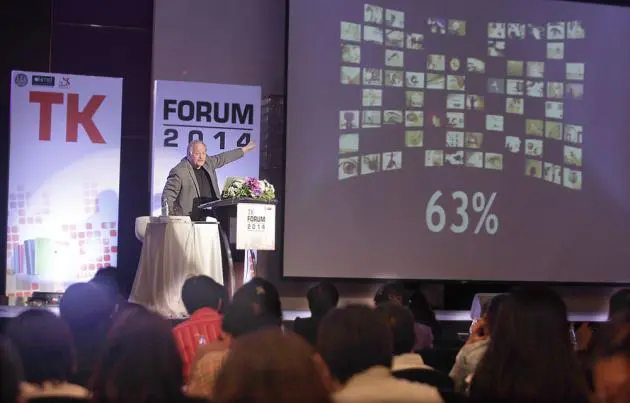


The traditional classroom is no longer suitable for the digital generation, says educator Ian Jukes
THE RECENT NEWS about a Thai youngster unwittingly running up almost Bt600,000 on his mum’s phone bill buying items while playing the popular “Cookie Run” game is but one example of the “digital bombardment” kids of this generation are facing.
In Bangkok to give a talk at the TK Forum 2014 on strategies for teaching digital learners in today’s classrooms, educator Ian Jukes stressed the pressing need for Thailand to develop a new learning model that will serve the needs of the emerging digital generation.
While today’s young people might look the same as their parents did at the same age, they are in fact wired completely differently thanks to constant exposure to electronic media and this has profound implications for the future of education. The digital generations are not the students for which conventional schools were designed, nor are they the students teachers were trained to teach.
Jukes points to Thailand’s shoddy tablet policy to illustrate the importance of “headware” over “hardware”. A well-designed curriculum is more important than digital devices in developing “headware”, which can be defined as such key mental skills as critical thinking, problem solving and decision making.
“In order to teach kids to be 21st-century thinkers, you need to do is to change the curriculum so that it focuses more on creative thinking and problem solving. You want to teach higher-order thinking skills, rather than the traditional ones. In a lot of places including the US and Canada, technology drives learning when it should be the other way around,” says Jukes, the executive director of InfoSavvy Group and the author of “Teaching the Digital Generation”, “Literacy Is Not Enough” and “Living on the Future Edge”.
“Learning has to define technology. This isn’t about teaching kids Power Point lessons. This is about teaching kids to be more effective communicators. Likewise, it’s not about teaching kids Microsoft Word but training them to be able to write, feel comfortable in a written exam, be able to calculate and articulate. These skills are needed. It comes down to properly aligning our technology intentions to our learning intentions. These key skills are of paramount importance in the future and jobs in the future will require the headware more than anything else,” he stresses.
To hammer home why the traditional model of teachers standing in front of the class is no longer effective, Jukes cites studies that demonstrate how digital bombardment affects the visual cortex in the back of the brain.
One study conducted by the University of Rochester found that visual-processing skills increase after as little as 10 hours of gameplay. Further tests showed that people can remember the content of more than 2,500 pictures with 90-per-cent accuracy several days after exposure, even though they see each picture for just 10 seconds. Recall rates after one year remain at about 63 per cent.
And the same research shows that when information is presented orally, people only remember about 10 per cent 72 hours later. Add picture content to the material, however, and retention skyrockets up to 65 per cent. Thus the simple addition of supporting visuals can increase students’ retention by as much as 650 per cent.
This is because the brain processes images 60,000 times faster than it does text.
“The eyes of older generations unconsciously find an intersection about one-third of the way down the page and one-third of the way in from the left. We oldies read in what’s called a Z curve. Recent research tells us that people consume digital content in a fundamentally different manner than they do traditionally printed physical content.
“Digitally formatted materials, with their in-built opportunity to quickly move to other information, means that most digital readers scan rather than read digital content. It is the known as the F pattern.”
Brought up on a diet of video games and Web surfing, the vast majority of students are no longer auditory or text-based learners.
Jukes instead defines them as “visual or visual kinesthetic” learners.
“They’re wired for multimedia. New technologies are constantly changing our children and how they learn. Game consoles and mobile phones have replaced TV, and the Internet is replacing traditional schools as a learning source,” he says.
“Since digital children are neurologically wired differently from the older generation, they not only see, but also interact with the world in a very different way. Kids who are four or five years apart are already neurologically different. And there’s a world of difference between them and the digital users aged 30 to 35 years. Kids today were born into it. It’s their native language,” he says.
Digital learners don’t socialise the way their elders do either and prefer to stay connected all the time. An interactive platform gives immediate feedback and rewards, while in the traditional classroom feedback may take as long as 35 minutes if it comes at all.
“Kids demand to control time and in a classroom they have to sit passively. For them, that’s boring. They won’t learn with the traditional model of teaching,” he says.
“Play is work. Their learning is relevant to fun. But the focus must always be on critical thinking and problem solving. Learning about technology is just a byproduct. It’s the thinking skill that’s most important.
“Kids need to be able to look at information and find out what’s true and what’s not, and apply that information to solve real-world problems.”
Jukes regards Finland as the world’s best model for digital education. In Asia, Singapore remains the best digital learning model even though Jukes is still sceptical about its success.
“The most highly regarded education system in the world these days is Finland. They are putting the fibre-optic network into every corner because that is the new highway,” he concludes.
OUR DIGITAL WORLD
- The TK Forum continues today from 12.30pm with a panel of Thai speakers discussing “Crucial Skills for the Digital Age – What Thai Children Need and How We Can Prepare”.
- Find out more by calling (02) 264 5963-65 extension 113 or visit TKForum.tkpark.or.th.
