
Myanmar sheds the shroud


Play
Acclaimed photographers expose the considerable charms of a once-isolated nation
A Thai who recently returned from a sojourn in Rangoon told me that Myanmar reminded her of the Thailand as her grandparents described it 40 or 50 years ago.
For many visitors, this is the country’s premier lure: Burma – Myanmar, as it’s now generally known – has been mostly sealed off from outside influences since 1962 by a succession of military dictatorships and rampant censorship. Even owning a telephone was beyond the means of all but the most affluent Burmese.
During those dark ages, which only ended in 2011, the travel trail was bounded by haphazard infrastructure, government decrees and, in some of the states warring for independence, by threats of violence. For the most part foreigners refused to go there out of fear that their tourism dollars buttressed the junta, a former pariah on a par with North Korea.
Those concerns are in the rear-view mirror now that the country is finally looking forward instead of back to a golden age tarnished by tyranny and crackpot generals who governed the country with the help of astrologers.
Still, all the questions and conundrums continue to hold back would-be travellers. Few memoirs, movies, or even travel tomes have emerged from a nation that only just slipped free from the shackles of censorship and an Orwellian propaganda network.
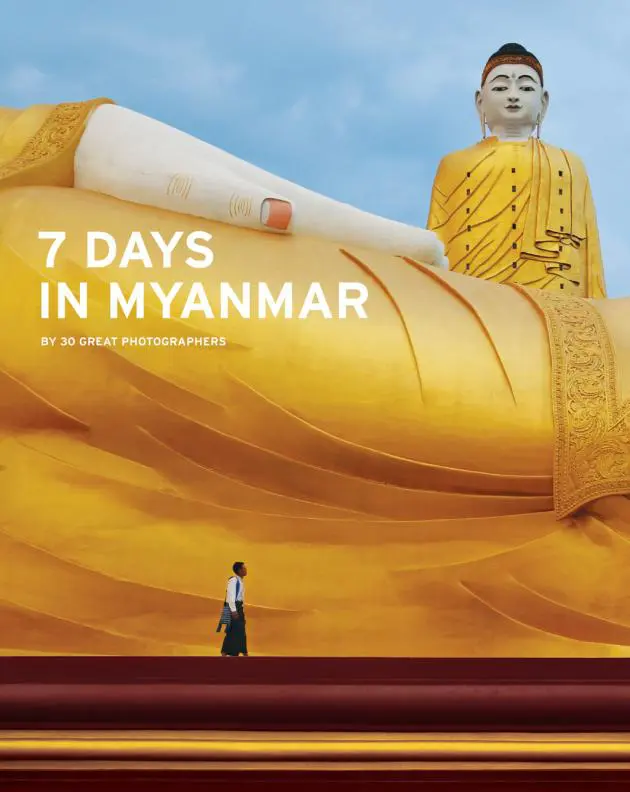
The new coffee-table book “7 Days in Myanmar”, however, fills in some of the blanks and empty frames. Celebrated photographers like Bruno Barbey, who took the cover shot, Michael Freeman, Raghu Rai and Steve McCurry spent a week touring the country to expose its many different facets, joined by an ad hoc team of 26 other photographers, nine of them locals.
Englishman Chris Steele-Perkins shot the acrobatic sport and dance of chinlone. Played with a rattan ball, it’s the Burmese version of a body of athletic traditions with a 1,500-year-old pedigree, including takraw in Thailand and Malaysia and hacky sack in North America.
Kaung Htet ventured into a jade mine in Kachin State, which is still subject to political upheavals and violent spasms, to return with a few pictorial gems.
By contrast – and by definition this is a country of startling contrasts – Malaysian SC Shekar shot a series of images of Yangon’s historic buildings, whether charmingly dilapidated or lovingly restored.
Like airline magazines, books of travel photography lean towards the lightweight, tending to smooth over a destination’s edgier elements. This book, though, takes a punchier approach. That’s especially evident in the images from a Karen boxing camp, where Thet Htoo photographed a boy of 12 lifting a concrete block with his teeth.
Nevertheless, all the most hallowed images of Myanmar that are enshrined in the minds of travellers and armchair daydreamers are here, too. There is the bedazzling Shwedagon Pagoda in Yangon and the Golden Rock, perched precariously on a cliff and supposedly held in place by a hair of the Buddha. There are the leg-rowers on Inle Lake and local women daubed with face paint called thanaka.
To underscore the book’s history and illustrate the country’s immense transformation, Denis Gray, a former Associated Press bureau chief with 40 years’ experience in the region, wrote the preface.
“Returning to Myanmar after so many years of being banned and reporting on the country from long distance was almost disorientating, but a most wonderful shock. I could interview people openly, elicit very critical opinions and still use their names in my stories.”
To make the book even more of a bonanza for your baht, it comes with a DVD documentary that shows the photographers in action.
Other textual contributions come from editor Nicholas Grossman and Burmese historian Dr Thant Myint-U, while the British Library’s John Falconer contributed an essay on 19th-century photography in Burma under British colonial rule.
Perhaps the book’s strongest point is that it puts a human face on a country for which, for decades, the only recognisable visage was that of Nobel laureate Aung San Suu Kyi. These are telltale portraits that reveal a gracious, gentle and extremely tough and resourceful people.
“I think all of us will say the same thing,” observes Michael Yamashita, renowned for his images in National Geographic. “The most memorable part of the experience was the people, their charm, their grace and their hospitality. It is truly special.”
In a digital age where every destination, from Antarctica to Zimbabwe, has been overexposed, Myanmar’s legacy of culture and history and its zealously religious spirit remain undeveloped in the realm of popular culture and travel lore.
That makes “7 Days in Myanmar” a valuable contribution to what is rapidly becoming the hottest and coolest destination in Southeast Asia.
7 Days in Myanmar
By Gray et al
Published by Editions
Didier Millet, 2014
Available at Asia Books, Kinokuniya, Bt1,850
Reviewed by Jim Algie
_ Jim Algie’s latest book is a collection of prize-winning short fiction called “The Phantom Lover and Other Thrilling Tales of Thailand”. More bytes and pixels at www.JimAlgie.com.
