
The early Hitchcock


Play
Silent films offer glimpse of great things to come from "The Master of Suspense"
“Hitchcock was incredibly clever”, when it came to making the switch from silent film to sound, says Professor Charles Barr, an English film historian who has written extensively about Alfred Hitchcock.
At the centre of the first Silent Film Festival in Thailand are three early efforts by the iconic director, giving Bangkok audiences a glimpse of what was to later come from “the Master of Suspense”, and director of such films as “Vertigo”, “North by Northwest” and “Psycho”.
Nine films from Hitchcock’s silent period survive, and three have been showing in the Silent Film Festival organised by the Thai Film Archive with support from the British Council – “Paradise Garden”, “The Ring” and “The Lodger”.
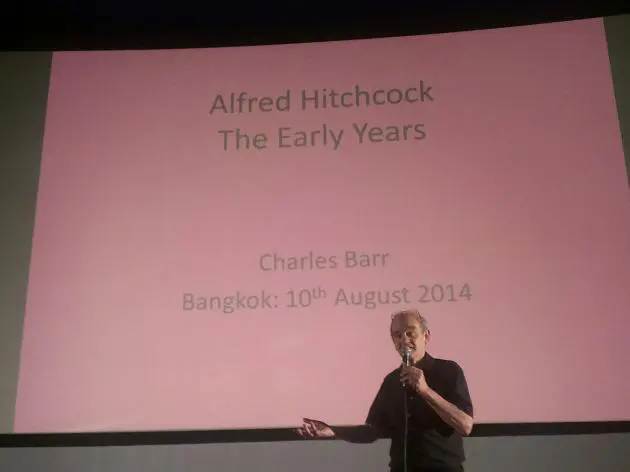
To study Hitchcock is an economical way of studying the entire history of cinema, Barr pointed out in a talk at the festival on Sunday, noting that Hitchcock’s career spanned 50 years across the middle of the 20th century, starting in 1920.
In all, Hitchcock directed 10 pictures during the silent era. Nine of them were painstakingly restored by the British Film Institute, with support from public donations, and screened as part of the 2012 Cultural Olympiad on the sidelines of the London Olympics.
One film, the 1926 adventure yarn “The Mountain Eagle” is lost, though experts haven’t yet given up hope of finding it. “If you know any old buildings, do keep an eye out for it,” Barr told the audience.
Among the silents, his directorial debut “The Pleasure Garden” has many of the trademarks his films would be known for, including blonde heroines, betrayal and murder.
For Hitchcock, the transition to sound was abrupt. He was in the midst of making “Blackmail” in 1929 when British International Pictures suddenly decided it should be a talkie.
But he found ways to convert “Blackmail” to sound without having to change very much of it. One scene was reshot for the sound version, having the villain playing piano while threatening the heroine.
And long after the end of the silent era and his move to Hollywood, Hitchcock’s films had extended silent scenes, such as in 1959’s “North by Northwest”, in which Cary Grant finds himself dropped on a roadside in the middle of nowhere. As he waits wordlessly to meet someone, the suspense builds.
Hitchcock also found ways to incorporate sound into his silents. For example, the festival’s closing film “The Lodger” has the owners of a boarding house worrying that the man renting the room upstairs might be a serial killer. They look up to the ceiling in fright. “We see the sound of his footsteps,” Barr said.
