
Going against Mother Nature


Play
Creating a unique breed can come at a very high cost to the animal and its descendants
LAST WEEK, I wrote about the Bengal cat, a hybrid created by breeding a domestic cat with an Asian leopard cat.
The Bengal is not the only cat – nor are cats the only species – to be “hybridised”.
I’m not talking about combining one breed of cat or dog with another breed, but combining different species or sub-species.
Sometimes, Nature herself does the combining. Domestic dogs breed freely with dingoes, for instance, as do grey wolves with coyotes.
In the case of the Bengal, the domestic cat and the Asian leopard cat don’t normally mate. In the 1970s, however, scientists in the US began interbreeding the two. The Asian leopard cat has a partial immunity to feline leukemia, and they wanted to find out if this immunity could be passed on to the offspring of the two species.
At the end of the Bengal cat experiment, the scientists gave the animals and their offspring to a breeder. Her interest was not scientific but artistic, and through the years, she developed a breeding programme that would pass on the extraordinarily beautiful markings of the resulting hybridisation.
This hybridisation has continued, with both cats and dogs. The “stone cougar” and the “Chausie”, for instance, are crosses between a domestic cat and a jungle cat. The Bengal has been used to create other breeds too, such as the “Serengeti” (Bengal/Oriental Shorthair) and the “Toyger” (domestic cat/Bengal).
The main question is: Why create such hybrids?
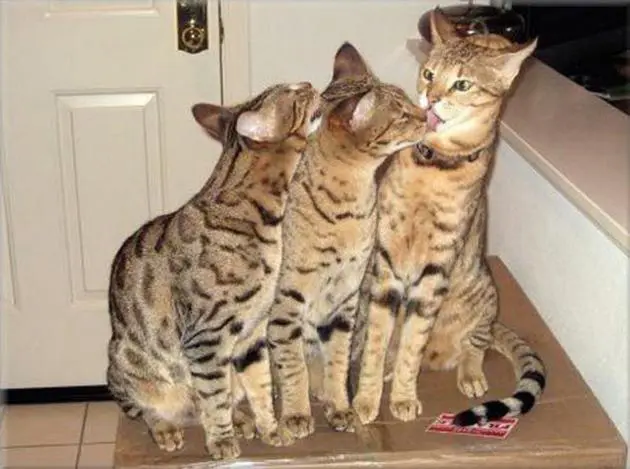
It’s true that some people breed wild animals with dogs or cats for the money. Whenever a new hybrid appears, people are willing to pay lots of money for the offspring. The “Savannah”, the result of breeding a domestic cat (including Bengal) with an African serval, can cost between Bt70,000 and Bt1 million.
Other people like to think of themselves as artists, using their breeding programmes to “paint” a new animal.
In the hands of inexperienced or uncaring breeders, however, these programmes involve inbreeding. The offspring might have a beautiful coat, but by breeding parents or grandparents with their children, the health problems of the parents and grandparents could be doubled or even tripled.
In some areas of the world, it’s not even legal to keep some hybrids such as the “Savannah” because this particular creation is difficult (impossible in some cases) to tame, not a pet you want in a home with small children.
Owners of Savannahs claim that the cats are not wild but simply extremely energetic and require outlets for all the intensity.
Some people argue that hybrid breeding shouldn’t be controversial at all, pointing out that even our domestic cat and dog breeds are the result of some kind of inter-breeding.
For me, I’m extremely uneasy. A number of the wild cat breeds that people have been using to breed with domestic cats are endangered in the wild. If you argue that the breeding stock isn’t wild-caught but comes from zoos and such, I wonder what kind of life this breeding stock is offered once their “duties” are done.
Other people argue that they have created these new breeds as a substitute for wild animals, that they’re actually helping conserve endangered species.
I’ve never met anyone, however, who’s said: “Yes, please. Give me the hybrid instead of the real thing.”
I also understand people who want to create something new, something wild but eventually, in later generations, domesticated. I understand people who want to own something beautiful.
The best place to find really beautiful animals, though, is at the pound or from an animal rescuer. Tens of thousands of dogs and cats need homes every year – and that’s only in Bangkok.
Create hybrids only after all the animals in our sois have homes and caring owners.
