
What makes a design clever
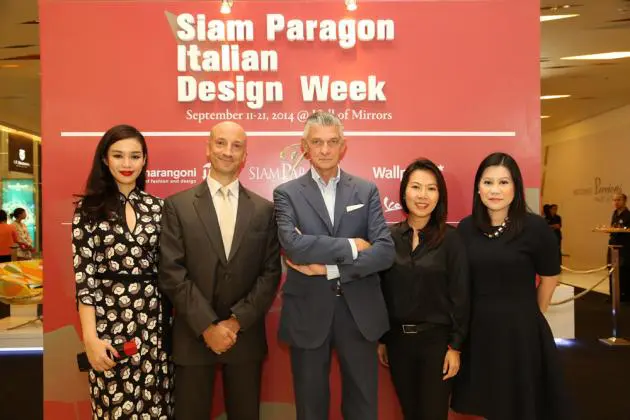


With Italian Design Week underway in Bangkok, one of the top guns in the business offers some advice
“THE INTERESTING THING about design today is the range of possibilities,” Italian furniture visionary Giulio Cappellini said last week while in Bangkok to promote Siam Paragon Italian Design Week. “Thanks to new technology and new materials, designers can give new life to old shapes.”
Deemed by Time magazine one of the world’s top 10 trendsetters, Cappellini has his stylish furniture in museums around the globe, and his approach to design proved to be an inspiration at the Bangkok event.
Organised by Wallpaper magazine and Milan’s venerable Istituto Marangoni, Italian Design Week showcases not only work by Cappellini and Emilio Pucci but also Vespa scooters, Alessi kitchenware and a slew of Thai clothing designers who were schooled at the Marangoni.
Cappellini plays a significant role in shaping academic appraisals of design, through the institute and other venues, authoring history texts and serving as visiting professor at universities overseas. For aspiring young designers, he’s a fount of knowledge and a cherished mentor.
“My approach is always to try and create something that works, that’s very pure, very simple, sophisticated and timeless,” Cappellini said. “Design creates best sellers – good design creates long sellers. So creating something that makes people smile – despite the thousands of tables or chairs already available on the market – that’s a very important part of design today.
“I tell young designers, ‘It takes a lot of time to do a project today that will still reward 10 or 20 years from now.’” He points out that thousands of people are employed in the industry just making prototypes of products that might not even make it to the market.
“My advice is, ‘Don’t do too many things at the beginning. Do a few projects, but good projects. Also don’t think that, if you do one chair or one table, you will be famous. You have to follow the project and the idea like you are a baby.’”
Cappellini tells his proteges they must be good at communicating. “Designers have to speak with the company, follow the prototype, the research and development teams at the companies. Being able to do a fantastic drawing isn’t good enough if you can’t communicate verbally.
“So the role of the designer is bigger than in the past. You cannot do just a project and that’s it. Sometimes, from the first idea to the final product, you will have to change a few things, maybe when you work with the materials. So you have to be very open-minded.”
Cappellini also stresses the need to maintain a global viewpoint. A designer should be able to assess a firm’s chances in the world market. “Some products are good for the United States, some for Europe, some for the Far East. But the goal is to sell the product worldwide.
“Consumers these days like to mix up different things, maybe an old-fashioned house with a contemporary interior design. Their attitude is very free, and you have to accommodate that.
“It’s also very important to work on a living space at the actual scale. It’s more beautiful to do a nice sofa, table or chair in the actual dimensions [rather than modelling in miniature first]. For fashion it’s different – you can sell same bag, same car design around the world, but when you enter people’s homes, you have to take care of their history, their traditions, their sensations.”
As for establishing a brand of their own, Cappellini tells the rookies it’s usually difficult at first but in the end someone will discover them. The Istituto Marangoni cultivated some of the world’s top names, among them Franco Moschino, Dominico Dolce of Dolce and Gabbana, and Alessandra Facchinetti of Valentino.
The Thai alumni include Ploi Horwang of Him+Her, Chavaporn Laohapongchana of PS Material, Tui-Tipanan Srifuengfung of Tu’I and Wannaporn Poshyanonda of RougeRouge. Vichukorn Chokedeetaweeanan of Greyhound and Chaichana Ohpanayikool of Shake Appeal also attended the Milan institute and are presenting their work this week at Siam Paragon.
“Establishing your own brand nowadays presents different difficulties in different countries,” Cappellini notes. “The name of the brand is very important, especially since it has to signify quality.
“Most important companies with brands in the market invest in the future, in research. Italy is well known for good quality. Consumers don’t look at just the product but also the reason on the back of the product – the internal research, the quality of material. They want to spend money, not throw it away. People who spend a lot of money on high-end products also want something exclusive. That’s another point to think about.”
This freedom of choice on the market has to be carefully considered, he said.
“I’ve taught classes on public-consumer theory. It’s sensational! In the past people might have used one brand for everything, from head to toe, but today they can mix more freely.
“You have to use your creativity to try and do something new, that’s never been done before, something that looks like it came out of a dream. When people see it, they go, ‘Wow! I can’t live without this.’”
“The real spirit of creativity today is also about innovation. If we’re not up to date, we can’t be creative today. You can’t become famous in a day. It takes years and years. Even if you’re talented, you have to be professional and have big passion for your job. When I look at the iconic pieces from the ’50s, they still look contemporary even after 60 years.
“For Thai students, it’s good homework to just work. Believe in what you’re doing, go ahead, and, if you are distinguishable, the rewards will come. To be a designer is a serious job, but it’s also fantastic. It’s a privilege.”
BRILLIANT IDEAS
- Italian Design Week continues through Sunday in the Hall of Mirrors on M Floor at Siam Paragon.
