
Sobering perspective


Play
Yokohama Triennale ponders the meaning of oblivion
IN ITS FIFTH iteration, the Yokohama Triennale this year casts aside the event’s usual festive mood and asks the audience the meaning of oblivion.
The art festival, held every three years, now under way at the Yokohama Museum of Art and Shinko Pier Exhibition Hall in the Minato-Mirai area serving as its main venues. More than 400 works by 65 artists from 19 countries are featured.
Serving as the event’s artistic director this time is Yasumasa Morimura, an artist active on the front lines, instead of an exhibition planning expert.
Inspired by “Fahrenheit 451,” a 1953 science fiction novel by Ray Bradbury, Morimura decided on a theme called “ART Fahrenheit 451: Sailing into the Sea of Oblivion”, giving the exhibition distinct features.
“It would be regrettable if the event ended up as transitory merrymaking. I wanted to transmit something that puts weight on a serious theme from Yokohama,” Morimura said.
Bradbury’s classic is about a near-future society in which books, a symbol of freedom, are burned and society is dominated by extremist thinking. Overlapping reality with the world of the masterpiece, the exhibition sheds light on artists and their works that are destined to be forgotten or disappear as well as works that have taken up such a theme
A section called the “first chapter” features abstract paintings using white as their base color in an attempt to invoke a feeling of “silence” through the works’ reticence.
It is in the “third chapter” exhibition hall that you will find works embodying the world of “Fahrenheit 451” – the heart of the exhibition.
Among the exhibits in the third chapter is “Moe Nai Ko To Ba” (“Inflammable Words”), a book produced through joint works by multiple artists. The book features various images and texts related to “oblivion”, including a poem by Kokichi Nakaya, the symbol of post-war Okinawa, which Morimura hand-copied, along with Morimura’s pastel drawing, and a poem by a female Russian poet who lived under the reign of Joseph Stalin.
Visitors to the exhibition are free to turn the pages of the book. After the exhibition, there are plans for the book to eventually be discarded, leaving its content only in people’s memories.
War memories seem to be another key theme. Exhibits include a three-dimensional work combining a shell and a cross by US artists Edward and Nancy Reddin Kienholz, titled “The Big Double Cross,” and a letter written in katakana by painter Shunsuke Ma-tsumoto to his family around the end of World War II.
The exhibition also pays close attention to things that tend to be forgotten in a society of massive consumption.
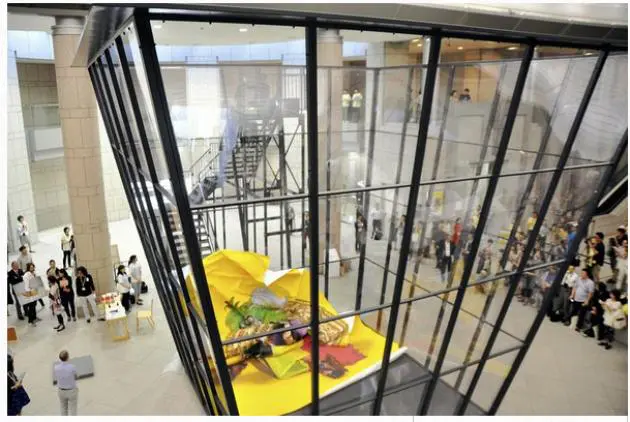
At the museum’s entrance hall stands a massive transparent garbage bin, called “Art Bin,” a work by British artist Michael Landy. In other words, the work is a “garbage bin of art.” Professional and amateur artists who send an application to the event are allowed to discard their failed works into the art bin, raising awareness of consumption and disposal, which are repeated over and over in civilized society today.
A different section in the same hall features cheerful paintings and calligraphy works by students of Kamagasaki Geijutsu Daigaku – Kamagasaki Free Art University – which is working to support the creative activities of day labourers in Nishinari Ward, Osaka.
Other works on display include scores by composer John Cage on the theme of silence, Michio Fukuoka’s bizarre sculpture featuring a balloon, and a reproduction of the atelier of the conceptual artist Yutaka Matsuzawa, whose theme was the extinction of humankind.
Having a total of 11 chapters consisting of exhibitions and events, the exhibition certainly is rather conceptual.
According to the exhibition’s secretariat, the event this year is organized with a budget of about 1 billion yen, up 100 million yen from the previous edition. About 300,000 people are expected to visit the event – about the same level as the previous event.
The success of the event will hinge on whether it will be able to lure a wide range of visitors, including younger audiences. In an effort to attract visitors, new services have been made available, including an audio guide service in which Morimura explains certain must-see works.
GET GOING
The Yokohama Triennale runs until November 3. For more details, visit www.YokohamaTriennale.jp.
