
Stories in the strands


Play
Artist Imhathai Suwatthanasilp relates the changes in her life through art fashioned from hair
TO IMHATHAI Suwatthanasilp, hair is a symbol of identity, something that’s powerful in its physicality yet also incredibly personal. For nearly a decade, she has been crocheting strands of human hair – that of others’ as well as her own – into wondrous mixed media art that relate to significant episodes in her life.
Her new solo show “Ok Reuan” (“Rebirth”), which refers to the setting up a separate household after marriage, illustrates not only another transition in her life but also womanhood. Currently on view at Bangkok’s Numthong Gallery, the works have been created over the past several years – a period that has seen Imhathai and her three sisters move out of the shared family home and build nests of their own.
The female pelvic cavity is used to reflect womanhood – the state of being a wife, a housewife and a future mother. Hair, which has its own life cycle, metaphorically speaks about the cycles of decay and rebirth and her fallen hair – the dead cell – becomes the main material and is reborn through a new form of art.
“I was listening to dharma teaching about life as a couple. The monk said that getting married is akin to rebirth. That’s because we have to live with a new family – our partner and his/her family members. The thought of that ‘rebirth’ inspired me to use the pelvic form as a metaphor for a new life. ‘Ok Reuan’ for me is not very different from being born again, but in the same old body and with the same soul,” says Imhathai, a lecturer at Silpakorn University – her alma mater.
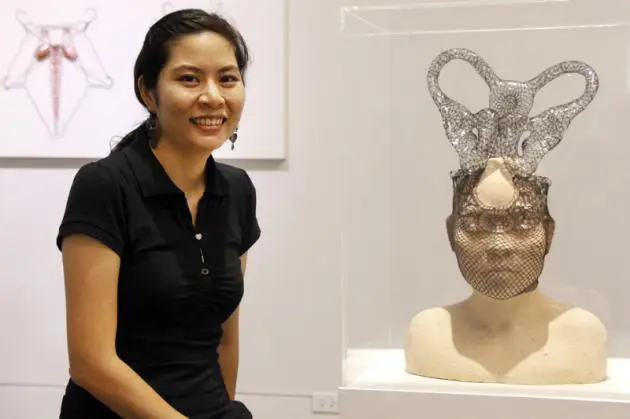
Her “rebirth” at the age of 33 in a clay-sculpted bust – a self-portrait – titled “Rebirth Crown” whose face is covered with a web of crocheted hair strands. On its head is a pelvis-shaped blown-glass tiara covered with a mesh of woven hair.
“I couldn’t use my own hair for this work. It’s too thin and fragile to hold the blown glass, so instead I collected strands from my friends with thick, strong locks. I use only fallen strands, not cut hair, to symbolise life’s decay and delicacy,” says Imhathai.
Opposite is “Dreamcatcher (Home Sweet Home)”, a work composed of old clothes hangers intertwined to form a circular frame. A sheet of diaphanous fabric is attached to the centre with Imhathai’s hair crocheted in the forms of a small house, flowers and trees to reflect the welcoming ambience of home.
“It symbolises the ‘home sweet home’ dream. The clothes hangers come from the days when my sisters and I lived together. The form is inspired by the yantra – a sacred cloth believed to protect against evil – as a way to filter out all that is bad.”
More clothes hangers appear in the erotic work “Dreamcatcher (4 ladies)”, which consists of four pieces representing the four sisters. The clothes hangers are shaped in pelvic forms and attached with red synthetic hair. The white oval-shaped stones and clamshells, representing the ovaries and female genitals and symbolising birth, fertility, nurturing and growth, are also enclosed in a web of red hair.
“This is the first time I’ve experimented with synthetic hair,” Imhathai says. “The oily effect of the red-coloured hair projects an image of blood vessels.”
While all three of her younger sisters opted for the traditional Thai wedding, Imhathai decided to shun wedlock and simply moved in with her partner. “Living together is more important than a marriage ceremony,” she observes.
The start of life as a couple is shown in “Bless”, with red synthetic hair again used to cover a large conch shell representing the Thai wedding ceremony for which it is traditionally used to hold the blessed water that parents, relatives and elders pour over the hands of bride and groom.
While the water is poured, the groom and the bride wear garlands on their heads and these are connected with string. Imhathai reflects the ceremony in “Wedlock”, which features a string crocheted from red synthetic hair linking a piece of white jade at one end and a stone at the other, each enclosed in the red strands.
“I searched for the meaning of ‘som rod’ (to wed) and found that it means two persons who have equality. There are stones at each end of the string: on the left is a gemstone of white jade while on the right is a polished natural stone. While singly they both have a different value, they voluntarily join in married life and that gives them equality.”
For the new show Imhathai has also experimented with a series of seven drawings on canvas. Using a crocheting needle – the same tool as she uses to crochet hair – she made light scratches on the surface of a canvas pre-coated with offset ink, moving the needle in a loop to form the shape of the pelvic structure.
Imhathai was inspired to use hair as a biomaterial for her art by her father, who started to grow his hair long after being diagnosed with cancer. When it reached his waist he tied it into four pigtails and cut them off, giving one to each daughter.
“He said he wasn't a wealthy man and all he'd been able to give us was an education. His hair, on the other hand, had grown from his own body and was a symbol of his identity and his flesh.”
She turned her bequest into intensely personal art in her first solo show “DNA”, exhibited in 2007 at Bangkok’s White Space Gallery, stretching her father’s pigtail out across three wooden slingshots he’d made. She’d also kept the pillow from her father’s hospital bed, and crocheted a cover for it from her own hair. The drawn-out process of crocheting in repetitive patterns had a meditative quality, reflecting her affection and inner longing for the subject at hand.
Two years ago, the artist cut her own pigtail and for “rebirth” placed it on three stones in a light box under the title “Sleeping Beauty”. Adjacent to the work is “The Thirty-First”, another light box showcasing a row of 31 small containers woven from her own hair.
“It records another chapter in my life, the day I reached 31 and entered a period of maturity. I started collecting my fallen hair after a shower on 31 occasions. Each time, I wove a bunch of hair into an organic form. Inside each piece is a small white stone on which is inscribed the date the hair fell out.
Imhathai doesn’t only use hair to record her path through life but also for charitable purposes. Her 2012 show “Hair for Hope” at Bangkok’s Ardel Gallery, offered succour to people dealing with cancer. Her art pieces in the form of butterflies and flowers – metaphors for love and hope – were crocheted from the hair of patients undergoing chemotherapy and sold to cover the cost of treatments for people in need.
HAIRY TALES
“Ok Reuan” (Rebirth) continues until October 11 at Bangkok’s Numthong Gallery.
The gallery is in Soi Aree 5 (North) off Phahonyothin 7, Phahonyothin Road.
It’s open daily except Monday from 11 to 8.
Call (02) 617 2794 or visit www.NumthongGallery.com.
