
There's art happening here


Play
Western interest is keen, says the Guggenheim museum chief, as the Asian Art Council meets in Bangkok
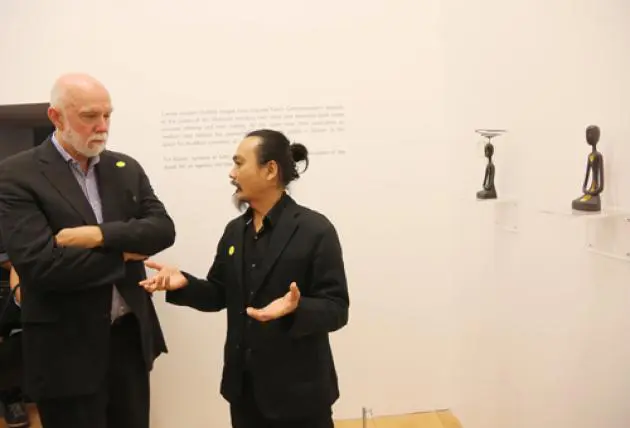
RICHARD ARMSTRONG, director of the US-based Solomon R Guggenheim Foundation and Museum, was happy to give the Thai art scene further hope last week when he declared our art worth collecting.
Armstrong’s talk at the Bangkok Art and Culture Centre was part of a symposium organised by the Culture Ministry and the Guggenheim on Southeast Asian art. Dozens of museum directors, curators, art critics and scholars are meeting through Sunday under the auspices of the Asian Art Council.
“We’re already interested in the new idea of Asian art,” Armstrong told The Nation, crediting the ministry’s permanent secretary, Apinan Poshyananda, with guiding the relationship between the Guggenheim and Thailand to this stage. “We’ve acquired many works by Thai artists, like Rirkrit Tiravanija, Araya Rasdjarmrearnsook and Navin Rawanchaikul.”
Armstrong said he was impressed with the current exhibition at the art centre, “Thai Charisma: Heritage + Creative Power”, for which Professor Apinan served as curator. “I see the potential of young Thai artists.”
The show on the eighth floor features 38 historic ancient artefacts juxtaposed with contemporary “interpretations” by 19 Thai artists.
More than 200 people attended Armstrong’s talk on “Asian Art and a Guggenheim Constellation” on Thursday night. He explained the museum’s long interest in Asia, which has led to efforts including the UBS Map Global Art Initiative, which chart contemporary art in three geographic regions and “No Country: Contemporary Art for South and Southeast Asia”, a recent show in Singapore that featured Navin’s work.
Armstrong noted that the Guggenheim’s first Thai acquisition was Rirkrit’s “Untitled 2002 (he promised)” and it hosted his exhibition “The Shapes of Space” in New York in 2006. Since then it has been increasingly drawn to Southeast Asian art.
“No Country”, which was also mounted in New York, had Navin’s huge multiple-figure painting “Places of Rebirth” and the Guggenheim now also owns Araya’s 12-minute video “The Treachery of the Moon”. Kamin Lertchaiprasert’s massive installation “Sitting (Money)” is in a vault in New York – 366 meditating figures made of old Thai banknotes.
“By creating an international community of thinkers and practitioners, the Asian Art Council promotes a curatorial mandate based on international exchange, critical conversation and cultural awareness,” said Alexandra Munroe, the Guggenheim’s Samsung senior curator of Asian art.
The Bangkok programme includes four round-table discussions focusing primarily on China and more specifically the Robert HN Ho Family Foundation Chinese Art Initiative at the Guggenheim. It’s an effort to foster global appreciation of contemporary Chinese art through a series of commission-based exhibitions of “important” but lesser-known artists.
At the same time, participants are examining ways to “diversify” global interest in Asian art by deflecting some of the attention away from China so that Southeast Asia rises in prominence.
Hou Hanru of Maxxi in Rome and Qiu Zhijie, whose critically acclaimed “The Unicorn and the Dragon” was at last year’s Venice Art Biennale, are sharing their thoughts on the notion of “De-centring China” at the symposium. The idea is to demonstrate “the legitimacy, inclusion and relevance” of modernism beyond the customary hubs of Paris and New York.
The Asian Art Initiative, begun in 2006, is designed to “strengthen the museum’s curatorial and educational programming by exploring and presenting global perspectives on modern and contemporary art”.
Research-based exhibitions, educational courses and acquisitions for the permanent collection are all part of the plan. The Guggenheim Foundation has long looked overseas for new ideas and today has a network of museums and art-and-education programmes around the world.
The Asian Art Council, founded in 2007, is intended to be a forum for critique, debate and innovation around key issues in modern and contemporary Asian art and in transnational art studies. The council meets twice a year to advise the Asian Art Initiative regarding acquisitions, exhibitions and research strategies.
The Art Council members also visited the Museum of Contemporary Art, the Bangkok Sculpture Centre and the Jim Thompson House Museum and met with many artists at various studios and galleries around Bangkok. This will also build networks of Asian art in Thailand.
