
A round on Shepard Fairey


Play
The man who made the Obama "Hope" poster creates a new label for Hennessy cognac
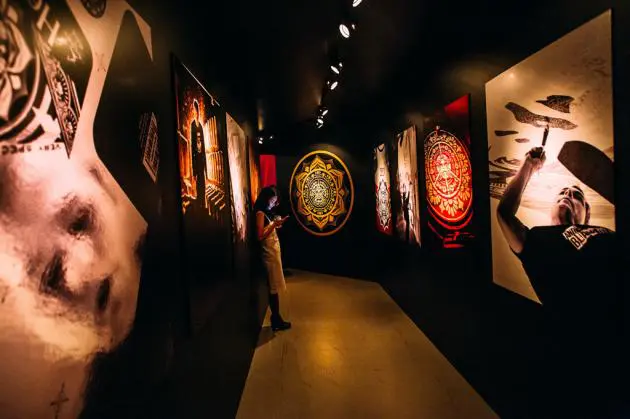
Cognac maker Hennessy VS treated reporters from around Asia to a performance in Tokyo by American street artist Shepard Fairey recently, part of its launch for a new label design.
LA-based Fairey – who shot to fame amid controversy over the “Hope” poster he created during Barack Obama’s 2008 presidential campaign – was at the Star Rise Tower to demonstrate his DJ skills as well. He played hip-hop along with Japanese DJs Olive Oil and Seiho. Later he sat down with the Thai press at Cafe Bohemia in Shibuya district.
Where do you find your inspiration?
It’s a matter of looking at life creatively and, in this case, seeing how what I do could overlap with Hennessy’s graphic history and the characteristics of the cognac itself.
I think there’s an elegance and warmth to the cognac. In their graphics they’ve used things like grapevines and other decorative floral elements. My image is really about peace, harmony, elegance and a celebration of the better things in life and the better things about humanity.
What was the main challenge?
Working small – I like to work bigger [laughs]. I came up with a design and realised, ‘The size needs to match the label and this is too busy, too much going on.’ So this was as much as I could fit on the label without it feeling too crazy, but I’m happy with it.
This was the one Hennessy liked right away, so that made it very easy for me. I also always use similar colours in my own artwork – gold, black, red and cream.
You incorporated your signature word “Obey” into the design.
Oh, it’s in there – right there, the icon – and appears subtly elsewhere. There’s a little monogram down here. Sometimes it’s nice to have viewers discover things on their own. There are some stars, a little bit more of heavy-metal style with the birds around it. Of course people probably know this, but every different application has different needs, so this is what felt right to me.
Tell us about the flower.
It’s loosely inspired by the lotus flower. Flowers imply harmony with the earth, so it’s not specifically about any one cultural reference – it’s more the overall feel. Going to China, Hawaii, Japan and even a lot of the parks in Los Angeles, I’ve noticed I gravitate toward floral motifs. There’s an appeal in their design symmetry as well as in their connection to nature.
I love a lot of different things. I’m always going to art shows, to see what’s happening on the street, to hear music, to the trade shows for fashion and skateboarding. I also collect books, old art and new art, old design, new design, architecture, photography.
I look for stuff on the Internet too, like everyone else, but when I go to places like bookstores or junk shops, I find things I might not discover through the Internet because they aren’t high on the search engine. So I think it’s important to not just rely on the Net.
You’ve achieved a remarkable level of fame.
I work hard and I’m very grateful for everything I’ve accomplished, but in some ways, when I look at how much talent there is out there, the more famous I get, the more humble I feel.
I know how many other great people are doing work, so every new opportunity that comes my way I just do the best I can to make it strong, to make it good. A lot of the opportunities I get are unique and I’m very lucky to get them. Sometimes I feel guilty that I get so much and other people who deserve it don’t, so I have the gallery where I can give other artists shows. I used to do a magazine too and I would always focus on new, up-and-coming artists.
One of my favourite things about the art community is that, even though a lot of artists, and especially graffiti and street artists, are very competitive with each other, it’s also sort of a support system, a family. A lot of the artists I knew before I was famous or before they were famous, we’re still all friends.
