
To build the world's best


Play
Vietnamese firms claim top prizes at the World Architecture Festival
Vietnam's tremendous surge in handsome buildings has earned it top honours in this year’s World Architecture Festival. Specifically it was “The Chapel” that was named Building of the Year, a structure made of recycled materials, while the country garnered four other awards as well.
Nearly 2,000 architects, designers and representatives of their clients attended the festival at Singapore’s Suntec Convention and Exhibition Centre early this month.
The World Architecture Festival, now in its seventh year, gives practitioners a chance to share ideas and catch up on new technology and trends.
German architect Ole Scheeren gave the keynote speech on “Architects and the Cities”, Britain’s Richard Rogers talked about “Citizens and the Compact City” and Professor Sir Peter Cook shared his thoughts on “Art and Public Space”.
Discussions covered sustainable and “universal” design, such as “Designing cities for health, well-being and delight”.
Nominees from China, Malaysia and Vietnam were up to 140 per cent this year, reflecting the architecture boom in Asia, along with the winning projects in Singapore, India, Iran, Australia and New Zealand. Relatively little-known firms in the Asia-Pacific region competed in 30 categories alongside well-established outfits like Zaha Hadid Architects, Aedas, Studio Gang and Foster and Partners.
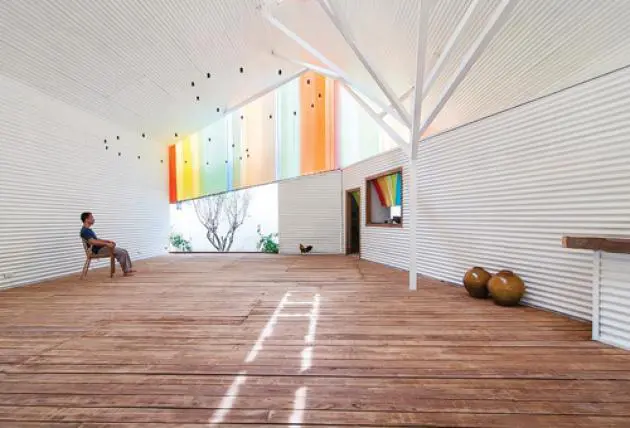
Nguyen Hoa Hiep of A21 Studio, based in Ho Chi Minh City, designed the Chapel, an urban ward in the city’s Binh Chanh district. It gives the residents a sorely needed community centre, catering especially to youth while offering room for conferences, weddings and exhibitions.
It was selected over nominees from 50 countries, including the underground Danish Maritime Museum by BIG, Zaha Hadid’s futuristic Jockey Club Innovation Tower in Hong Kong and OMA’s colossal De Rotterdam Skyscraper, though the last settled for a win in the “Culture” category.
The judges liked the way the Chapel embraces both history and modernity, creating maximum effect with minimal materials. “Colour and light have been deployed to put people at ease,” noted WAF programme director Paul Finch, “and the architect has found poetry in the mundane.”
The steel frame and metal sheets used to build the 140-square-metre Chapel were leftovers from the owner’s previous projects, saving significantly in cost. Three layers of printed fabric cover the windows, creating a rainbow of light inside, while a tree-shaped steel column supports the roof. The building accommodates a cafe with similarly recycled furniture. The kitchen and utility areas occupy a triangular space along one side.
Vo Trong Nghia Architects also won in the “Hotel and Leisure” category. Its “eco-tropical” restaurant Son La north of Hanoi was selected over Japan’s Nikken Sekkei with its modern Ritz-Carlton in Kyoto and a beach resort by Thailand’s Foundry of Space Co, the KC Grande Resort and Spa-Hill Side on Koh Chang.
Adapting to the muggy and often stormy climate, Son La comprises eight separate stone buildings and an open-air dining hall built of bamboo.
The same thinking went into the FPT University Building in Hanoi, winner in the “Education” category. Amid the country’s chronic energy shortages, Vo Trong Nghia made ample use of greenery to minimise the need for air-conditioning. At the same time it takes advantage of the sunlight, win and natural sources of water.
In the “House” category, the firm took top honours for “House for Trees” in Ho Chi Minh City’s densely populated Tan Binh district. Five concrete boxes serve as “pots” with trees planted on top, forming an oasis amid the low-cost housing that surrounds them.
HCM City Architecture University took first prize in the “Student” category with a building for the future called “Restoring Nature Life”.
The Singapore Sports Hub won in the “Sport” category, Asia’s first integrated sports, leisure, entertainment and lifestyle destination. Occupying 35 hectares on the waterfront, it’s a key project in the government’s urban-development plans extending through 2020. The strategic location next to the city centre ensures that it’s well connected, accessible and inclusive. Not only is there ready access to the Mass Rapid Transport network, it boasts extensive pedestrian walkways.
DRAWING BOARD
The next World Architecture Festival will be held from November 4 to 6, 2015 at the Suntec Convention and Exhibition Centre at Marina Bay Sands, Singapore.
For more information, visit www.WorldArchitectureFestival.com.
