
A many-splendored thing
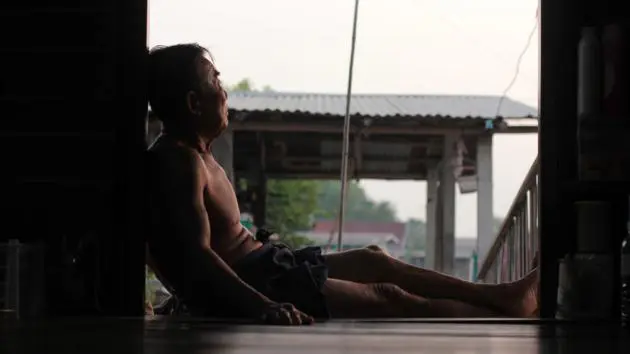


The love that binds an elderly couple together comes under the spotlight in a new documentary
IN A SOCIETY where the divorce rate has shot up by more than 27 per cent in less than a decade, with one in three marriages not making it past the 10-year mark, it’s hard to visualise a love and respect so deep that allows an elderly man to nurse his invalid wife day after day with nary a word of complaint.
Poo (grandpa) Somboon is that elderly man and his touching story is portrayed in the new documentary “Somboon”, following him as he cares for his wife, a sufferer of chronic disease. Four years in the making, the film by young director Krisda Tipchaimeta premieres tomorrow night as the opening entry of the 12th World Film Festival of Bangkok.
“All the time I was shooting, I kept asking myself what I would do in his situation. Would I walk away or would I have the courage to be like him? If I’m honest with myself, I have to admit that I couldn’t do it, couldn’t provide the care,” says the 28-year-old director. “It’s not just me. Even my crew and friends who have seen the footage are stunned by what Somboon does for his wife and equally convinced they couldn’t do same if push came to shove.”
Krisda, whose parents divorced when he was 16, says the movie has made a tremendous impact on his life.
“I never saw that kind of tender relationship between my parents. Watching grandpa Somboon is an inspiration to me and I imagine to any young people. It’s so rare, especially nowadays, to see such unconditional love,” he says.
Throughout the film’s 80 minutes, the camera tracks Somboon’s daily routine as he takes care of his wife Lamiad’s needs. There are no dramatic scenes to make the film more emotional, merely a simple portrayal of Somboon waking up and starting to clean the area in which his wife stays with rubbing alcohol, ensuring that her chronic renal disease is not further complicated by bacteria. Lamiad is unable to walk and is also showing signs of Alzheimer’s, so she needs help in a myriad of daily tasks such as washing, dressing, eating and going to the hospital.
In between the routine tasks, the audience learns that Somboon and Lamiad entered into an arranged marriage without knowing each other, which was common in Thai families at the time.
Love grew and their relationship strengthened as they spent time together, raised their children and faced hardships. Lamiad also took care of him when he fell sick.
“For me he is the role model for married life,” says the director.
Krisda first heard of Somboon and Lamiad from his college professor Saowasak Putararuk, who told the young man that their lives were interesting and would make a good film.
He and a photographer went to Somboon’s house in Ayutthaya’s Sena district and soon afterwards started to document the couple’s life.
“At first I was worried because the subject is not a celebrity but an ordinary man and that would make it difficult to attract an audience. But after seeing footage, I had goosebumps all over. It’s so powerful seeing how a man can take care the love of his life,” says producer Sathanapong Limwongthong.
Somboon and his family were reluctant at first to be part of the film and it was only after Krissda spent time with them that they eventually agreed.
Shooting started in late 2009 and continued apace for almost two years with Krissda and his crew regularly returning to Bangkok for short periods. They ensured they didn’t miss anything by entrusting a nephew who lives nearby with a camera.
Then came the great flood of 2011, which left Somboon and Lamiad trapped in their house without clean water and electricity for months. Trips to the hospital were no longer possible and the footage captured during this time clearly illustrates the extent to which the disaster affected ordinary people.
Krissda is aware that those watching the film might well wonder why the couple’s children are not involved in their mother’s care. “Most of them work in the city but that’s not the reason,” he explains. “It’s because grandpa Somboon doesn’t want to let anyone take care of his beloved wife. He believes he can do it better. He even learned patient care from the hospital so that he could do everything properly at home.”
Producer Sathanapong adds that they have used their own money to make the film, which has so far cost them more than Bt300,000. They still need around Bt100,000 to complete the project as well as push for its release both at film festivals and in the cinema.
After the World Film Festival, “Somboon” will travel next month’s International Documentary Film Festival Amsterdam. A limited Thai theatrical is being eyed for next year.
A graduate in film studies from Suan Sunantha Rajabhat University, Krisda was earlier recognised with the Suphannahong Special Award for his short “Song of the River”. “Poo Somboon” is his debut feature. He is currently working as a member of the crew for Sathanapong’s film location company, which manages foreign film shoots in Thailand, including “The Lost Medallion”.
LOVE AND SACRIFICE
- “Somboon” will open the 12th World Film Festival of Bangkok tomorrow at SF World Cinema, Central World. The screening is by invitation only. It screens publicly at 6pm on September 24.
- The World Film Festival of Bangkok runs until October 26. Tickets are Bt120 with 500 packages of five tickets for Bt500.
- The festival will also come to SF cinemas in Khon Kaen from November 7 to 9, Pattaya from November 14 to 16 and Chiang Mai from November 20 to 23.
- Find out more at www.WorldFilmBkk.com.
