
Fun ride on India's soul train
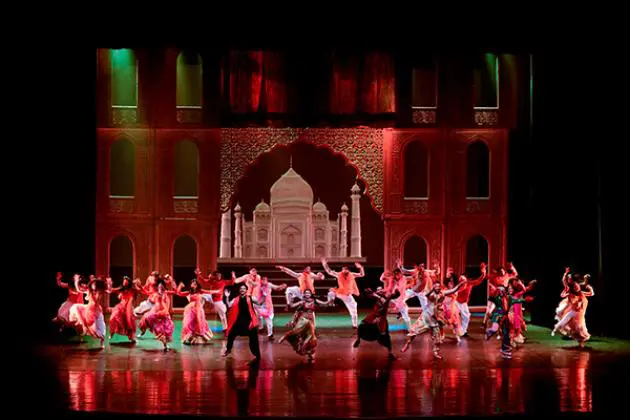


"Taj Express" such a delight that even the lip-synching fits in with Bollywood craziness
Bangkok’s legions of Bollywood fans were treated to a lively evening last weekend when Mumbai’s first musical, “The Taj Express”, roared into the Thailand Cultural Centre as part of the International Festival of Dance and Music.
Making good on its promises of extravaganza, escapism and romance Bollywood-style, the two-act musical is a story about an Indian-born, London-raised journalist who finds love on a trip to Mumbai.
First we meet Bollywood film producer Raj Pakora, who’s planning an epic that “has Oscar written all over it”. But we also learn that the money for the film came from Shakaal, a cutthroat criminal who was a servant of the Maharajah of Ranthambore until he was accused of stealing a sacred ring and had to flee.
The money swap was secretly recorded, though, and Raj has his sidekick guarding the incriminating DVD with his life.
Then we’re introduced to Varsha Singh, a journalist dispatched from London to cover the film production and write an article on what’s expected to be “the greatest love story ever told”. She’s overwhelmed by the vibrancy of Mumbai – until Shakaal’s gang steals her phone. Fortunately the hunky Showbizz Khan retrieves it for her, and Varsha decides to stay longer in India and search her long-lost father, with Khan’s help.
The plot thickens when Raj discovers that his assistant has given the DVD to the press by mistake. A plot is hatched to get it back.
The second act takes place aboard a train as our lovebirds travel to Punjab and then Varanasi, where Varsha finds out that her father has died, having waited years for her return. She and Khan bond more deeply and fall in love. It’s soon revealed that Khan is a prince and the only heir to Ranthambore. The hero and heroine rejoice, dance merrily at their wedding and live happily ever after at the stunning palace.
If you’re a hardcore fan of musicals, you might be a little disappointed by this one’s predictable storyline. There are gaping holes in the plot too, such as what happened to the DVD and whether Raj and Shakaal were ever punished for their misdeeds.
Another disappointment was that there was no live singing – no live music at all, in fact. This must be one of the few stage musicals in which none of the four main characters actually sings, instead lip-synching to tracks selected from various Bollywood blockbusters.
Meanwhile a narrator would regularly appear onstage with the actors, commenting on the action and even reciting some of their lines for them, as if joining in the dialogue.
Of course no one expects realism or logic from Bollywood, and it has to be said that the music, which after all dominated the show, was wonderfully rearranged with Western flair – touches of hip-hop, EDM and Latin beats, making familiar tunes even more captivating and fun.
The dancing, too, as well choreographed, extending beyond typical Bollywood moves steeped in tradition to more stylised routines. The dancers were very professional, quite capable of amazingly elaborate movements that were sharp and quick but at the same time sensual and smooth.
Combined with the show’s 2,000 costumes, these factors made every number mesmerising, sexy, glitzy and playful – just as one would expect from a decent Bollywood performance.
By the time “Bollywood hit No 7” boomed through the speakers, with the actors dancing and spinning around like no one’s business, we were fully dazzled and no longer questioning the plot. It was by now just a matter of enjoying the magical ride aboard the “Taj Express”.
On the Web:
www.TajExpressTheMusical.com
