
Bamboo in the mix


Play
A Vietnamese artist restores traditional values through paper
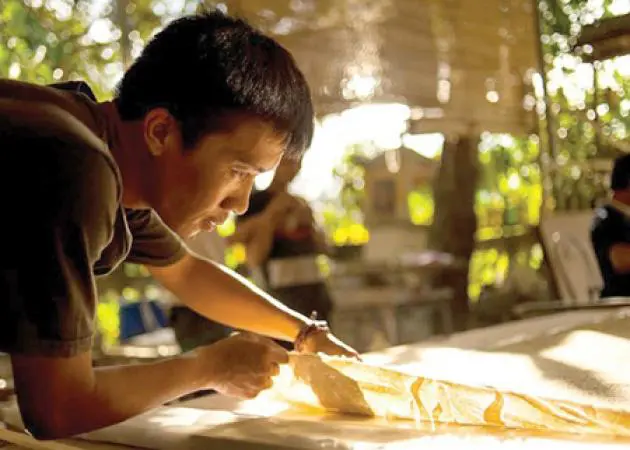
Artist Phan Hai Bang, who created a very special type of paper called truc chi, is now working with his team to bring back what he calls “old values” in a really big way and breathes new life into crafts that he believes are uniquely Vietnamese.
In 2002, after years of researching and experimenting, Bang began trial production of truc chi, a paper made from bamboo pulp, using techniques that resembled the way the Vietnamese paper “poonah” was made.
Each sheet of the paper can stand alone as an art work, thanks to a graphic design that is added at the end of the production stage.
The paper has inspired the creation of many other artistic and daily-use products that use it as the raw material including lanterns, wallets, candle boxes, handbags, wall paintings and table calendars.
In 2012, the paper made its market debut as an ornamental item. Since then, it has gained popularity among art communities in the country as well as in France, Belgium and Thailand.
Earlier this year, graphic design artists, who are also lecturers at art colleges in different parts of the country, gathered in Hue for a workshop to discuss ways to further develop local art forms.
They learnt about new printmaking techniques that could serve their work, including book art, printmaking installation, truc chi papermaking, non-toxic lithograph, and gumprint.
The popularity of truc chi was evident at the workshop, with most participants – veteran artists to young students – choosing to learn the truc chi technique.
Le Huy Tiep, former president of the art committee at the Vietnam Fine Arts Association, says truc chi is one of the most inspiring contemporary art tools he has seen to date.
Le Anh Phi, a student of the Hue College of Art, agrees, adding, “truc chi gives me a bright outlook for a future career in art”.
Several artists have recorded notable achievements with the paper. Phi and Ngo Dinh Bao Vi, two members of Bang’s Truc Chi Garden team, won encouragement prizes at the national Young Artist Symposium held in Hanoi last August.
Phi used truc chi and graphic prints for his work called “Ky Uc Lang Que” (“Countryside Memory”) and Vi did the same for her installation called “Vi Tinh Yeu La Du Cho Tinh Yeu” (“Only Love Can Feed Love”).
Nguyen Hong Phuong, a workshop participant, came in third place at the Capital (Hanoi) Art Prize contest last month, also using truc chi and graphic prints.
Despite the paper’s popularity, Bang says he is only at the first stage of his dream.
“My dream is to unite artisans who weave bamboo and make paper pictures, hand fans, bamboo lanterns, kites or embroidery with me, a truc chi producer, to create Vietnamese craft products that amaze foreigners with their artistic values and outstanding craftsmanship.
“In the short-term, the union could benefit craft villages that fight on their own for revival. The paper could attract new consumers and give the craft new markets.”
However, it appears as though artisans in traditional craft villages around Hue and Hoi An have not been able to meet the main requirements of Truc Chi Garden. Bang, Vi and Phi have had to make themselves artisans in bronze, bamboo, wood and leather processing.
While Vi spends several hours a day cutting leather and sowing by hand to create truc chi wallets, Phi works on cutting and carving tiny bronze items for jewellery box locks, painting frame holders and placing truc chi markers on each product.
“We do not blame artisans of the craft village, we understand that they have to follow market demand, but we want to preserve the skills and techniques that our ancestors had,” says Vi, explaining that no truc chi product is mass-produced.
Bang says he wants at least one piece of value from a traditional craft or culture on the products. A lantern, for instance, can have patterns of bai choi, a traditional folk game or musical instrument found in traditional paper paintings of Sinh Village in Hue.
A bamboo bookmarker, for example, can be shaped like a xam huong card, which is used for a traditional royal game.
“What we want is to revive our ancestors’ skills in another form and style, so that new values are added to the return of old values,” Bang. says
