
What lies beneath


Play
A Hong Kong photographer documents the lives and living conditions of the mentally challenged
Whether it’s a human being or a house he’s shooting, Dustin Shum’s aim is to get under the skin and look for the essence.
My first brush with Dustin Shum’s work was at a show hosted by Society for Community Organisation in October. They had just published a photo book “Life and Times” featuring 11 stories about people with psychiatric problems illustrated with photos by Shum, which were on display.
The first thing that struck me about his subjects – some of whom were present at the event, studying and talking to their own image intently, as if they were someone else’s – was how similar they were in fact to people like us, the so-called “normal” human beings, lucky enough to have been spared such a debilitating condition.
Shum had shot the people as well as the paraphernalia that made up their world – nicotine-stained dentures, a naked nylon doll, a rain-drenched Hong Kong skyline as seen through a crack in the window pane, a black and white photo of the long-deceased mother of one of the subjects hung from the wall, with an ungainly tilt to the left.
“I didn’t have an agenda in mind when I started photographing people with psychiatric problems,” says Shum, who, nonetheless, has displayed a sustained engagement with the theme.
“Life and Times” is a follow-up of the earlier “Live Alone a Life” (2007). Although he insists he would like to maintain a certain distance from his subjects for the sake of honesty and artistic integrity, Shum’s journey –on both professional and personal levels – is now indelibly linked to that of these mentally-unstable people, often lonely, miserable and living on the fringes of society.
“The government policy regarding mental patients is more about curing the disease rather than integrating them with the mainstream of society,” says Shum. If only his sympathetic and regardful documentation of the private worlds of these people could ensure they had “access to new, improved medicines and more medical facilities”, Shum would consider it a tremendous reward. “The social stigma, of course, won’t be that easy to erase.”
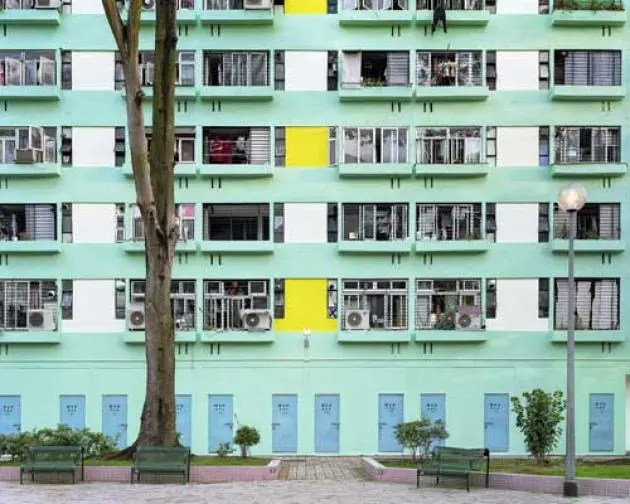
I meet Shum again, almost a month later, at The Salt Yard – a gallery dedicated to showcasing some of the most avant-garde works in photography from across the world. Shum is the resident curator of this space, tucked away discreetly in an industrial building in one of the most-congested areas of Ngau Tau Kok. For a while he had been curating shows of outstanding works by mid-career photographers in international reckoning – Patrick Nagatani’s portrayal of atomic waste, and Shen Chaoling’s gleeful, celebratory performance trucks from Taiwan among them. Now Shum was ready to show some of his own – the second phase of his photographs based on public housing in Hong Kong, somewhat literally called Blocks.
When I tell him that there was perhaps a similarity between Shum’s work on the mentally challenged and public spaces – hat he was perhaps trying to humanise both – Shum, the soft-spoken, self-effacing man that he is, looks visibly thrilled.
“I treat buildings as organic entities and not as typical architectural studies,” he says. “That’s why most of my pictures are shot under an overcast sky, and never with artificial light. Like buildings on which several coats of paints would have been applied, human beings too have lots of layers to themselves. I want to see what’s underneath those layers rather than the coat itself.”
What lies beneath the make-up is not always a pretty story. Shum’s images of renovated building blocks, painted in neon shades of lime green, aquamarine, with strawberry pink cement rings around the bases of newly-planted trees are, in fact, a commentary on how those in charge of gentrification of public housing might have scant regard for the people who reside there.
“Sure, getting from Plot 1 to Plot 3 has become easier, but the elevator towers in Cho Yiu Chuen look surreal. If you look closely the balcony around 15th floor in a building in Hing Wah Estate to facilitate access to other buildings is an add-on, obstructing the view from the window on the floor beneath. It’s like a tumour growing,” he says.
The riot of vivid colours on newly refurbished buildings, he says, is indeed eye-catching, “but you don’t want to live there. It doesn’t give one a sense of home.”
What could have indeed fostered a sense of familiar comfort and neighbourliness, says Shum, were the traditional-style tea houses in stand-alone structures, now sadly making way for multi-storey structures, for the sake of optimum use of space.
Thirty years ago, when Shum was a small boy, he was brought to Shun On Estate in Kwun Tong. Although he hated it then, the emotional bond with On Yat House, in which he still lives, is a truth he cannot ignore. The seeds of what would later develop into an urge to document public facilities – parks, streets, residential spaces – were probably sewn in him at that moment, nurtured over the years to reach a state in which he is heavily invested in public housing and yet has perspective enough to take a dispassionate view.
“No one has been able to return an honest and poetic look on Hong Kong landscape like Dustin Shum,” says Steve Bisson, an Italian photographer who started the very-influential online photo journal, Urbanautica. “He is skilled at portraying the urban landscape of Hong Kong in a distinct way. In his photos I feel the desire to understand his city, while maintaining a certain distance and respect. He is certainly an intellectual open to the world, and ‘hungry’ for contents and discussion.”
Shum himself is probably more comfortable being relatively low-profile though. He gave up a secure well-paid job in the media to embrace the uncertainties of his “expensive hobby”. His ultimate pleasure is in scanning the negatives from his shoots. “That’s when I question my own intuitions, criticise myself. I’d develop a roll only after days, sometimes weeks, after shooting. I like to approach them as strangers.”
