
Where the silkworm's the star


Play
Families are flocking to the Jim Thompson Farm cool-season fun and fabulous colours
THE ITALIAN-THEME restaurant complex Primo Piazza and the new water-park Khao Yai Fantasy are helping draw bigger crowds to Nakhon Ratchasima’s Pak Chong district, and meanwhile the Jim Thompson Farm in neighbouring Pak Thong Chai remains another popular destination for families.
The annual Eco Tour is a wonderful chance to admire the beauty of nature amid winter’s cool breezes, and the place brims with the charms of rural Isaan.
Now there’s also an exhibition on the science of raising silkworms, presented in collaboration with the Queen Sirikit Department of Sericulture.
“Our farm tour is now in its 16th year, with the focus as usual on Isaan culture, Thai silk and organic agriculture,” says Chutima Dumsuwan of the parent firm, Jim Thompson. “We always get great feedback, and we had 160,000 visitors last year, up from 90,000 in 2012.
“This year there’s something else as well – the sericulture exhibition shows how silkworms live and what they eat and also covers various medical uses, cosmetics and even a bulletproof vest made from silk.”
Although there are no “Art on the Farm” displays scattered around the site this year, the tour aboard a colourful shuttle bus is as enjoyable as ever, a rolling expedition through the 600 rai of flower gardens, vegetable fields and a model Isaan village with a handicraft market.
The craftspeople are quite at home in the wooden houses typical of Korat that, along with the religious structures on view, showcase the beauty of architecture from a bygone time.
En route you learn all about the silk company founded by American former CIA operative Jim Thompson in 1950 and how the farm (which opened much more recently, long after Thompson’s mysterious disappearance), continues to help ensure a robust future for the Thai silk industry.
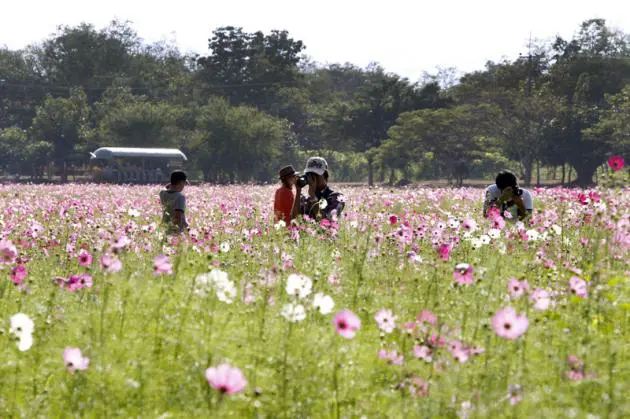
The tour begins against a breathtaking array of pink cosmos and their beaming yellow cousins, the sunflowers. “This is Thailand’s largest cosmos field and they’ve only just turned pink,” says architect Phaholchai Premjai, an adviser to the farm.
There’s a stop at the U-Pick organic vegetable field and Hanging Garden, where you can buy day-fresh tomatoes, spaghetti pumpkins, asparagus, baby corn, zucchini, eggplant and all sorts of salad vegetables to take home at low prices – just Bt30 to Bt60 per gram.
Another addition to the tour this year is the Flower Labyrinth with its adjoining pumpkin patch. A handy hillside allows for panoramic views of the corn crop, tunnels of morning glory and fields of rice and berries, all redolent with fragrances.
The sericulture exhibition draws attention to the mulberry trees growing everywhere, while, in the Hor Jak Pavilion containing the main displays, cocoons are frequently spotted in use as decorations.
As well as the life cycle of the silkworm, you find out about fagara silk created by the larva of the Atlas moth dining on torch ginger (Etlingera elatior), as well as different cultivation techniques, such as stacking the cocoons in pyramids.
Cassava and castor complement the silkworm’s primary diet of mulberry, you discover as you watch the whole process of making silk and get to know how the various tools are used.
Long before the American Thompson came along, it’s explained in a section called “The Origin of Silk”, King Rama V sought to restore Siam’s silk culture and preserve weaving methods that dated back centuries to the days when the Silk Road brought European traders to the East.
Her Majesty Queen Sirikit gets a well-deserved share of the credit for renewing these efforts and promoting Thai silk overseas. “She established the Department of Sericulture to conserve the traditions, develop production and research innovative techniques,” says the department’s Dr Saridipron Chuprayoon.
The segment of the exhibition titled “The Silkworm and Her Majesty’s Kindness” has photos of the Queen making the rounds of the royal projects and outlines her notions for improving the silk industry. Sewn onto Thai silk garments sold overseas, the Royal Peacock emblem guarantees high quality, for example.
“Our aim,” says Saridipron, “is to increase the artisans’ income through more efficient weaving techniques and by wasting nothing in the process.”
Some of the innovations in the industry are indeed extraordinary. There’s a bulletproof vest made primarily of Thai silk, and a compound of silkworm protein that stimulates the body to manufacture collagen, a boon to the skin. The branches of mulberry trees are useful in cultivating oyster and shiitake mushrooms.
Speaking of food, there are now all sorts of mulberry jams, chips and juices. You can buy a facial scrub made from cocoons, too.
WORM’S-EYE VIEW
>>Tours of the Jim Thompson Farm are available through January 11, daily from 9am to 5pm.
>>Admission on weekdays is Bt120 (Bt80 for children) and on weekends and during the New Year holidays Bt140 (Bt100 for children).
>>Find out more at (02) 762 2566, www.JimThompsonFarm.com and the “Jim Thompson Farm” page on Facebook.
