
Building on hope


Play
Malaysian architect's volunteer efforts at the heart of relief efforts in Aceh
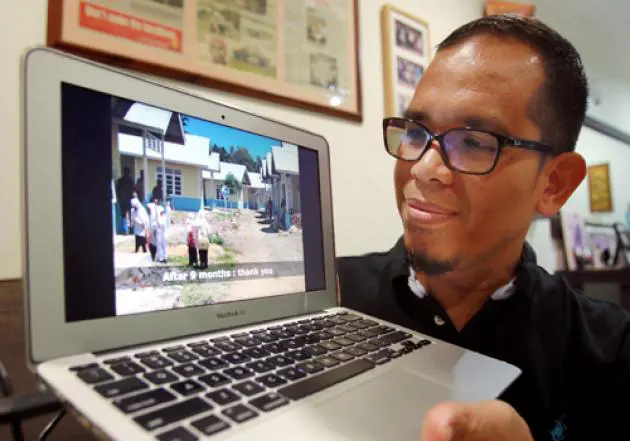
Architect Norazam Abu Samah is swamped by invitations for coffee and meals whenever he visits the bustling coastal village of Weu Raya in Aceh in Sumatra, Indonesia. That’s not surprising given that he designed the village for 178 families there following the 2004 Boxing Day Indian Ocean tsunami, which left a swathe of destruction in its wake with 167,000 dead and more than 500,000 people homeless in Indonesia alone.
Kampung Weu Raya was the first to be reconstructed in August 2005 in time for the Muslim period of fasting, Ramadan. These permanent houses marked a step towards a semblance of normalcy for the traumatised community in which nearly every family had lost a loved one.
The village is one of 16 projects that the non-governmental relief organisation Mercy Malaysia has successfully completed in Aceh. The others include a public health centre, nursing college, pharmaceutical academy, secondary school, two orphanages, and a tsunami resource centre constructed from a donation collected from Malaysian citizens of RM25mil (Bt236.4 million).
While waves of volunteers came and left, Norazam stayed on for four years as Mercy Malaysia’s head of operations, appointed by the organisation’s charismatic president Tan Sri Dr Jemilah Mahmood. Norazam’s architectural training and calm leadership were crucial to the successful implementation of Mercy Malaysia’s efforts.
He was among the trio of first responders dispatched to Aceh when news came of the undersea earthquake and tsunami on that day in 2004.
“We entered Aceh by lorry. News reached us about 100,000 people dead. We thought it was exaggerated, says Azam, as he is known “But when we approached the town centre, that’s when we saw the piles of bodies and hundreds more floating down the river. The stench was unbearable. The places we couldn’t access were in even worse condition. Each time a bulldozer lifted a mound of sand, bodies tumbled out.”
Following the emergency and early recovery phases, Azam could finally contribute his skills fully to the reconstruction and rehabilitation stages, which began as early as January 2005.
Designs for core houses were rapidly drawn up following meetings with villagers. Although traumatised, they chose to remain at the original site of their village, about 2km from the shore.
“When we proposed rebuilding the village immediately, the villagers were overjoyed as nobody wanted to live in a temporary camp although the tarpaulin tents were comfortable and spacious enough to stand in,” says Azam.
“I cannot stress the importance of understanding the local culture and context as an NGO operating in a foreign place. The people just wanted something simple, functional and easy to implement, not something that would end up as white elephants. Our volunteer architects printed out drawings of the houses based on individual needs, and each homeowner signed an acceptance form.”
Even before Aceh’s Reconstruction Board reopened in May 2005, rebuilding work for Kampung Weu Raya had already begun in April. Each 36sqm home was built with sturdy meranti wood and concrete. A team of 30 skilled villagers and 180 construction workers from Medan, the capital of North Sumatra, set about raising one house a day.
“The challenge was in getting materials, and the logistics involved,” Azam recalls. “Local businesses and all components of the building industry had collapsed. I couldn’t even get cement. We ordered our supplies from Medan and schedules were impossible to maintain. Loads of dubious ‘contractors’ had sprung up overnight.”
He says he gained a lifetime’s worth of practical education in seismic-resistant design through his four years living in Aceh, during which he closed his firm in Kuala Lumpur.
“If we don’t make allowances for future disasters, we are burdening future generations,” he says. “For example, flood-prone areas mean buildings need to be on stilts. Our hospital has a disaster management zone in the form of a central courtyard for instant evacuation or to manage teams. Tents can be raised here and it can also act as a place to contain corpses. Piping and sockets are already fitted in the planter boxes. On most days, it is a relaxing space!
“A safe building doesn’t mean it’s indestructible, but one that allows its inhabitants the time and opportunity to evacuate safely before it collapses.”
A graduate of Universiti Institute Teknologi Mara, Azam worked for several firms before starting his own architectural practice from home.
His interest in humanitarian work began in 2000 when his wife, Mastura Nordin, 48, a civil engineer, began collecting clothes and food for Afghanistan-bound relief shipments for her gynaecologist Dr Jemilah, who founded Mercy Malaysia in 1996.
Following his stint in Aceh, Azam went on to serve in other disaster-struck and strife-torn places like Pakistan, Myanmar, Syria, Gaza, and Tacloban in the Philippines, after Typhoon Haiyan struck that city hard last November.
“In disasters, you can see that the preservation of life is the most important thing. Everything else is secondary and replaceable,” says Azam.
He is currently serving as vice president in Mercy Malaysia but hopes to step down soon to make way for new blood.
“I hope we can raise more humanitarian volunteers as the joy you are rewarded with is immeasurable and life-changing,” he says.
