
Fashion fast forward
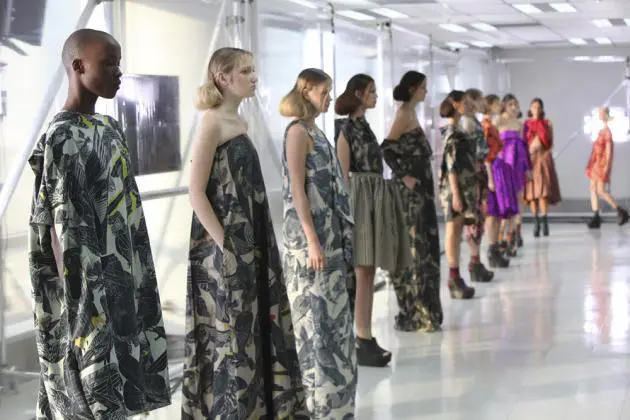


It was a big year in clothing, with a local design house taken over in a multi-million-Baht deal and the opening of several high-end stores
DESPITE THE POLITICAL upheavals that saw much of Bangkok temporarily shut down by protesters early in the year, Thailand’s fashion industry continued to flourish in 2014. High-end brands appeared totally unconcerned about the unrest, going ahead with plans to open flagship stores in the city’s upmarket malls with such regularity that events were occasionally put on hold for a couple of days so as not to clash with another opening.
And there’s still plenty of room for the industry to grow, not least because 2015 will see the market welcome a potential 600 million extra shoppers as the Asean Economic Community comes into effect. The Mall Group has announced plans to deal with the expected influx of consumers with several stores scheduled to open in the new year.
In terms of Thai fashion, one of the biggest new items to hit the headlines in 2014 was the acquisition of Greyhound, a leading fashion and cafe brand, for Bt1.85 billion by Sub Sri Thai.
Since founding the brand 34 years ago, Bhanu Inkawat, who has stayed on as creative director, has maintained that Greyhound’s success is down to “style” in fashion, living and eating. He not only values creative minds but also understands that brand development needs strong roots to uphold its branches. The company currently operates 15 Greyhound-franchised outlets in Asia, both fashion concerns and cafes, including five in Hong Kong and one each in Shanghai and Beijing plus a concept store in South Korea. It plans to have 25 overseas outlets within the next three to five years and its success is the inspiration for many newer brands.
Bhanu stresses that the fashion industry must find ways to stand on its own two feet rather than rely on government support.
“Support from the government is very on and off,” he says. “Even if you are a very gifted designer like Alexander Wang, you cannot stand alone. There must be someone to back you up in term of marketing, material suppliers, distribution, in fact everything apart from design. Look at South Korea. Their government helps export not just entertainment field but the overall K-Pop culture. That’s expanded into fashion. This is the real challenge that Thai designers have to face and to overcome. The whole lifestyle segment is growing.”
Polpat Asavaprapa, president of Bangkok Fashion Society and designer of Asava fashion brand, says he believes Thailand’s creative economy is now very strong. “The past years have seen rapid growth in Thai fashion thanks to other lifestyle segments such as retail stores, which are growing in parallel. We are also meeting the challenges of competing with midrange international brands,” he says.
However, he echoes Bhanu’s views that Thai fashion is not as influential as it could be despite the strong designs and large customer bases in Singapore, Hong Kong and Malaysia.
“We need the government to improve our image and show that we are no longer a based manufacturing-based country. And while Thai fashion has improved significantly, we must not be overconfident,” says Polpat.
“Our member designers nowadays work with a global perspective in producing collections based on fashion seasons—spring-summer, autumn-winter, cruise collections and so on. We have the standard look book, the right press releases. And the BFS is the platform for young designers to work more systematically.
“At Asava, we are on par with DKNY, H&M and Zara but to compete with them, we have to follow international norms on seasons as well as other aspects. The only problem of the creative economy is that as a designer, I have to compromise on design so that my clothes are commercial. But in the end, you want your stuff to sell. You want to do something that you love but you have to make sure that you have customers. You have to find the balance. This is the challenge.”
Many Thai designers have sought to promote the country’s silk culture by moving away from looks typically viewed as “unfashionable” when using Thai silk fabric.
In their latest project, “Weaving Dialogue”, the Office of Contemporary Art and Culture and Srinakharinwirot University’s Centre of Academic Services, have revolutionised silk fashion by calling on renowned designers, Platt Pladhi from Realistic Situation, T-ra Chantasawasdee from T-ra, and Wisharawish Akarasantisook from Wisharawish, to give it a new look.
The end result was a showcase of 120 beautiful silk creations in a uniquely contemporary style.
“We want silk to be part of our everyday life and serve as daywear rather than just for evening events or special occasions like weddings,” says Platt.
His designs are adapted from motifs made by native hand-woven silk and combined with such geometric elements as polka dots, lines, stripes, triangles, and squares. The silk is interlaced with other fabric creating a more casual yet eye-catching design.
T-ra says that many young designers are afraid to use silk in their collections. “They think it is expensive and out of date. I firmly believe they should do more research and go through the process of producing silk fabric and creating different structures and patterns,” he says.
T-ra’s designs play with a colourful palette, flower brocade and birds motifs and use a draping technique to create gorgeous dresses, pleated skirts, smoked blouses, and trousers.
Wisharawish combines mudmee silk and natural tie-dyed silk with flared skirts. He also uses layering techniques with transparent materials to form interesting patterns.
For its part, the international luxury market seemed little affected by either political instability or thinner wallets. While some stores saw a drop in shoppers in the first half of the year, others were hardly affected.
Luxury retail mall Central Embassy went ahead with its scheduled opening and now boasts such high-end tenants as Maison Martin Margiela, Ralph Lauren, Jil Sander, Givenchy, Michael Kors, CH Carolina Herrera, Christian Louboutin, Isabel Marant, Kurt Geiger, Roberto Cavalli, Saint Laurent, La Martina and Pomellato.
Sopavadee Bejarajati, division manager of Club 21 Thailand, says that nowadays the company represents about 30 brands and recently added to the firm’s cachet by launching new flagship stores for Calvin Kline Collection, 3.1 Phillip Lim and Proenza Schouler as well as two new brands, Giorgio Armani and Emporio Armani. Four more brands are coming next year, she says.
“Brand principals see Thailand as a huge potential market in Asia and the time is ripe for expansion. The lifestyle of young affluent consumers has changed. They are well educated and well informed about fashion. They are eager to spend on cars, food, and lifestyle products,” she says.
