
This saddest of centenaries


Play
Two books contemplate World War I - not the battlefield butchery but why the war happened and how it changed everything
Authors and publishers are fighting the First World War all over again now that four years of centennial commemorations have begun, and the first two books on the subject to arrive at The Nation for review suggest the struggle ahead might be just as long and daunting, though thankfully bloodless.
Interestingly, neither of these books is about the Great War itself. “The War that Ended Peace” (by far the more engaging of the two) is about the events leading up to the conflict. “The Long Shadow” is about the war’s legacy.
In the former, Canadian history professor Margaret MacMillan wastes not a breath in 600 pages in explaining the underlying conditions and interlocking shared and selfish interests that brought on a catastrophe that killed six and a half million soldiers and countless more civilians.
Matters were so complicated that it’s easy to see why schoolteachers ever since have simplified the genesis by hastily placing pistols in the hands of Gavrilo Princip and the rogue band of Serbian nationalists who conspired to assassinate the crown prince of Austria-Hungary during an ill-advised visit to Sarajevo on June 28, 1914.
Princip fired the shots that killed Archduke Franz Ferdinand and his wife, an action rightfully seen as the “spark” that lit the fuse. But what a long, tangled fuse it was, and what a monstrous powder keg awaited at the end of it. The array of dominoes waiting to fall in succession at any careless nudge was vast, each piece teetering for years, if not decades.
MacMillan’s surprise for many modern readers is that, for nearly a month after the double assassination, no one else in Europe thought much about the incident. Domestic strife in Albania was of greater concern at that moment, and the British were also knee-deep in dire negotiations over Irish home rule. For most Europeans the summer holidays were getting underway. Even in Vienna, one of two capitals in the “dual monarchy” of Austria-Hungary, the amusement parks stayed open.
Not until Austria-Hungary delivered an ultimatum to Serbia nearly a month after the murders did ears prick up, and only when Vienna rejected the Serbs’ reply two days later did the worrying begin. At the same time, though, almost everyone expected the crisis to blow over, as so many others had done throughout the long peace since the Franco-Prussian War. And anyway, if there were indeed to be more hostilities among nations, surely they would end just as swiftly as the last, in a matter of months.
As the title of her book indicates, MacMillan stresses that World War I brought to end a sustained period of peace, the likes of which we have yet to see again. Since the German humiliation of France in their war of 1870-71, no major hostilities had broken out, thanks to measured diplomacy and the forging of alliances intended for trade and defence rather than aggression.
The chapter titled “What Were They Thinking?” isn’t about how people could turn abruptly evil but about the common mindset in a time of harmony and civilised behaviour (colonial brutality notwithstanding). To the unprecedented ease of life fostered by the industrial revolution was added revolutionary thinking in the sciences and fine arts. There were Freud, Darwin and Picasso, changing forever the way humans saw their world.
There was also increased nationalism and racism, however, and the unavoidable matter of honour for oneself and one’s family (duelling was still common) – and for one’s homeland. There was rising demand for economic equality and an end to autocratic tyranny. Nietzsche was far from alone in yearning for an end to civilisation as it stood, however violent its overthrow might be, for the last of this “rotten, filthy peace”, as RN Stromberg called it.
Nevertheless – with tensions building as Germany, an adolescent nation seeking its share of the colonial treasure, engaged in a naval-arms race with Britain and jousted with France over Morocco and with Russia over Bosnia – there was a significant peace movement. It was not unlike the anti-war movement of the 1960s, another considerable surprise in MacMillan’s book.
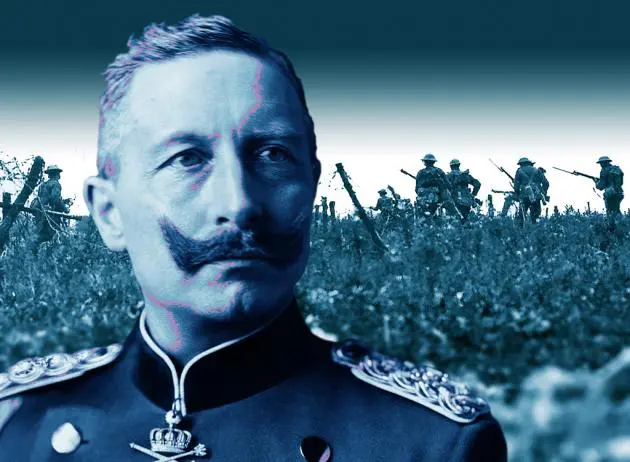
Its efforts would evaporate, of course, along with the laughter shared by the emperors of Britain, Russia and Germany when they met in May 1913. King George V and Tsar Nicholas II were in Berlin for the wedding of their niece, the daughter of Kaiser Wilhelm II. In just over a year’s time the former two, in their Triple Entente with France, would be at war with Germany and Austria-Hungary.
MacMillan goes to great lengths to show how reluctant these and other national leaders were to commence hostilities, though she lays the blame squarely on Germany for “allowing it to happen”.
Once the pistol shots rang out in Sarajevo and then Vienna’s overreaching demands for recompense were rejected, one nation after another began mobilising troops, proceeding with extreme caution to avoid being seen as the aggressor.
The way MacMillan describes this chain of events at the end of her book reads like a cliff-hanger, and the epilogue, a brief overview of the war itself, carries the suspense into the German army’s rush through Belgium. All of this, as she points out, was in sharp contrast to what happened next. By 1915 the combatants were hopelessly bogged down in the trenches, no one able to gain the upper hand, and there they stayed for the next three bloody years.
“The Great War marked a break in Europe’s history,” MacMillan writes. “Before 1914, Europe for all its problems had hope that the world was becoming a better place and that human civilisation was advancing. After 1918, that hope was no longer possible.” Its people looked back at “a lost world”.
David Reynolds’ “The Long Shadow” is every bit as ornate in its detail as MacMillan’s book – and just as readable – but the focus is on ideas rather than personalities.
The shadow of the First World War fell on geographical boundaries, governmental and economic systems – and strategies for the next war. It dramatically affected philosophical outlook, engineering, the news media, the movies and so much more. In fact, the shadow has reached our feet a century on. And it’s still stretching further.
Reynolds barely gets a toehold on the actual events of 1914-18, but it’s surely as important to understand the consequences of history, seemingly forever unfolding, as it is to know the root causes of its upheavals.
The Long Shadow: The Great War and the Twentieth Century
By David Reynolds
Published by Simon & Schuster, 2014
Available at Asia Books, Bt525
The War that Ended Peace: The Road to 1914
By Margaret MacMillan
Published by Random House, 2014
Available at Asia Books, Bt650
Reviewed by Paul Dorsey
