
Peace, love and floral patterns


Play
Lagerfeld declares that the midriff is the new cleavage while Raf Simons harks back to the past
Chanel’s haute couture view of the coming spring-summer season, revealed Tuesday, is distinctly storybook – but with midriff-baring outfits proudly declaring that “the stomach is the new cleavage”.
One of the tentpoles of the haute couture shows this week in Paris, the Chanel event held in the capital’s glass-roofed Grand Palais attracted a slew of international celebrities.
They included “Twilight” actress Kristen Stewart, Kris Jenner (mother of Kim Kardashian and of Kendall Jenner, one of the models in the Chanel show), French actress/singer Vanessa Paradis, South
Korean rapper G-Dragon, and Dylan Penn, daughter of actors Sean Penn and Robin Wright.
They watched a parade centred on a set-piece worthy of a fairy-tale conservatory: a grey artificial winter jungle with grey flowers that mechanically blossomed to life when “watered” by an obliging team of male model gardeners.
Orbiting that shrine to tropical spring came the models: flower children in gossamer-light pinks and coral and blues and reds, some topped off with wide-brimmed hats, many wearing black sock-shoes.
The refrain throughout was a belly-baring look evoking a ’60s free-love wardrobe for carefree teens. An easy look for the nymph-like models to carry off.
For wealthy earth-bound Chanel customers, however, some serious abdominal work will first be in order, as designer Karl Lagerfeld himself admitted after the show.
“The new cleavage is the stomach,” he said.
“The upper part” – here his half-gloved hands describe a bosom far more generous than those on the waifish models – “everybody did it.
“Now we go a bit lower, and it (the stomach) is even more difficult to keep in shape.”
That word of caution will undoubtedly fail to dissuade the coterie of Chanel-clad celebrity fans, some of whom came up to congratulate Lagerfeld.
Kris Jenner, for instance, was dressed top-to-toe in the French high fashion label, from the sunglasses to shield her from paparazzi flashes, to her see-through netted pants hiding nothing of her legs.
“I like your pants,” Lagerfeld said to her.
“You know where they came from!” Jenner laughed in reply.
Jenner’s daughter Kendall was one of the Chanel models showing off her naked waist above a white skirt upon which printed orange and white blossoms crowded the hem. The short top was black and (her mother would approve) see-through.
Lagerfeld enthused about the petal prints – that perennial springtime reference. “It’s a kind of flower woman – I don’t want to say flower child – of the 21st century,” he said.
He also explained the pop-up storybook theme that ran through the show.
“For people who don’t like to read, which is not my case, pop-up books are the best,” he said.
There was no deep strategy to it, he stressed. “I had like an electronic flash, I saw something like this and did what you see now. I cannot explain how and why, I don’t know. I’m not a marketing person.”
As mercurial as his inspiration might be, Lagerfeld’s eye for unusual beauty still held true in his choice of model for his climactic piece, a wedding dress with a long, complex feather-flower-embroidery train.
The ensemble, escorted by the gardener-models, was carried by Molly Bair, a young American model with a triangular face of broad forehead, narrow chin, protruding ears, intense eyes and sulky mouth all giving her a strange, almost extraterrestrial look.
“She looks like nobody else,” Lagerfeld said.
“She’s like from a science-fiction movie, a kind of ET of beauty. I think she will be a big star because she looks like nobody else.”
The stars were also aligned at Dior’s Haute Couture fashion show in Paris the previous day.
American-Israeli actress Natalie Portman – the advertising face of Dior’s “Miss Dior” perfume – was sitting in the front row, somewhat less stiffly than her Queen Padme persona from the “Star Wars” prequels.
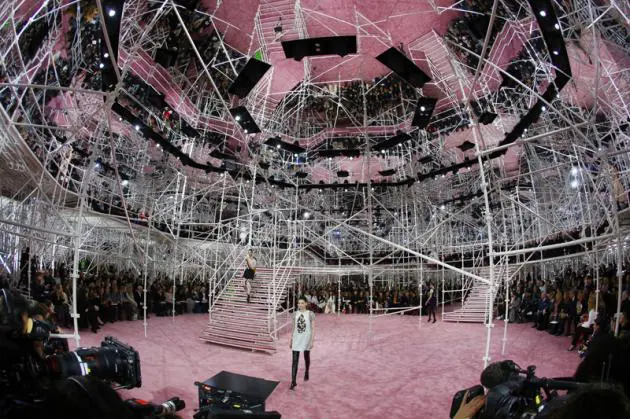
Second was the spring-summer collection itself: all groovily “Barbarella” with fluorescent orange boots and skintight catsuits with flower-power patterns worn by models descending from a multi-level space-opera set purpose-built in the gardens of Paris’s Rodin Museum.
Third was David Bowie’s early years London pop washing out of the sound system, including tunes performed by his stage alter ego Ziggy Stardust.
It was very retro space age – yet designer Raf Simons injected the show with a look at once sexy and light.
“I was always thinking of the future for so many years and I was always anti-romanticising the past, but the past can be beautiful too,” he said.
The colourful garments, he said, incarnated “the romance of the 50s, with the experimentation of the 60s and the liberation of the 70s”.
His ambition was for “something wilder, more sexual, strange and certainly more liberated for the haute couture and for women”.
Bright, very bright colours, lines and swirls competed for attention on the outfits, which ranged from Dior’s trademark thin-waisted, flouncy dresses to second skins to mid-thigh tunics with latex leggings. All carried on exquisitely stilettoed shoes and eye-catching boots.
It was as if Austin Powers were piloting the spaceship, headed for Woodstock with an ultra-glam female party crew on board.
Indeed, Dior itself described the collection as a time-travelling “hallucinogenic amalgamation” in its production notes.
The idea, it said, was to subvert the typical Dior “femme fleur” image it has built up over the years.
Flower power, indeed: a nostalgic trip harking back to a breezier, maybe more innocent, time when fashion, leisure, music and the beginning of mass travel promised what seemed a bright future of free love and world peace.
Current events in the news may give the lie to that promise, but maybe that’s why the privileged crowd watching the show applauded so heartily – hailing this image of hope over reality.
The VIP crowd putting its well-manicured hands together included Chinese model-actress Angelababy, 1960s and 1970s American model Marisa Berenson, and Bernard Arnaud, the head of the LVMH luxury goods empire that controls Dior.
Backstage, the couturieres who handmade the garments spoke about the challenge of working with material like PVC, which was made into see-through jackets for some of the numbers.
“We had to learn to work with it – we’d never done that before... find threads that can’t be seen, that don’t break,” said one, who gave her first name as Florence.
Simons said he sought to invoke the way women in the 1960s and 1970s expressed political views through their bodies and what they wore.
The bodysuit, for instance, was “not changing the body – it is the body, so in that sense I think it’s interesting to communicate directly with purely the form of the body”.
Challenging the often-grim news from around the world was a priority, he admitted.
“This for me is also about love. The ‘60s and ‘70s were much about love, so it was a conscious decision to go there right now,” Simons said.
